Friday, January 05, 2007

Andrew Garcia: Mimicking the Voice of God


Ahhh....The Arms of Morpheus.

Andrew Garcia, one of the victims of Flight 93, the hero's flight, always struck me as odd or unexplained. My fascination began with the first paragraph of the successful, 62-year-old's obituary
"It wasn't unusual for Dorothy Garcia to answer the phone and be confronted by a strange voice she didn't recognize. Time and again, it turned out to be her husband, Andrew, disguising himself. Invariably, even after 32 years of marriage, she fell for it."
This struck a silent chord in me. Flight 93 should have been called the voice-mimicry flight for all the narrative hero-myth seeds planted by Airphone that day. America went off to war on a sea of "Let's Roll" tattoos, nose art, bomb notes and aircraft-carrier-deckhand synchronized spelling bees. (Bush's Bring It On was Moral Majority cowboy code from Pat Robertson--don't confuse the Latin with the Greek.) The "they fought back--now it's our turn," signs went up like mushrooms after the rain on 9-12. Even the P-FLAG offspring got in on the act, with rugby instead of soccer their true sin--one of marketing. Even with the meme bar set high, widow Dorothy hurdled with ease, reprising the old standard, gold-wedding-band-back-from-hell, routine, to join the crowded ranks as yet another Christian motivational speaker with some shelf life and a great punch line.
Several factors lead me to believe Garcia was C.I.A. and his shop was cover.

First, what family business takes a redaction, followed by the word, Group as its name?What devote Christian would name his "business Cinco Group, using Cinco as an acronym for Christ in Company," as reported in the New York Times, when Cin is pronounced Sin, unless by mimicry, he means something else?
Isn't CINCO more likely to be born from the Collaborative and Interoperable Computing research area? Saying "industrial products business" is almost advertising the real work of "high-explosives delivery systems and the software they love too much." From now on anyone fit and trim is suspect of covert activity in my book. You want to go undercover? Grow a paunch. No raping the world without consequence and then feeling good about it afterward while you blow smoke rings with your Gauloise, thinking, "I be the man!"


I hope the secularists among us heed the wake up call (can you say Kagawa little boy?) Given the speed of technological advancement--wasn't voice-recognition the hot thing before 9-11?--what fresh hell will we have to contend with next, pray tell? Pat Robertson says the Lord told him a big American city will go this year, sometime around September he thinks, but the Lord wasn't clear on the date. The casualties will be in the millions. The morality of our so-called Christian nation is too poor to sustain and protect both us and, say, the Iraqi toddlers. It's the innocent American unborn babies, and the frozen wanna-be's, whose voices cry out in the desert. Help!


"...whimsical bent with a devout Christian faith..." Pittsburgh Post-Gazette

"Many of the passengers were also devout Christians."
"Andrew Garcia named his industrial-products business Cinco Group, using Cinco as an acronym for Christ in Company." The Fourth Target By M. G. LORD New York Times, September 8, 2002

Andrew Garcia of Portola Valley was a businessman by trade, but whose real passion was his family. As the owner of an industrial products company, he frequented the East coast for business meetings and so it was the day before he boarded the ill fated United Airline Flight 93 on September 11th. According to his Son, he was a man of values, always inquiring as to the welfare of others. Christian Talk Radio 740am

1961 you went to work for United Airlines as purchasing manager for a short stay,
Dorothy worked as a secretary downstairs and what a great team you two became.
In time you left the airlines with Dorothy, founding Cinco Group without delay.
You were true Soul mates as well as best friends without question or say.
A prankster with Dorothy and with your many friends of an array,
You would call her and disguise your voice but it was all in fun and play.
You were a Christian man who humbly bowed your head to pray.
Your concern for others can and will never be outweighed.


Memorial Quilts

Thursday, January 04, 2007

Brian Birdwell: How to Serve Man

One of my "insights" into the September 11, 2001 Pentagon attack, which began to emerge recently, five years after the attack, has promised to be a very difficult piece of the puzzle to share because it is so ugly. I've explored my degree of certainty with the truth, my normal five-percent doctrine, a humility allowance for error, was bumped up, since I combine serious research with what I can only call inspiration, but what others might only call madness.

This Reuters news photo by an unnamed stringer was published this morning, and I take it as a sign to proceed.

"A housing debtor runs after setting himself on fire to protest against Chile's housing system in front of the government palace in Santiago January 4, 2007. The man extinguished the flames by jumping into a pool outside the government palace and was arrested by police. CHILE OUT REUTERS/Stringer(CHILE)

A housing debtor?
I'd throw back Chilean Habitation-Costs-Arrears Performance Artist Survivor Shaman. If anything is art, to me,this man is art, and timing is everything at the Burn Art Gallery. Too bad nobody was ready, willing or able to show off such artistry at the Pentagon on 9-11. It turns out, the injuries storyboard wasn't so hard to produce after all, the various solutions all boiled down to one, the strangely motivated, Lt. Col. Brian Birdwell. Writing two years after 9-11 in the conservative Washington Times, Rowan Scarborough, the well regarded author of Rumsfeld's War: The Untold Story of America's Anti-Terrorist Commander, displayed a note of skepticism, in Survivor studies the whys of 9/11

"Few inside the [Navy Command] center survived. In fact, in a catastrophe that appeared as if it would produce mass numbers of wounded, just seven inside the Pentagon, including Mr. Shaeffer, were critically burned."

I have little sense about the other six, Wayne Sinclair, Louise Kurtz, Kevin Schaeffer, John Yates, Juan A Cruz-Santiago and Sergeant Janice Jackson, although I will say, Yates and Kurtz came out of the same corridor as Birdwell and were handled in similar fashions, minus the publicity. Kurtz was also on her second day in a new job there. The points of evidence that support my charge against Birdwell, are singularly his.

Lt. Col. (Ret.) Brian Birdwell is living proof why recruits are warned never to volunteer in the military. Birdwell did volunteer for duty on 9-11. I submit he volunteered to undergo a controlled burn, as a leading player in the narrative drama, like another headliner, Maj. Lincoln (two memes down) Leiber, Birdwell was chosen for heroism and its aftermath.

Firematics training includes entering a smoke house, entering a burn tent stretches the imagination, but only for its moral horror. I wonder if Birdwell's burns were consistent with his briefings. He suffered a controlled flash burn over 60 percent of his body, half of that being third-degree burns, as reported in his and his wife's Christian burn charity web site FaceTheFire.org.

A comprehensive article in the US News & World Report on December 10, 2001, reports that
  • Birdwell survived because he left his office and went to the men's room. His officemate in Room 2E486, Cheryle Sincock, did not survive.
  • Birdwell is the burned man seen with shirt off and hands raised, being loaded onto an ambulance in images taken by Will Morris and Hillary Smith Garrison of the Associated Press. These few images constitute both the the minimum credibility, and the maximum extent of the news images staged for select cameras in front of the West facade of the Pentagon. It was a staged area, not a staging area
  • Birdwell is the only burn victim identified in the official record as having been carried to a triage site. The self-justifying reviews of the medical response in the Pentagon reports is entirely anonymous as to the victims.
  • The President and Laura Bush's "Hospital Salute to a Soldier Injured in the Terrorist Crash into the Pentagon" was a major Karen Hugh's produced media event, fraught with narrative. Bush's holding of his salute for 18 seconds as Birdwell slowly tried to raise his injured arm in return,can still raise a goose pimple.
  • Birdwell's aftermath was assured, if not his afterlife. In retirement, he runs a burn charity with no apparent attachment to credible organizations like the Shriners, .It is a Christian motivational front that promises only to throw real charity dollars into the fire.
  • Birdwell is motivated by an extreme brand of fundamental Christianity, his and his wife Mel's Christian burn charity, FaceTheFire.org and his Christian burn book, Refined by Fire: have a primary purpose to glorify the God of his understanding, his Lord and Savior, Jesus Christ.
  • Larry Dowling of Corbis, who took pictures at the Pentagon on the morning of 9-11, and in the Oval office that evening, took this picture of Birdwell with Norman Minetta.

Birdwell with his wife Mel

I suppose, I should have started with the part about inspiration. The public record was dished out in the same fashion it was planned and created, with a contempt for the hearts and minds of its consumers that can make one choke. Such sloppy work and deliberate muddying of the waters provides a perfect cover. In the case of the Pentagon, the sheer totality of its conception suspended our disbelief. Which is not to say we bought it. We bide our time, and wait for The Big Guy to get to The Big Lie, so that the Big will Die.

At some point, I saw Birdwell in an interview on one of the cable news channels, and his truth became apparent to me, as I saw the consequence of who he had become. By his fruits we shall know him, I believe, is how the New Testament puts it, or maybe it's the Old. Barely able to contain an agitation of resentment, he went through his al-Qaida talking points disconnected from his rage. He described the horror of his treatments, the cadaver skin grafted to his forehead, the maggots introduced to eat the necrotic tissue in his body, and anything that makes leaches seem preferable is pretty awful. But the abstract "enemy" constructed for him to rage upon simply wouldn't take it, as it won't for the rest of America anymore either.

I titled this piece To Serve Man, in honor of an early 1960's episode of The Twilight Zone in which men from outer space come to earth bearing blessings that result in great material abundance and peace.They also bring a book, which the linguists are quick to translate the title of, To Serve Man, which delights the people. They grow fat and happy in response. Attempts at translating the rest of the book are the plot of the episode. Despite the concerns of a few, vacation tours to outer space are offered, giving the populace a 21rst-century version of Roman bread and circuses. The hero decides to see for himself what's up, and joins the line to enter the spaceship, but just as he does, the ingénue races up saying, "We've translated the rest of the book! It's a cookbook!" but the hero gets pushed inside. Perhaps as a kid, this was my first experience with suspense, because I can still feel the thrill at discovering the double entendré. The suspense now is killing me.

The evil is in the church, and it begs the question, who cooks and who burns? Stay tuned.


Wednesday, January 03, 2007

Ron Sachs: Stealth Agent for a Higher Power

A small but important contribution to the body of visual evidence of the attack on the Pentagon on September 11, 2001 was made by Ron Sachs, a freelancer whose work is handled by Corbis Sygma. A political insider of years standing, he's become something of a court portraitist during the recent administration, with apparently unlimited access to the powerful in Republican Washington. A name search at Corbis returns over 3000 of his potent news images, each expressing with clarity an emotion or truth worth a thousand words. His subjects must love him---they let him in big time.

And now, he can return the favor to us.

Sach's was one of several professionals producing work at the pentagon that morning, who also were in the Oval office that evening to photograph President Bush addressing the nation, and I hated him for his privileges.

Or so I thought. I began to realize that despite the bad company, Sach's wasn't fawning over subjects, he was telling an almost unbearable truth in nearly every picture. His glamorous shots taken each year of arrivals at the White House Correspondents' Dinners surely go to the wrong heads, but then his images of Sharon and Ozzie Osbourne arriving in 2002 skewered the event as well, revealing the celebratizing of journalists, instead of celebrating journalism, which is apparent now, if it wasn't then.

Sach's pictures of Chuck Burlingame's funeral are gravely beautiful but not hagiography. With his shots of the exclusively black orphans of Pentagon victims waiting to see the president at a 2002 memorial service, an actuarial truth about attack victims emerges.

Ron went along with the programs of the powerful, giving them the mirrors that made them look their best--—or so they thought-—-all the while collecting truth.

That explains this picture.

(On edit: Fuck Flickr. Flickr deleted my entire 3000 image 9/11 study account at the request of a government agency. Rot in hell, Yahoo. I found a copy on my hard drive.)


Ron Sachs, originally uploaded by stevenwarran.
11 Sep 2001, "Washington DC, United States --- In a terrorist attack, a hijacked plane flew into the Pentagon, tearing into the right side of the building. Part of the Pentagon later collapsed as a result of the damage. An injured person is transported out of the Pentagon in a makeshift ambulance following the attack. --- Photo by Ron Sachs/Corbis Sygma --- Image by © Ron Sachs/CNP/Corbis

Holes in the official story all stem from decisions necessary to focus the impact and direct the deaths, otherwise a 747 would have been used, and damn the torpedoes! A missile going in sideways below the level of the second floor of a poured concrete building meant even a paper dictionary on a wooden stand survived unscathed at the point of impact on a floor above, people did as well, I should think. You can map out the floor plan of recently reoccupied offices on the two lower floors yourself, to see the intention of any sacrificed.

The injuries storyboard was the hardest to produce that day, and various solutions were employed to create the arc of injuries one might expect from a plane attack. From the simple bad acting seen in pictures of the dusty and the traumatized, to the complete anonymity of the seriously injured and their care providers, just look at the 215-page Arlington County After-Action Report, alongside Rumsfeld's 139 page Responding in the Pentagon, to see the numbers not add up. A couple of staged medical vignettes produced a dozen or so necessary images that are corny and ill-fitting. The creation of a work product consisting of seven serious burns is a topic I'll save for later.

With less than 100 wounded, (Maj. Lincoln Leiber left the hospital AMA to get back to the action, (which was the wrong meme, dude,) the medical over-response depicted in the narrative record is an indictment of the truth. That Sach's took the Corbis image of a private vehicle being pressed into service to transport victims to hospital, while every other image records scores of ambulances and helicopters waiting empty, is evidence of his genius for getting the truth out, and either the grace of God or the utter stupidity of man.

With the distracted traffic cop, the casual-dress response, and the suburban atmosphere miles from the action, this image not only defeats the narrative, but gives Ozzie Osborn a hell of a good laugh.

Friday, November 24, 2006

Jack Werber and his Palestinian Hanging

The New York Times yesterday published the obituary of 92-year-old Jack Werber, a survivor of Nazi death camps who was instrumental in helping save the lives of several hundred interned Jewish youngsters, a story told in a book he co-wrote, “Saving Children: Diary of a Buchenwald Survivor and Rescuer.”

The writer for the Times, Dennis Hevesi, ended his obit with this paragraph:
"But bad memories did not fade. A photograph, now infamous, emerged after the war, Professor Helmreich pointed out. It shows three prisoners at Buchenwald. Two are hanging by ropes tied to their hands behind their backs, suspended from a tree. A third prisoner is on the ground. It is Mr. Werber, the professor said, “an officer standing over him with stick under his arm, looking down, a foot jutting into him.”
Professor Helmreich is William Helmreich, director of the Center for Jewish Studies at Queens College, who was Werber's co-author of the 1996 memoir.

The man lying face down in the photograph appears lifeless to me. A logical interpretation of the image is that the man has just been cut down after being hung. If the man is Werber, why was he being punished? Didn't he have a high status in the camp as a "barracks clerk?" At what date after the war did Werber's claim of being the man in the picture emerge? Did Helmreich and Werber's 1996 book carry the identification? Why did Werber wait 52 years to write of his experiences at age 82? Would his memory be trustworthy then? Are there any corroborating witnesses or evidence? Is the reference to the officer having a stick under his arm meant to imply Werber has been, or will be, beaten? The web site isurvived.org identifies the SS officer as Buchenwald's chief warden, Martin Sommer, known as the Hangman of Buchenwald. He was responsible for the deaths of hundreds of prisoners. Why would Sommer punish Werber with a flogging at a place of hanging?

If Werber has falsely, or mistakenly, identified himself as the man lying face down in the picture, what does that say about Jewish survivorship and victim-hood? That this most serious punishment---reserved for the gravest crimes in the camps, such as industrial sabotage---would be claimed by a surviving clerk, who later went on to success making Davy Crockett coonskin caps, is, if true, millennial in its madness.

In Jane Meyer's piece in the November 14, 2005 issue of The New Yorker titled, A Deadly Interrogation: Can the C.I.A. legally kill a prisoner? she writes,
"The Associated Press quoted an expert who described the position in which Jamadi died as a form of torture known as “Palestinian hanging,” in which a prisoner whose hands are secured behind his back is suspended by his arms. (The technique has allegedly been used in the Israeli-Palestinian conflict.)"
She is talking about Manadel al-Jamadi, an Iraqi "ghost prisoner" who died in Abu Ghraib after a brief "interrogation" at the hands of covert C.I.A. operatives. As may be clear in the Nazi-era photograph, contributing to death is the dislocating of the arms and the collapsing of the thoracic cavity, which leads to asphyxiation. In other words, it is a crucifixion.

Meyer's writing in The New Yorker on the difficult topic of torture has been superbly balanced and nuanced. So I was surprised when I nearly passed over her delicate parenthetical contextualization of "Palestinian hanging," without its meaning registering. Who named it that?

Well obviously, the name was given by the Israelis, who must utilize the horrible and gruesome practice with some frequency to have come up with an insider term as code to use among themselves.

This is not to say that Palestinians haven't also resorted to this sort of torture, just logically they wouldn't name it after themselves.

To spend time looking through internet archives of images of the Nazi holocaust against the Jews in the 1930's and 40's, puts in context the terrible images that flow out of Iraq and Gaza and Lebanon today. It helps me to feel forgiveness for what are, in my opinion, the bullying, amoral tactics of Jewish perpetrators, by knowing that these outrages aren't recent inventions of evolving sick minds, rather they are based in an explainable fear, which must be challenged with sympathy and support for the underdogs.

The Jews are trapped in a cycle of victimization and violence, repeating over and over, off the map and into the sea.

But having joined in an unwise and unholy alliance with American Evangelical Christian groups, combined with the crooked corporate interests who launched George Bush's evil political career, they have become the perpetrators of a destabilizing terroristic threat against Americans like myself. Oddly enough, through Bush, Bandar and George, they share the onus of the Salafism and Islamism of the corrupt ruling family of Saudi Arabia.

For Mr. Werber to self-identify not only as a survivor, but also as a rescuer, adding on an unseemly claim to be the tortured man in an infamous photograph is an illogical overreaching. But it also is a clear sign of God's presence in our affairs. Mr. Werber lived a long and good and successful life--more importantly, he timed his death expertly. May his passing help trigger the self-examination necessary for peace. Victims of unimaginable savagery, through fear Jews now have became as bad, if not worse, than the Nazi sadists who nearly extinguished the race.

On edit, Dec. 26, 2008:

According to this web site, the photograph below is of a photographic display and was taken in the Museum at Dachau in May 2001.

A note says, "The photo, which is a recreation of the 'tree hanging punishment at Buchenwald,' is not included in the new Museum at Dachau which opened in May 2003."

"According to Harold Marcuse, Professor of History at the University of California at Santa Barbara, this scene was created in 1958 for an East German DEFA film, which is why the photo is no longer used [at the museum.] Reference: H. Obenaus, "Das Foto vom Baumhängen: Ein Bild geht um die Welt," in Stiftung Topographie des Terrors Berlin (ed.), Gedenkstätten-Rundbrief no. 68, Berlin, October 1995, pp. 3-8."

Clearly a variation of the same scene, perhaps Marcuse and Helmreich should compare notes.

Sunday, November 19, 2006

Daryl Donley: The Man Behind the Lens

(You may prefer a sequential Daryl Donley experience, in which case, please see my first Donley blog, then move on to my second Donley blog, before continuing here, but I encourage you to try and give it a reverse cowgirl if you're game!)

A video tape of a Library of Congress event, Capturing History: Photojournalists and 9/11, which was held on June 20, 2002, stars the amateur photographer Daryl Donley, who was at the right-slash-wrong place at the Pentagon on 9-11-01, together with a panel of four professional New York City photojournalists working on September 11, 2001, has just worked its way into my consciousness. The one hour and 37 minute tape will begin to play if you go here, and once there you can switch to Real Player for better control options.


The program was sponsored by the Prints and Photographs Division of the Library of Congress, which purchased the 9-11 work of the five. The four professionals had their photographs showing together in a New York gallery, which provided easy, one-stop shopping for the L. of C. How Donley got discovered is a moot point here, although the moderator of the panel, Jeremy Adamson, risks asking the question "So how did your shots get into the media if you don’t have a media connection?" he fails to ask the same of himself: How Donley's Pentagon images wound up in the Library of Congress is the pink elephant sittting in the middle of the lecture hall.,


In any event, Donley is more rhinestone than zircon, especially when experienced amid a couple of diamonds shining forth from the New York contingent. Contrasted against the backdrop of images of real suffering and heroism, Donley reveals more than he intends. The three new photographs we see added to his previously known corpus of five, add absolutely nothing to our knowlege base, but are thrilling nonetheless to jaded old skeptics like me, who drearily click banal view after banal view.

I can't imagine how banality like that exists in the universe without getting sucked down a black hole.


But the real revelations come from watching and hearing Donley in action on tape--my carefully rendered transcript is only a poor substitute. He almost loses it at the very start of his presentation, when even he doesn't take himself seriously, and again, at the end, when asked a question he's obviously prepared for, he flusters. But it's in his mindless rehashing in the middle that some very interesting logistical information sneaks out.

Daryl Donley Transcript Capturing History June 20, 2002 Mumford Room Library of Congress

Hi, umm, before I show the images I’ll just briefly say, umm, as Carol has just mentioned, that I was in front of the Pentagon, stopped in the worse commuter traffic I’d ever experienced, before or since, and then heard a very loud plane, it got progressively louder, and it got so loud I ducked in my…(laughter)…is anyone out there? (laughs)... I, I ducked in my car it got so loud, and I turned to my right and the plane was next to me, umm, at an angle, at just above ground level, and I later realized it had knocked down lampposts next to me, and saw it fly into the Pentagon.
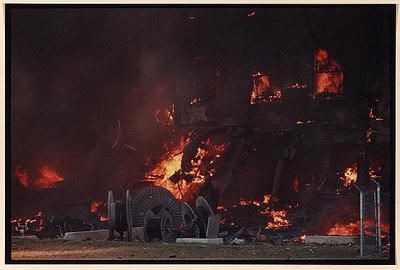
(Picture 1: Overview of diffuse fire with rusty guardrail in front)
So I’ll show you the first image and (question…you have the projector on?) yes, (laughter) there we go. This was the very first photograph that I took. Umm. What, what happened was I, as soon as the plane crashed into the Pentagon, and I, like everyone else, screamed a great deal, got out of my car, paced across the highway, a number of times, and then I realized I had all my camera equipment with me—I was going to photograph Senator Kennedy at the Kennedy Center that night unveiling a new exhibit, and umm, as I spoke with umm, other photographers, umm, Steve, who will speak later, umm, we both had the same reaction, of “I can‘t photograph this!” And the next thought was, “I have to.” So I went to my car, grabbed my equipment, I was shaking like I’d never done before, and had to load camera, film and batteries, and so my first photograph was about three minutes after the impact.
(Picture 2: Diffuse fire—close up)
The thing that really shocked and amazed me was I do have some very nice equipment, I have a 100 to 400mm zoom lens, and I was at the maximum, umm, 400mm scanning the scene, looking for the plane, and could not find it. And, all I could see is possibly some scrap metal in the foreground, but I could only distinguish that later.
(Picture 3: Generator fire)
As you may know, umm, this was the side of the Pentagon that had a, renovation work, done on it, and from what I can tell, this is a generator that was fenced in the construction area, which is right next to the impact site.
(Picture 4: Brand new image: Yellow firetruck arriving)
Umm, this is the only photograph I really waited to happen, umm, this is the first emergency vehicle on the scene umm, I first photographed it in the distance, to the right, if you’re looking at the Pentagon, and since I felt like I was recording a sequence of events, I really wanted to firmly establish what happened and when, so I waited for the fire engine to come into the frame, and then shot it.
(Picture 5: The Donley Fireball)
This is a secondary explosion, probably, , don’t know, probably another tank of fuel in the back of the plane and, it was probably about three or four minutes after the impact, umm, it is about 35 feet in diameter, the explosion goes up to the fourth floor, above ground on the Pentagon, umm, and, you can, I think, in another photograph, you’ll see something else I want to show you.
(Picture 6: Long shot—smoke)
There’s now two columns of smoke, umm, I showed this to my cousin who was in special forces and he knew exactly what kind of jet fuel it was from the way it was burning and the color, and you can see in the top right the sun being eclipsed, also in the foreground, in a couple of photos, you can see the lamppost that was knocked down.
(Picture 7 New close-up)
This is an emergency vehicle at the Pentagon that is for the heliport, where helicopters land, and it was decimated, there is a firefighter running towards it with a fire extinguisher.
(Picture 8: New road shot)
Um, people began to evacuate of course immediately, umm, there was not…people were not running…they were moving quickly, and some people were actually walking slowly, umm, just because they were in disbelief and I could just tell, a major puzzlement: them not knowing what had just happened. This is looking north along, umm, Washington Blvd and Route 27, of all the pentagon employees and personnel evacuating, and cars stopped. Once we were stopped in traffic we were held there for at least ten minutes, and then when they were ready, they wanted us out of there as fast as possible. Also you can see in the road, possibly, all the, umm, debris from the Pentagon—there’s lots of cement chunks in the road.
(Picture 9: New shot, different side of Pentagon)
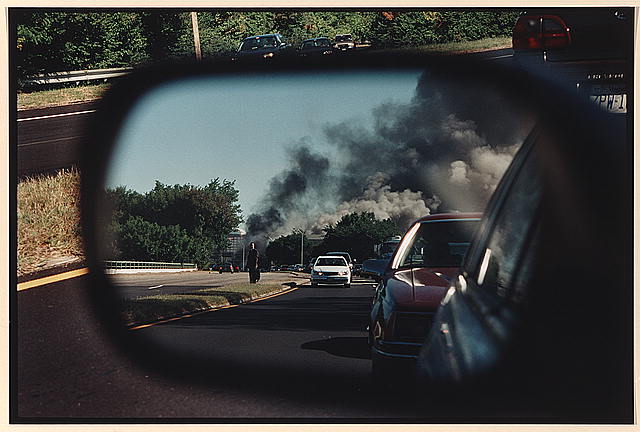
This is, umm, again, the emergency vehicles all assembled, as, as the time went on, it’s to the right of the Pentagon if you’re on the roadway. Once we got cleared out, umm, once I picked up my camera I became a photographer, umm, and was looking at the scene as a photographer, always looking for the shot. And as we drove away, as we were moved out, I photographed some personnel on the side of the road, and then this shot caught my eye in the rear view mirror, and for me it really tells the story of the day and what happened to all of us, just a basic disbelief and shock of what has just happened, with the, if you can’t see in the back, there is a, umm, gentleman, a businessman with a briefcase, standing in the middle of the road, right in front of the source of the smoke in the distance.(Tape edited?) And thank you.(Scattered applause.

Jeremy Adamson: Daryl you were there at the Pentagon, your photographs were reproduced, Life magazine. How did that happen?

Well, I never wanted to be a photojournalist, (laughter) umm, I have always been passionate about photography, umm, I certainly admire and respect all photojournalists (snicker,) but its not something that I wanted to do, fulltime, so when, when I was, but I, if you will, was at the wrong place at the wrong time….

Susan Watts (NY Daily News Photographer): Or the right place at the right time

....or the right place at the right time....but first I just wanted to address this certain theme in photographing in circumstances like this, there seems to be a certain (inaudible) that “then something took over, and I’m a photographer,” there’s a certain distance that happens, it’s sort of like Tai Chi, practicing everything slowly but then all of a sudden when called to, everything is fast, but it’s comfortable, it’s automatic, you don’t think about it, umm I have been a photographer most of my life, umm, just in different contexts, so the moment I decided, umm, that I was going to photograph, then it was not about me, it’s about recording history and then all of a sudden I was a photographer and it was just automatic, umm, so, umm. I’m sorry....what was your question? (snicker)

Jeremy Adamson: (patting Donley’s arm) So how did your shots get into the media if you don’t have a media connection?

....umm, well....after, umm, I, finally....well, to cut to the end of the story, once I finally got home and was watching the news like everyone else, I remembered I had a friend who worked at the Gannett, newspaper, main office, so I called her with, umm, I called her and told her I witnessed what happened....concentrating....and she took down my account....starring off into the middle distance....and she brought me to her photo editor that Friday after I got the film back when the lab reopened, umm, and....hocus pocus—keep the focus!....from there it went to a photo agency and the, umm, images got published throughout Europe and made it into the Life book....nod..…nod?…....silence....I just want to add one thing too, that something that was very satisfying to me in the vein of recording this for history, I did get a full set of my images to the FBI, umm, I had contacted them through somebody else, and it was something I wanted to do, it took a while to accomplish, but umm, but I had noticed that one of the images, that was not up here—a close up shot of the entry point of the crash, that I noticed five week’s afterwards, that there was a person in it, and, umm, which completely horrified me, then I notified the FBI and got them a full set of photos and they said it would help with their investigation, so that was very satisfying, that, just in that decision to make, to take, the photos, that it would make a difference....nod....once we were stopped in traffic we were held there for at least ten minutes, and then when they were ready, they wanted us out of there as fast as possible. Once we got cleared out, umm....and as we drove away, as we were moved out.

What is Donley saying here? Don't try and read between the lines, just read the lines!

I'm editing in (on August 21) a juicy quote of Donley's from an article by Gary Wheeler published in Gannett News Service, on September 11, 2001, called "Witnesses: Airplane hit the Pentagon hard", The quote reads, “Another witness, Daryl Donley, saw the crash as he was driving on Washington Boulevard. Among debris that was scattered as the plane crashed, he found a "scorched green oxygen tank marked 'Cabin air. Airline use'" on the road.” The article has been apparently, suppressed


Tuesday, November 14, 2006

Steve Riskus Needs a Critical Thrashing

When I said in a recent blog that Steve Riskus’ Pentagon 9-11 “strike” photographs weren’t posted online in a timely enough fashion to be credible as evidence, I generated a response from a certain online persona named xjacktarx, who posted on the Riskus message board,
"That guy says you waited months to make those photos public, but didn’t you post them on pr.n or pf.c or whatever it was on the actual day of the attacks?”
If I had only read that message board first, a discussion of the work of Gerard Holmgren and Dick Eastman, it would have spared me my mistake. Not only was the Riskus series posted online September 11, winding up on a website launched only the day before, but the posting was up within an hour, which is quick editing, even for a task force. This would confirm my belief that in the five relevant Riskus pictures (eight others are meaningless, pointless contextual poppycock,) the foregrounds were staged and photographed in advance and married to the background scenes of a burning Pentagon within the hour. Such doctoring is common throughout all the meaningful work of every photographer who took pictures that day at the Pentagon.

I dug a little in the Internet archive known as The Wayback Machine, and came upon the Critical Thrash Index of Terror, a synopsis of the web site’s history. After posting his pictures on September 11, 2001, Riskus updated the site on March 11, 2002 with the addition of thumbnails, probably as an enticement for those with slower computers who were having a hard time uploading such large photo files. Lastly, on January 6, 2003 he created the page as we see it today, an existential blank slate, without context or linkage, but with an overkill of contact information as compensation.

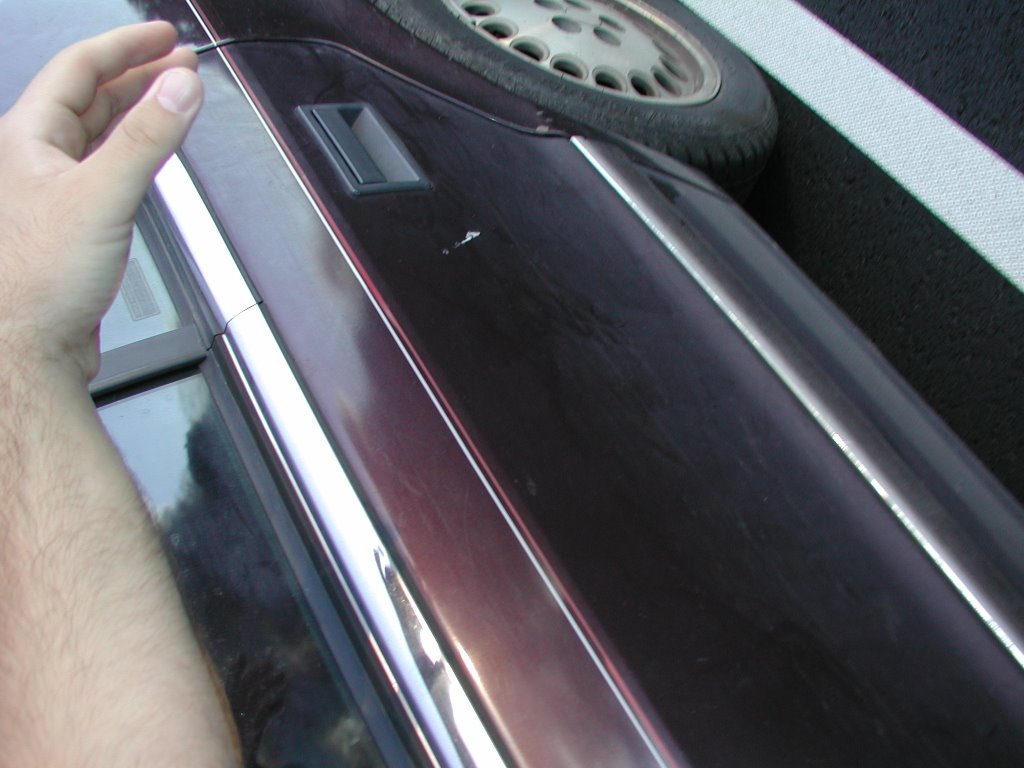
His JPEG’s are numbered 11 through 26, so first, we can wonder what became of images one through ten? And since his current website displays 13, not 15, we cull to find two missing images, numbers 16 and 21, and how such things can be indexed and be missing from the archive taxes my computer organizational skills completely. Additionally, we find two images, numbers 12 and 14 that were thoughtfully relinquished from the current web page—shots of the Riskus arm,

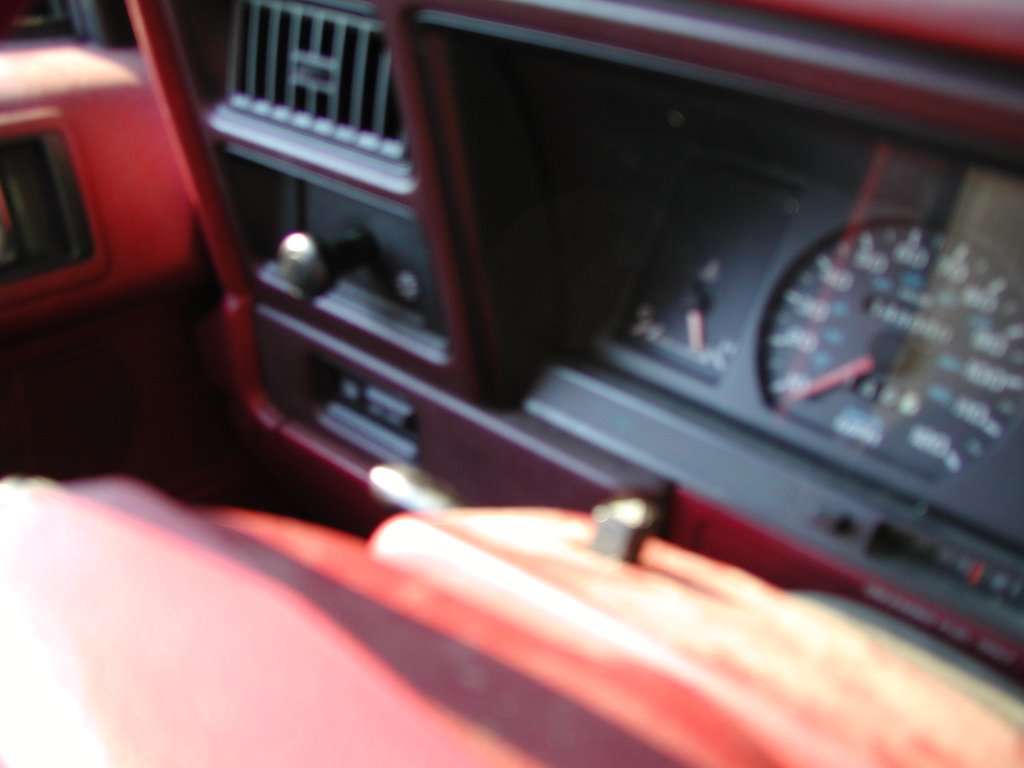
and the Riskus dashboard.


These were probably originally intended as tributes to the authenticity Gods but were misunderstood as burnt offerings in the temple of Skepticism and Cynicism, thus fell out of favor. As is typical of all the Pentagon photographs, the least amount of information conveyed is the clear intent—here, atypically, by a lack of camera focus, not that knowledge of a Burgundy Impala's mileage would be empowering to anyone.

The great discovery of the index is the unveiling of Riskus’ role in the authoring and disseminating to the web on March 27, 2002, of
A list of witness at or near to the Pentagon, September 11th, 2001 collated from reports to be found online,”
a document I first linked to from an article published in the National Review on April 9, 2002, by the conservative columnist, James S. Robbins, called, 9/11 Denial, an attack on Thierry Meyssan's book, “L'Effroyable Imposture,” the earliest book published to question the Pentagon story. In the article, Robbins lays claim to being an eyewitness himself, although he links to an eyewitness list, which doesn’t have his name on it. No authorship is claimed for the list, but internal evidence suggests guilt by association with Robbins. For instance, the entry for Alfred S. Regnery, "president and publisher of Regnery Publishing, Inc., a sister company of Human Events,” is definitely TMI. A clue to a Riskus’ role is in a truncated quote given for Mike Walter, the USAToday reporter who was one of the many Gannett employees who saw a ferreting American Airlines 757 jetliner burrow in sideways to the Pentagon. Walter's quoted, "I was sitting in the northbound on 27 and the traffic was, you know, typical rush-hour--it had ground to a standstill. I looked out my window and I saw this plane, this jet, an American Airlines jet, coming. And I thought, ‘This doesn't add up, it's really low.’ And I saw it. I mean it was like a cruise missile with wings. It went right there and slammed right into the Pentagon."

Left out, his CNN quote continues, "Huge explosion, great ball of fire, smoke started billowing out. And then it was chaos on the highway as people tried to either move around the traffic and go down, either forward or backward. We had a lady in front of me, who was backing up and screaming, 'Everybody go back, go back, they've hit the Pentagon.' It was just sheer terror." Was that left out on purpose because it conflicted with the visual evidence of detachment and calm that permeates his shot? And why by the way, did Daryl Donley get the only early fireball shots and the big Life bucks? Riskus was there and he didn’t need to compose himself, the cool dude.


The website which is his cover story, doesn’t even link to his terror page. All in all, it is a weird level of participation in these matters.

Before there was criticalthrash.com there was youthenrage.com where somebody by the name of Dave Hackett had a slogan Youth Enraged For All My Life. When you clicked on his picture you read, "There is nothing here yet. Hopefully soon I will be obtaining a digital camera and a new domain name for this site. I plan on making this site a place for midatlantic pool and ditch skaters. I want this to be a network of all the skate spots around. Eventually I will be putting up a messageboard so people can post the places they skate. I will also put up a gallery and a listing of wide decks and crap like that. If you have any suggestions or anything like that email me." So what happened Dave? You don't have to be indeterminate any longer.

Wednesday, November 08, 2006

Artist Aaron Koplin Soars with "Flight Patterns"


It's been awhile since I've been as excited by a creative result as much as I am in watching a very short video clip, Flight Patterns by Aaron Koplin, found on YouTube,


A shorter but much higher quality version can be found at the UCLA Center for Embedded Networking Systems

Koplin takes F.A.A. flight data and uses it to create luminous video maps of human interconnectivity in an ingenious and utterly modern retake on the famous video capture of the FAA radar screen going slowly blank on September 11, 2001 after American air space was shut down in response to the attacks on New York and Washington.

Art at its highest level heals, and Koplin's goes a long way in healing the collective wound of 9-11, so much so, in fact, that the work makes the idea of flying seem almost magical again.

Part of its artistry for me stems from the setting at U.C.L.A. that gave rise to it, a National Science Foundation Science and Technology Center, given partial funding by the federal government, since the Christian conservatives haven't caught on to it yet as Art with a Capital A, and demanded the money be used instead for third-world abstinence education.

Koplin's work is part of a larger project called Celestial Mechanics, which is "a planetarium-based artwork installation that visualizes the statistics, data, and protocols of man made aerial technologies---a graphic display of the paths and functions of the machines hovering, flying, and drifting above our planet. The sky is filled with aircraft that transport people from place to place, perform utilitarian duties, assist in communications, enact military missions, or wander above us as debris. Celestial Mechanics combines science, statistical display, and contemporary art by presenting these mechanical patterns and behaviors as a dynamic visual experience," to which I say, O.K!

A work sheet page here documents different components that go into the assemblage.

Flight Patterns has already generated artistic response, a sure sign of merit.

Artists have been at the forefront in stopping the descent of the earth's peoples into the madness of Armageddon, a list that in my opinion includes even the director Mel Gibson---a man true to his artistic impulse. Aaron Koplin (and I insist on pronouncing that as Copeland) is a rising young star with a bullet, up there with the artist who woke me up, old Harold Pinter.

Sunday, November 05, 2006

Temporary Mounds of Dirt Were Erected at Strategic Points at the Pentagon to Block Views of a Plane Strike

The largest of which shielded the Citgo gas station from direct views of the Pentagon impact zone, where an American Airlines 757 jetliner traveling over 500 miles per hour just a few feet off the ground crashed, disappearing entirely into the building's first and second stories, on September 11, 2001.

Perversely, the Citgo station became the center of media response in the days immediately following. That no professional reporter publicly questioned, to my knowledge, the presence of such massive impediments, might indicate no one had guaranteed immunity from a collective national delusion.

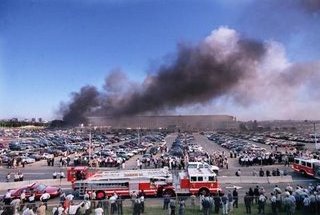
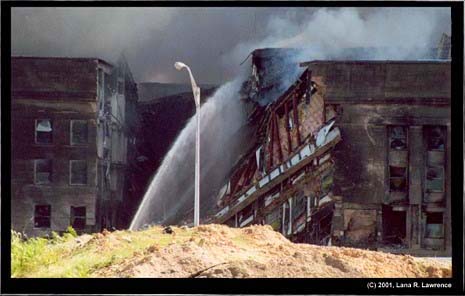
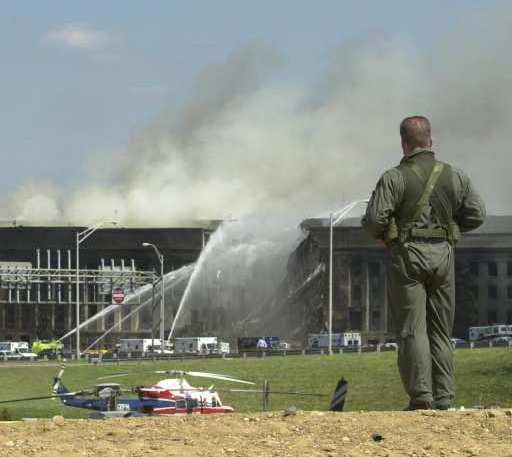
Compare the following two pictures: In the first, we see the firefighting response of September 11 occurring behind the dirt mound. In the second photo, taken ostensibly of promotional event, no dirt berm in place, although an erosion-control barrier has been installed, one may assume in anticipation of erection. Since the Pentagon is still whole, the picture must predate 9-11.

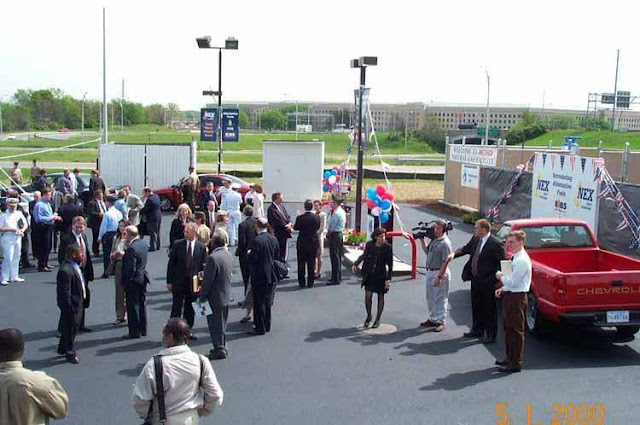
The pictures are deceptive, because of the unnaturally high vantage point both were taken from, it appears the Pentagon is visible in either, carrying a false implication the Pentagon was visible behind the dirt mound to anyone standing in the parking lot, where it would have been entirely obscured. Might not that have been the intent of staging a pre-dated event, complete with official press releases, the record to serve as back story, confounding analysis of the body of material surrounding 9-11?

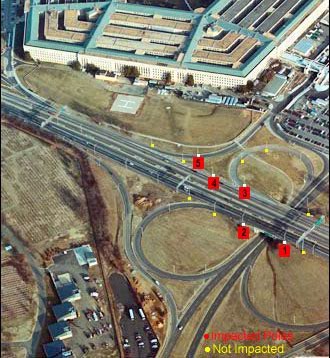
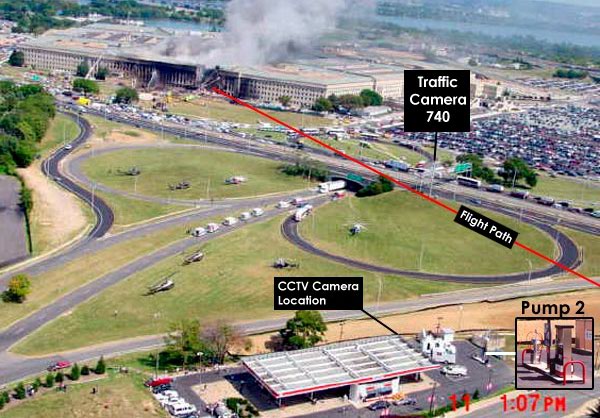
The following satellite image, taken in the immediate aftermath of 9-11, has color notations illustrating the two-plane theory, in which a commercial jetliner overflew the Pentagon, while a missile or drone attacked from a slightly different angle.

Several buff colored earthworks are apparent, the most notable lies under the purple "Light Pole" path, extending from the elevated I-395 highway along the front of the Citgo gas station for several hundred feet. A smaller mound lies at the resumption of the green "Eyewitness" path, near the Route 27 cloverleaf interchange. It figures in a great many misleading shots taken on September 11.

A mound of earth behind the Citgo blocked higher views from the parking lot of the Navy Annex. A fourth earthwork was constructed north of the Pentagon, and can be seen in several shots.

But many other members of the Fourth Estate, including all of those on the scene in the earliest hours who produced the entirety of the meaningful public record, were clearly co-conspirators to a covert false flag operation, undertaken by agents of an international military industrial complex, to motivate, and galvanize, the American body politic into a endless future of war.

This aerial view shows the relationship of the Pentagon to the runways at Reagan National Airport and it shows how easily a second aircraft could have overflown the Pentagon and safely landed.
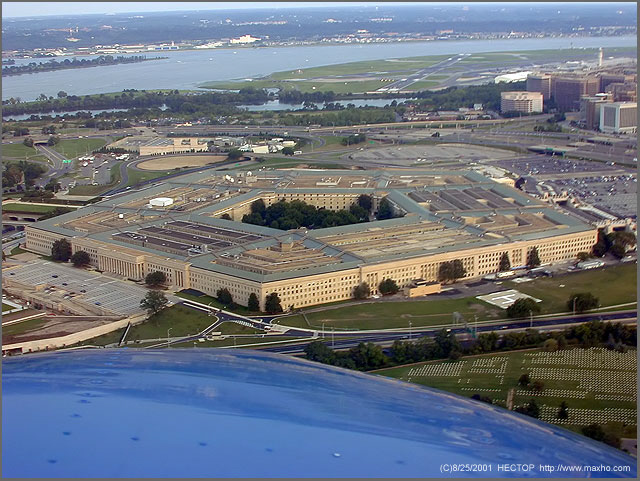
It is from a fascinating Russian-language website of a flight enthusiast nicknamed “Hectop,” http://www.maxho.com and apparently, it constitutes one-of-a-kind documentation, leading me wonder if such information wasn't meant to remain classified. Dated 8/25/2001, just 17 days before 9-11, we must question the coincidence as possible disinformation. I think not. Labeled "Commercial Rating Cross Country Trip/Pentagon,” the image emerges from a likely context of several dozen similar images taken on a sequenced, progressive itinerary that includes a very closeup aerial view of the post 9-11 devastation in lower Manhattan! These images' folder is just one element among many files, the various postings and musings reflecting a distinct, if unknown, Cyrillic personality. The contrast in authenticity couldn't be more startling, than with the contrived website of Steve Riskus, the putative source of officially "released" photographs.

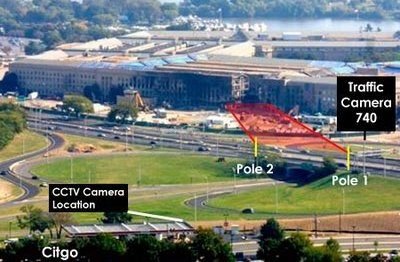
I wonder what that might be. Checking out the higher resolution photo here, can anyone get a clear determination, one way or another, if wire spools are “left-over” near the site?Moreover, has anyone questioned the legitimacy of propane and diesel fuel storage tanks being exposed in such a location? Even if only temporary, as part of a construction project, a diesel generator seems anachronistic here on many levels--useful as a smudge pot perhaps, it did that quite well--but useless and contraindicated. That is, if a permanent and manned firefighting substation be part of a standard air-safety procedure protecting a heliport that receives frequent presidential visits along with other high-level utilization, to also place exposed combustibles there as well be considered unwise.
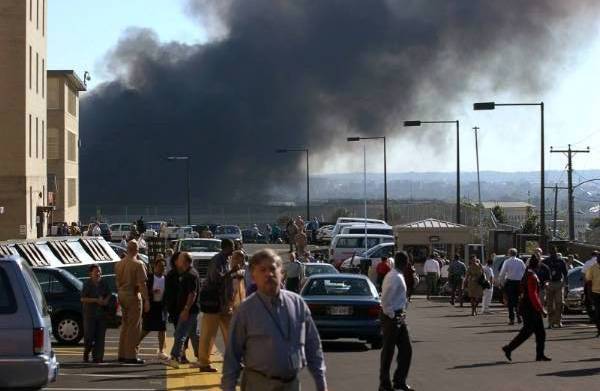
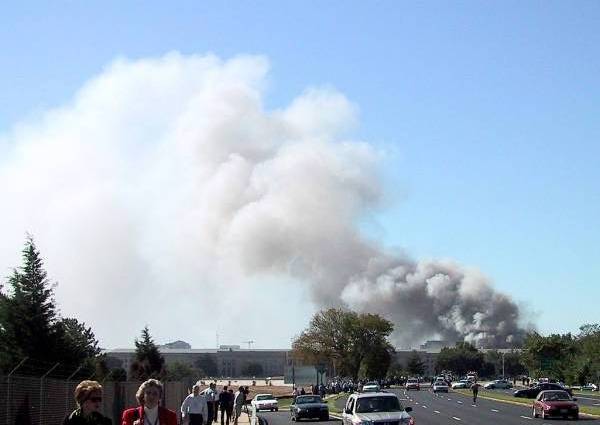
The southern edge of the mound can be seen in this photograph in which Pentagon employees are inexplicably shown going onto I-395, as reported, to walk home.
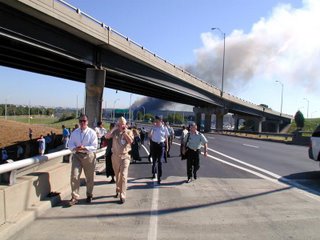
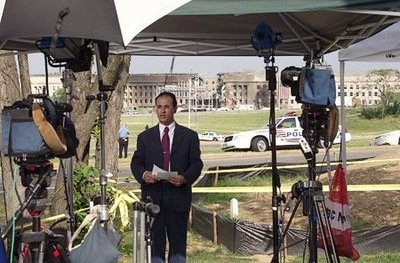
...although there was no reason they couldn't drive their home in their cars.The earthwork barricade petered out near a grove of trees......where press conferences were held in the shade. This picture has been taken at an unnatural height and angle and it is doubtful the Pentagon is in the sight line of an average-height person here.

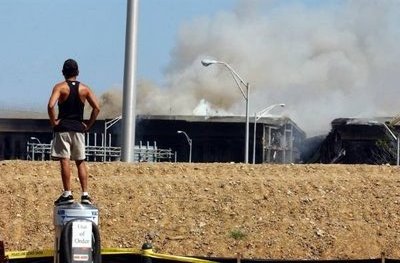
In my opinion, the following photograph was created with the intent to deceive. These bored seeming cameramen are perched on top of a news van--a rolled-up awning is visible at the edge, by their feet. The featured man looks at first glance to be leaning on a crutch, he appears to be standing on asphalt by inference. The distance between the van and the black plastic is foreshortened, and with tight cropping the Pentagon would seem to appear visible at ground level.
The following two aerial images show another mound of earth beside a cloverleaf interchange of Route 27. It lies in a direct sight line between the impact zone and Columbia Pike, also blocking the view from Navy Annex parking along Southgate Road.

You can get a better understanding of the lay of the land with the Google Earth overview below. The imagery shows a nearly completed restoration of the Pentagon, with the earth berms removed, but their vestigial traces can still be seen. (Correction: The berm is in place but the grass atop is dying of thirst.)
This mound is featured in several photographs taken at the Pentagon on September 11. Exactly why it was introduced as a visual element escapes me, because once you understand its location relative to its surroundings, photographs like the following become ridiculous. Why did this service member go up the hill in the first place? And since the piles were not the result of construction, why is the trailer and debris there?


Other images that present the mound are so pointless and inane, they should have raised red flags.

Some photos contain enough detail to deconstruct them, thereby revealing a disconnect with objective reality and lack of basic commonsense. They become clues to the larger truth: That this was a staged, fabricated event, a manipulated media circus from start to finish.


For instance, in the images above and below, these medical personel are walking in on the off ramp of southbound Route 27, also known as Washington Blvd, the road which parallels the impact zone. They will have to walk over a thousand feet to get to the triage area, which is a feature in many shots.


But they will have to cross over two wide concrete barriers, and two additional metal Jersey barriers, to get to the wounded at a triage location that only made sense as a public relations setup, with the background of a burning Pentagon to frame the scene.


Why didn't they just drive? We see scores of extra and unneccesary ambulances and medical helicopter transports. Multiple sources report there were only 40-50 Pentagon victims hospitalized, and according to The Washington Times there were only seven serious burn victims. That makes the visual record of a medical overresponse so excessive as to be damning. In countless images the responders simply stand around looking bored, their casual pose and lack of focus detracting from the intended dramatic effect.


Another dirt mound was created behind the Citgo, higher up on the hill. It did a good job of blocking the view from the entrance to the Navy Annex parking lot.
Another mound was constructed north of the North Pentagon parking lot. The following two shots were taken from Lady Bird Johnson Memorial Park. Several buildings accessed from the North parking lot were screened in this way.



It is scary to contemplate how the news media could have been manipulated as they were.
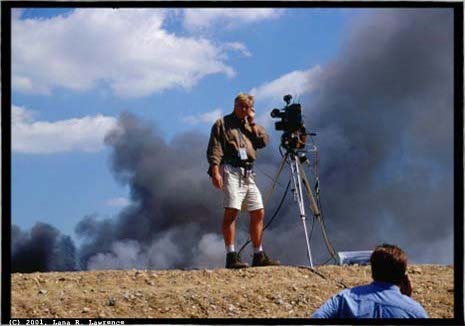

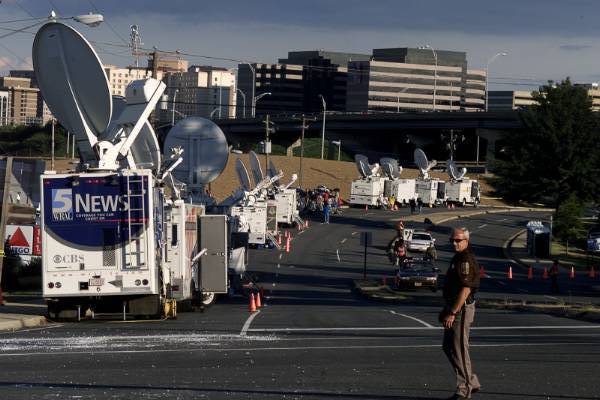
It was obvious they were meant to stay behind the wall.


Maybe you needed special permission for a look.

These cameramen have to crane their lens for a look over their shoulders.
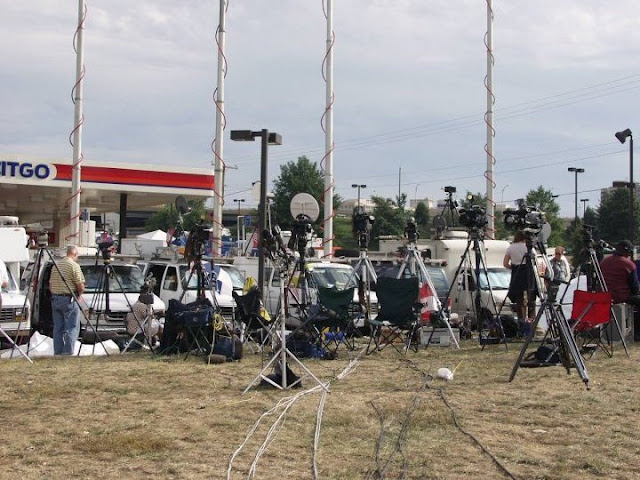

They were sandwiched at the short end of the Citgo canape, with Interstate 395 in the background.

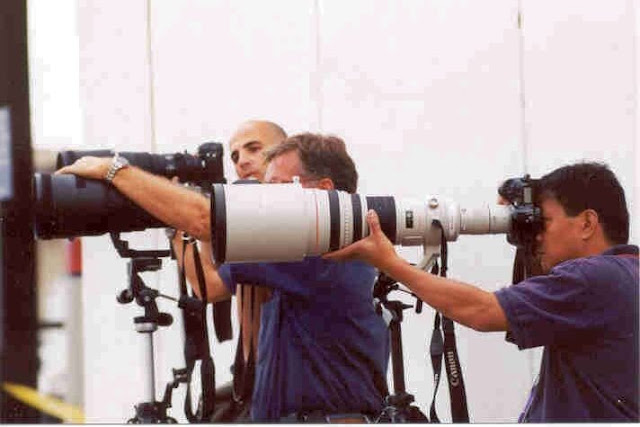
The most consistent element throughout the entire body of Pentagon 9-11 photographs is the distortion in our perception of the field of depth, the product of using special wide angle and telephoto lens, the only intent of which is to confuse our witness. These cameramen were perhaps legitimate, but kept back a great distance.

The most dominant characteristic is the homogeneity and repetition, the lack of individualized effort, artistic vision, authorial voice, within the work product, indistinguishable between professional or amateur, with only the minimum quantity of information making its way to us in every case, and rarely emotion of any kind reflecting off these beings.


Maybe it's because the real journalists were getting manhandled:
Q: Around that side of the building where the fire is and where the fire fighting's going on, I would appreciate it if you could intercede on behalf of the FBI to make sure reporters are allowed into a certain area there and allowed access in there so -- and not being threatened or, in fact, handcuffed and dragged away, that reporters do have an area close to the action where they won't necessarily interfere with things. But I -- would you --


Clarke: Absolutely. You know, as I tried to say at the beginning of this, we understand and appreciate what you're trying to do. Understand and appreciate just how difficult this all is. You know, Pam, as you said, this has never happened before. People are dealing with it remarkably, and we are going to make every effort we can to provide that kind of support, that kind of news and information to you, as we can. So we will work on that.


Q: The only reason I say that is the FBI was just -- granted they have a job to do, but they were a bit overzealous yesterday I think, and -- and just --


Clarke: Let me push back on you a little bit. The FBI is doing a phenomenal job. And they have an extraordinary task on their hands, both here and elsewhere. And we, I think, surprised them a little bit, saying hey, here we come, and we didn't give them much advance notice. But going forward -- and, you know, as you get into day two of this, we can start to put a lot more of those processes in place. So, heard and understood.
Department of Defense News Briefing--Victoria Clarke, Presenter
September 12, 2001 Torrie


An artificial reality can only look artificial.


Is this the Brave New World of the Neo-cons?
Can real people look and see and stop it?


Temporary Mounds Bar Theory Updated November 15


Concerning the earlier of two photographs of the Citgo gas station that lies between the Pentagon and the Navy Annex, which together constitute the nut of my Mounds-Bar theory, wherein the erection of temporary dirt berms that served to block views of the airplane strike impact zone on the Pentagon on the morning of September 11, 2001, is given its context and identification in a United States Department of Defense News Release here,, while the picture itself, in an uncropped, high-resolution, government-bandwidth version, here.


A writer for the American Forces Information Services, Jim Garamone, wrote an article for the DefenseLink News Alternative Fuels Help ‘Green’ the Pentagon, about an event I had the temerity to call a staged public relations happening. It was in fact an official ribbon-cutting ceremony opening the federal government's first multi-alternative fuel service station. In attendance were Deputy Under Secretary of Defense for Environmental Security Sherri W. Goodman; Assistant Secretary of the Navy Robert Pirie; Deputy Secretary of Energy T. J. Glauthier; Executive Director of the National Ethanol Vehicle Coalition Phillip Lambert; and President of the Natural Gas Vehicle Coalition Richard Kolodziej.


Even with the glamorous star wattage of two civilian alternative-fuels bigwigs I still say feh! The image depicts a contrived, artificial mock event in my opinion, performed by amateur actors under poor direction and little motivation. But why was the event undertaken and the image released?


An important detail to take under consideration is the date, May 1, 2000—significantly earlier then the date of just prior to 9-11, which I hazarded given the presence of a black-plastic erosion control dike in the picture--the first step toward building the earthwork. So if my theory is holds true, that the work was intended to block sightlines of the impact zone from areas which couldn’t be secured by other means, then the staging of this event, and dissemination of photographs recording it, served both to rationalize and alibi the subsequent images sharing the same contrived camera angles and views of the Pentagon building, providing a back story if you will, for the presence of the earthwork.


Jim Garamone is a military writer who also took photographs on 9-11 at the Pentagon, initially up close, and then back from the secured area at the Citgo. The implication of the earlier date is the conspiracy of September 11, which was a false-flag controlled self-wounding meant to galvanize Americans like a “new Pearl Harbor” into starting wars of choice against innocent resource-rich third-world nations, is far vaster than I first imagined. It reveals the enormous power of the “shadow government” at the heart of this undertaking to truly be bipartisan.


Other pieces of the puzzle fall into place under this new paradigm. The TWA Flight 800 disaster for instance, which for many Long Islanders remains a clear case of a military missile strike, regardless of what the FBI or NTSB reported. If true, two possible justifications for the event would be: it was staged to frame and blackmail current navy personnel into later participation in 9-11 (and the direct targeting of Navy war-game operations in the Pentagon signifies Navy involvement, witting or unwitting, and two, contrary to U.S. law, which makes the National Safety and Transportation Bureau the exclusive federal agency to investigate civil airliner crashes, the FBI was interjected as lead investigators of the crash on no legal or logical grounds except perhaps, as now seems probable, as precedent to co-opting the Pentagon disaster investigation.


Would the U.S. government, especially this one, have any compunction about killing hundreds of its citizens preparatory to killing thousands more, as a justification to wrongly kill hundreds of thousands around the world to get what they want? Hardly, in my opinion. It is our failure of imagination that people can stoop so low on a scale so vast, that shields the clandestine from discovery. We don't want to know the truth! It is hard, emotionally devastating work to arrive at this conclusion. Our minds revolt and resist until we’re exhausted. The canard, “the government is so incompetent there’s no way they could keep such a plot a secret,” is itself a dissemination of the big lie. The motto of the NSA is They Served in Silence, and it successfully guided their 38,000 employees, at least until recently, when the extraordinary circumstance of the warrentless wiretapping leak, which is proof the system worked, not the other way around.


Like the drunk who drinks around the clock but nobody realizes he's a drunk until, one day, he sobers up and everybody sees the difference, what makes the attack on the Pentagon so difficult to perceive is the completeness of the moral horror, let alone the enormity. No cameramen were independent of the plot, except perhaps some latecomers who took pointless shots with telescopic lens. Some researchers call the early photographs “pure,” as having come before a media clampdown, which is pure nonsense. The preparation, the execution, the response, and the recording were all micro managed, but poorly, with contempt. It is only by comparing 9-11 to a legitimate air disaster that we gain some insight. In the aftermath of Flight 800 for instance, private researchers were prosecuted for keeping a small fabric swatch of airplane seat upholstery, while at the Pentagon a fiberglass section of plane tail was “donated” to the Smithsonian after it supposedly fell in the open sunroof of a private citizen's automobile, while another fragment was mounted as sculpture for display in the office of Secretary of Defense Donald Rumsfeld.


Jon Culberson and Charles Burroughs, the Metropolitan Washington Airport Authority firefighters who "happened" upon the scene moments after the explosion, happened to take especially inane shots. Never do we see pictures of water or foam aiming at fire.


What once was unthinkable is our new Rosetta stone.