Saturday, December 03, 2011

New York State Library 81st ANNUAL REPORT 1898

TRANSMITTED TO THE LEGISLATURE JANUARY 4, 1899, BY THE REGENTS OF THE UNIVERSITY. ALBANY: UNIVERSITY OF THE STATE OF NEW YORK
BUILDING

Needs. Few realize the great amount of space required for the administrative work of the six departments of the University, and for housing, even inadequately, the great collections of the state library and the state museum. Most people think of the University as merely one of the state departments requiring only a few rooms. Our critics often complain that we occupy something like a third of the immense capitol. As pointed out in previous reports, the great space now used is wholly inadequate for our needs and the congestion is each year becoming more serious. We have now over 150,000 volumes boxed for lack of shelving, and while every effort has been made to keep this accumulation out of sight by storing it in the basement and attic spaces instead of leaving it where it would be thrust on the attention of the public, the dilemma is growing daily more serious. It is impossible to hope for any increase of room in the present building as the other departments are clamoring for more space and have long been jealous of the large proportion given to the library. They justly say that the only solution is an adequate fireproof building to which our more than 400,000 volumes and our very large scientific collections can be removed. Before that building can be completed, even if it were started this year, we shall be seriously crippled in our work, and our usefulness to the public will be greatly diminished.

Care. It must be remembered that the University is on a different plane from any other department, being a corporation created in 1784 and included in the state constitution of 1894 as a permanent feature of the state organization. This fact, together with the responsibility of the regents as trustees for the extensive property of the library and museum made necessary the usual rule in similar cases, that the ordinary custodians of the building, the cleaners, repairers and other employees are not admitted to the rooms where the valuable books and specimens are kept. It was at the request of a former superintendent of public buildings that he was relieved of all responsibility. As he justly said, it was entirely impracticable to hold the regents responsible as trustees for loss or injury to this peculiar and exceedingly valuable property if another department carried the keys and various employees over whom the regents had no control were sent in and out. We therefore have not only the supervision of the rooms but we have our own force of janitors, watchmen, elevator men and repairers and have the sole responsibility and expense of caring for our section of the building, except that the steam for heat and the electricity for lights come in from the mains without being charged to our appropriation. All our rooms are equipped with the best time-detectors and a responsible night watchman visits every room every hour from the closing at night till the opening in the morning. We have equipped the rooms with the best chemical fire extinguishers and secured for our watchman the powers of a policeman, and are able to report a greater degree of safety than ever before.

Elevators. We are promised for the coming year that the western staircase elevator will be regularly run so that the private library elevator shall be available for getting and returning books on the various floors, and that we may be freed from the unavoidable noise occasioned when all readers must come up through the main reading room. The need is urgent for changing both the staircase and library elevators to electric power as recommended, in order that they may be used on Saturday afternoons and other holidays and in the evening after the general elevator service of the building is closed.

Ventilation and Ceilings. There is the most serious need of proper ventilation, specially on the upper floor, which is now fully occupied from State street to Washington avenue. As it is directly under the roof, the need is intensified. A proper system has been laid out and the legislature will be asked for the modest appropriation necessary to carry it into effect the coming year. Besides ventilation we must also have the omitted ceilings placed over the rooms to protect from the extreme heat of the summer and from the waste of our steam heat in winter. The roof over the western section of the building is leaking in many places to the great danger of some of our most costly books, which we have been compelled to move about to escape the falling water. Our exceedingly valuable set of the London Times (274 volumes), one of the most complete sets in this country, is for lack of shelving piled on the upper floor, where it is peculiarly exposed to danger from the leaking roof. More floor shelving suitable for sets like this is urgently needed.

Improvements made. Lest readers of this report unfamiliar with the facts should infer from the continued statement of our needs that little is being done to improve and enlarge our quarters, I submit the brief mention of what has been done during the past year in the building department, besides the regular cleaning, repairs and police duty of the janitor and watchman. It will be clear from this that we are very rapidly approximating a reasonable ideal, and that while certain needs are still urgent we have abundant cause to be grateful to the legislature for its appreciation of our work and its liberality in its maintenance.

Most important of course is the occupancy of the fifth floor, formerly the attic, giving us a suite of rooms extending 300 feet from State street to Washington avenue and the width of the entire western section of the building. This includes rooms from 51 to 59. The system of numbering adopted gives the floor for the first figure and the number of the room, beginning on the south end, for the second. Where there are two or more rooms on the same east and west line, the room on the west front bears the number, and the rooms at the east have A, B and C added. Closets are indicated by adding lower case a, b, c, etc. to the designation for the room. Capital N, S, E, W are used for north, south, east and west galleries. In the numerous cases where the mezzanine floors, have been introduced, they are indicated by a .superior 2, 3 or 4. In this way the number specifies exactly the location of a room to one who has never seen the plan of the building or visited the room before, thus 41A2 is the second or mezzanine floor in the room east of the first or corner room on the fourth floor.

I give a mere catalogue of the more important additions and changes of the year. Room 15, wood floors for the storerooms to protect against cold and dirt; 31, new catalogue cases holding 3½| cm cards, for the alphabetic index of classified annotations to books; 31A, shelving replaced where removed when finance committee took rooms; 32, new removable stairs on iron hangers to reach the manuscript room and biography shelves without going up two flights and down one as heretofore. These stairs are temporarily removed during the session of the legislature but restore the convenient use of these rooms for eight months of each year. 333 and 34A3, a second story of iron stacks added for British patents; 33 and 34 new cases for the records of the accession department and for the sets of American and English catalogues; 35, atlas case with roller shelves, and reference bookcase for most constantly used dictionaries, gazetteers etc. adding greatly to convenience of use as well as to the durability of the books; 35N3, space inclosed on north gallery for janitor's supplies; 442 iron shelving for folios on north wall and in two cases; 46, coat closet for binders; 51, aisle to elevator widened to admit large furniture; 54 to 59, steam heat, electric light, carpets for aisles, Birckhead portfolio cabinets for photographs and plans, book-lift shaft inclosed in oak, outside ventilation for women's coat room; 55, end pieces for iron shelves, all iron work painted, two new fireplaces and mantels, floor sloped for trucks through library elevator, storm windows and shades added to rooms 55 and 59; 55A, partition and door shutting staircase elevator from reading room and increasing safety of library property, iron and glass ceiling to protect heat from waste, transom lifts to east windows for ventilation; 56, shelving completed for traveling or home education libraries; 59, walls whitened, floor finished, oak wall cases, cupboards and cabinets, fireplace and mantel, oak doors to shut off assembly attics and allow library territory to be securely locked; 65, perforated iron floor covered to prevent escape of heat from history reading room and dust from sifting through.

We have added on the east wall of room 65 an extensive rack for rolled maps. This consists of uprights 240 cm high and 40 cm apart. Each upright is provided with 22 iron brackets 12 cm apart, projecting 20 cm from the upright, the front of the brackets being 4 cm higher than the back. This rack furnishes a simple and inexpensive method of storing rolled maps. We have also built large skeleton pigeonholes for storing maps in rolls to test the comparative merits of the two systems. For flat maps a Birckhead portfolio cabinet has been provided. Our storage baskets for waste paper have all been replaced with galvanized iron cans with metal covers, an extra precaution enforced on us by the burning, with great attendant danger, of one of the storage waste baskets, probably through the carelessness of some smoker. Bentwood racks have been placed in the reading rooms as the most convenient, economical and durable accommodations for hats, coats and umbrellas. The public reading rooms have been beautified by the addition of potted palms and other plants. Having secured the needed partition so that, for the first time since occupancy of the new quarters, we have been able to lock the library rooms against approach from the attics of the main building, we have had permanent and trustworthy fastenings applied to all windows on the courts and staircases, and are now reasonably secure against forced entrance to our rooms.

On the whole the library was never in so satisfactory a condition, though much remains to be done. Obviously the additions named have made serious inroads on the appropriation which, while covering such expenditures of this kind as were found necessary, did not contemplate the extent to which we have been forced to make additions in order to use the new rooms. With the temperature in summer above 120° and in winter only 50°, it would have been nothing short of a crime not to have added the ceilings, partitions, storm windows, steam coils and ventilating ducts so that we can at least approximate in winter our standard of 20° centigrade (68° Fahrenheit) and in summer reduce the extreme heat due to the direct rays of the sun on the roof immediately over the new rooms.

PUBLICATIONS AND PRINTING

Legislation bulletin. With the present issue we complete the second volume of the annual bulletin of comparative legislation. As soon as practicable we hope to consolidate into a single book, with a single classification and index, the 10 bulletins already issued, thus greatly reducing the labor of reference, and meeting the growing demand for copies, which we can not much longer fill and which will continue to grow as new scholars and others interested in public affairs learn of the practical character of the work. In 1890 and 1895 we prepared a special financial bulletin showing comparatively the receipts and expenditures of each state in the union. This will be regularly published every five years, so that each volume will contain one financial bulletin. With experience we have broadened our scope and are including not only the actual laws passed, but a somewhat clearer indication of their character, and are adding all constitutional amendments and decisions of the court affecting the constitutionality of laws. In short, we are putting in the compass of our thin annual volume the information which a busy member of the legislature will find practically most useful in the preparation of bills or in the discussion either pro or con of proposed laws.

At the opening of the session we shall send to each senator and assemblyman the following statement signed by the director:

TO THE MEMBERS OF THE LEGISLATURE

The legislative sub-librarian, Robert H. Whitten, Th. D. has now completed the Ninth annual summary and index of legislation by states, covering the laws enacted in 1898. A new feature of the bulletin this year is a concise resume of the most important and distinctive legislation of the year, which indicates the general trend of legislation by reference to laws of previous years. The bulletin digests and organizes the enormous annual output of legislation so as to render available with a minimum of labor the most recent experience of other states, thus enabling those interested in any specific law to find readily what states have recently passed similar laws.

An outline of the bulletin is given on the back of this sheet with the number of laws recorded under each head. All these laws are in the library ready for immediate reference. The bulletin is sold at 25 cents, but a copy is furnished free to each member of the legislature and can be had from the Legislative division, State library.

A condensation of the resume" will also be sent out widely to inform the public of the trend of the legislation of the past year. The new legislative sub-librarian in charge of this work, Dr Robert H. Whitten of Columbia university, has given great satisfaction in the work thus far done, and we believe we have found a worthy successor to Dr E. Dana Durand, who was called from this position to a professorship in Stanford university, California.

Bibliography bulletin. During the past year 13 more bulletins were issued in this set. Four of them were bound with the report for 1897 according to our policy to include in each report all bulletins printed up to the time it is bound unless included in previous volumes. Bulletins no. 1 and 5 are out of print; no. 9-17 are appended to this report. Besides the bibliographies compiled by library school students, the series includes, as no. 12, a list of the Best books of 1897, with notes prepared by the public libraries division.

As no. 14, Index to subject bibliographies in library bulletins proves specially helpful, we index the subject bibliographies in the current numbers of all library bulletins as soon as received and insert them in the copy of the Index mounted on cards and kept in the main reading room. This consolidated index will be used in preparing a new edition.

This series of bulletins is mostly selected from original bibliographies presented by the library school students as a condition of graduation. Those not printed are available in manuscript at the library or may be borrowed by permission. The school is glad to receive suggestions from librarians, teachers, leaders of clubs, or specialists, as to subjects for which bibliographies or reading lists are specially needed, and contributions of available material are invited.

The nature of our work, as the library for some 1200 institutions of the state, compels us more and more to depend on the printing press to reach our constituency. The most serious problem in the smaller libraries is to be able to tell readers what has been published and to give practical assistance in hunting down material on almost every subject of human interest. It is fortunate that the work of our library school can be utilized in preparing these bulletins, which are of so great practical service, not only throughout this state, but largely in the most efficient libraries of the country, who eagerly add them to their working apparatus as fast as they are printed.

History bulletin. The library has issued no. 1-3 of its history series; i. e. Supplementary list of marriage licenses, a transcript of General entries, vol. 1 and Annotated list of the principal manuscripts in the New York state library.

It has long been a reproach that the richest state in the Union, having by far the largest and most valuable state library and the greatest collection of manuscripts bearing on American history, should not have published more largely in this field. The part that New York has taken in making the history of the nation, its geographic location, which made it the natural center for settling some of the gravest problems of our new country, seem to make it a clear duty to develop largely the work of the archivist. A beginning has been made and plans are laid out for adding each year substantially to our contributions to American history. To illustrate the feeling among students of history and literary men, I quote from an article in the Saturday review of books and art in the New York Times of Jan. 15, 18D8:

No one has ever attempted to investigate the colonial and revolutionary history of any part of the state without soon finding that much information he was in search of and ought to have could be obtained only from unpublished papers preserved in the capitol at Albany. Beyond the stately quartos published under Dr O'Callaghan's editorship and the few volumes Mr Berthold Fernow edited, there was little at his disposal in printed form. Calendars there were of state papers laid away there, but these simply told him what he might find by going to Albany; they served to emphasize still more the surprising indifference of state officers and legislators to the rich collections that are stored in the capitol.

The share of New York in the making of history on this continent has been far too great to make it any longer pardonable that any useful knowledge on the subject shall be concealed from those who wish to see it. Not only was New York one of the earliest places in the United States where Europeans founded settlements, but all through the formative history that embraced conflicts with the Indians, with the French, and with England, it was the vital center around which the long struggle, first between barbarism and civilization, next between Latin and Anglo-Saxon forms of government, and finally between English liberty and English personal government, was fought out and won. The valley of the Mohawk, the headwaters of the Susquehanna, the shores of lakes Champlain and George, and the valley of the Hudson supplied battlefields for a conflict extending over a full century and a half. Schenectady and German Flats, Lake George and Ticonderoga, Minisink and Cherry Valley, Elmira and Saratoga, Oriskany and Stony Point, Harlem Heights, Brooklyn, and White Plains recall those scenes and bring to mind the names of the men who on New York soil gave direction to the cause of humanity, which finally had its splendid triumph here— Sir William Johnson and Nicholas Herkimer, John Sullivan and Anthony Wayne, Israel Putnam and Nathaniel Greene, Philip Schuyler and George Washington.

There has never been lack of men competent and willing to undertake the laborious task of editing and printing these colonial and revolutionary papers. The thing lacking has been a legislature which would provide the funds for doing the work. No great sum would be needed whatever scale of typographic display might be proposed. Men whom the project has interested grow sick at heart when they reflect how small this sum would be, compared with expenditures that are constantly and easily made for less urgent purposes. Some years ago many thousands of dollars were expended on several resplendent quartos devoted to the Public service of the State of New York, volumes as striking in their form of manufacture as in their curious inutility.Those thousands of dollars expended in the publication of the colonial and revolutionary papers would have made a splendid start — something more than a start, in fact — toward their preservation for all time in print, and not only their preservation but their wide distribution.

In the stately edifice where these papers now find a resting place are staircases and corridors, vaulted ceilings, and wainscoted chambers to which the legislator points with pride, and upon which his untraveled constituents gaze with wondering eyes. But for men who think more of vital things in the life of a state, it is melancholy to remember how one of these show places represents outlays that might have saved New York from the disgrace which neglect of her historical manuscripts has fastened so deeply upon her. The stains of that neglect, though deep enough, are not indelible.

The regents have made the New York state library easily first in availability and usefulness to the public. They have also recognized their responsibility as trustees for the safety of its collections. In the face of no little popular criticism they have declined to allow manuscripts or books of which only one copy is in existence to leave the fireproof building and the constant watch-care of our own staff. The danger of fire, theft or injury in transportation is so great that the state might better afford to make the necessary investigations at its own expense rather than risk the total loss of any part of its treasures which from their nature no money could replace. This justifiable conservatism on the part of the regents in regard to sending our manuscripts to Washington or elsewhere to be edited and printed, throws on us a double responsibility to publish such parts as the public would most value. Only in this way can we justly meet the criticism that treasures are locked up that we neither publish nor allow others to publish. I am confident that the policy on which we have entered of making these resources available will command the approval and confidence of most intelligent citizens, who naturally take a warm pride in the position of leadership which New York has always occupied.

MANUSCRIPT DIVISION (page 29)

Established April 19,1881

The best estimates available indicate that we have upwards of 250,000 manuscripts. Obviously the fireproof state library is the best repository for all valuable manuscripts pertaining to the state. When historic or other material has been once printed and widely scattered, the destruction of any particular collection by fire is quite a different matter from the destruction of the only existing copy of a manuscript which no money can replace. As our country grows older and richer and its citizens have more leisure, interest in its early history constantly increases, and the value of manuscripts illustrating it is steadily enhanced. Nothing satisfactory will be accomplished with this great department till room is provided for work among its treasures. These are now crowded in an unventilated storeroom, cut off from the top of a blind corridor, 30 feet high. It serves merely to hold the manuscripts with reasonable safety till something adequate can be provided, but proper arrangement and accessibility to the public is quite impossible till more space is available. Then we shall have this room as the center of historical research and shall be able to collect and care properly for the manuscripts which in accordance with the statutes are to be delivered to the library from the legislature and from various departments and institutions controlled by the state.

For scope of the history series issued in connection with this division, see p. 20 and introductory note to History bulletin 1 appended to this report.

The archivist, George R. Howell, reports as follows for his division:

My time has for the most part been occupied in making searches, preparing certificates of service of soldiers in the revolutionary war, and in the correspondence involved in these inquiries or with other questions of history, geography or genealogy, referred to me for answer. During this period I have sent out about 150 official certificates of service in the revolutionary war and replied to hundreds of inquiries on this subject. So much time was needed to keep abreast of this work and in giving personal assistance to those consulting the library that I have been compelled to devote from one to three hours of the afternoon as well as the forenoon to library matters.

History bulletin 2 from this division, appended to this report, is a print of the earliest volume of manuscripts that relates to the colony subsequent to its surrender by the Dutch to the English in 1664, and contains matter relating to the transfer of jurisdiction and the adjustment to the new conditions in all parts of the colony. It is the first of a new series of publications of the original manuscripts in the,archives of the state in the library.

Several manuscript volumes in more or less frequent use have been indexed within the past year to save time in consultation. In addition to the two catalogues of the books in the manuscript room, one by author or title, and the other by subjects, I have made a shelf list to be able to determine at once at any time whether all the books are in place. Under these pressing claims for other work, I have done but little in indexing the Clinton manuscripts, but expect to continue this work as I find time.

I have made (entirely outside my office hours) a list of all the oil and crayon portraits in the capitol and, so far as possible, of all in the city halls of Albany and New York. This was done to facilitate answers to inquiries for portraits of our public men, often referred to me for answer.

As there has been a request from the New York historical society for the publication of the colonial manuscripts such as we have begun to publish, I would recommend the continuance of the publication of these for some time to come, or of a calendar to them, perhaps, inserting in many cases of important papers, the entire record.

MEDICAL DIVISION

Established May 21,1891

The number of medical books, serials and pamphlets published each year is startling in amount, and is rapidly growing larger. Only men of large means can afford to buy all these new publications; only those in the larger cities, and then in most cases to a very limited extent, have access to this important new literature. Yet the development of medical science makes it of the utmost importance that every practising physician should be able to know of the latest discoveries, for the life of any taxpayer of the state or of some member of his family may possibly be saved in a critical case through his physician's access to the recent information of the results of the experience of the rest of the medical world.

In view of the direct and practical importance of making medical literature available to every licensed physician in the state, it was proposed by the state library in 1891 that a department be maintained at Albany in the interests of the state as a whole. Even those who from time to time secured loans from the national medical library in Washington felt the great desirability of having a collection near at hand, which they could visit in person or from which they could get books, pamphlets or information more readily. The matter was presented to the legislature and when the Albany medical college generously offered to give outright its entire medical library, consisting of about 2500 volumes and an equal number of pamphlets, including many large and valuable sets, a law was passed establishing the state medical library and providing "that it should be open for consultation at all hours when the law library is open, and that it might lend books to every accredited physician residing in the state who should conform to the rules made by the regents for insuring proper protection and the largest usefulness to the people. The cost of transfer and of equipping rooms was estimated at $5000, and the expense of economical administration was estimated at $1500 for librarian and $3500 for subscriptions to serials, buying new books and for needed binding and repairs.new book. No physician for a moment begrudges the liberal provision made for the sister profession of the law, but as the medical library concerns an equally numerous profession and one so vitally important to every family, it may justly claim at least equal consideration. When we add to this that the honor of the state is at stake, after having accepted the splendid gift of the medical library with the distinct understanding that it was to be maintained on a par with the law library, good faith clearly demands that the needed appropriations, which every one admits have been most economically expended, should not be reduced below the $5000.

Appropriations. The first year the physicians received only sufficient appropriation for equipment and shelving, but were assured by prominent members of the finance and ways and means committees that there would be no difficulty in getting the regular appropriation of $5000 a year, since the state had accepted a gift with the distinct understanding that the physicians were to receive in future similar consideration to that shown the lawyers, for whom it had provided the finest law library in America. The medical profession was asked to delay for a year the practical work of its library, so that the appropriation might not exceed $5000 in any year. The money was economically spent, the rooms fitted up, the library transferred and the appropriation of $5000 was duly made in 1805 as promised. The next year on adjournment it was found that the needed $5000 had been reduced to $3500, and the library was seriously crippled. The next year the item was reduced to $1000, which was less than the cost of the annual subscriptions to serials (of which between 200 and 300 are taken) leaving nothing for binding them into volumes, for indexing, cataloguing, or the services of a librarian, and nothing with which to buy a single

Progress. Substantial progress has been made in the last year and, unless deprived of the proper appropriation, the future of the medical library is most promising. History and genealogy have been removed to the fifth floor, so that rooms 31, 32 and 33 on the third floor, originally intended for medicine, are now devoted to that subject, room 33 containing current serials and books issued since 1890, except bound periodicals. The student thus finds in a single room the freshest material on his subject. In each room sheets are bulletined showing the arrangement of the medical works. The state medical library now has on its shelves 8421 books and about 5000 pamphlets and is receiving regularly 222 serials, exclusive of annuals, biennials, etc. There has been received recently the largest gift since the library was established: 7346 volumes and 3661 pamphlets (including duplicates) from the State medical society. The state of New York can not afford to have this library take a second place. The system of sending books by mail and express to all points of the state is steadily growing, and is proving the most practical, convenient and economical, in fact, the only method by which many students can have free access to any needed literature.

Distant use. The state library was the pioneer in the system of paid help, by which any investigations desired will be carried on in the library at the mere cost of the time consumed by the librarian or assistant at the rate of his annual salary. This enables one at a distance, for a trifling fee, to save the time and expense of a long journey, and often the trained librarian can do more in an hour than one less familiar with the resources of the library could in a half day. The time is evidently near at hand when most of the physicians of the state will have long distance telephones, so that they will be in immediate communication with the state medical library whenever needed, and a competent medical librarian would be able to render most important services impossible before the invention of the telephone.

Traveling libraries. The system of traveling libraries started in our own state library and so widely adopted in other states may be applied also to medical literature. A collection of books, serials and pamphlets on any special subject can be sent out for the temporary use of a club or society, or even of a single physician who wishes more than could be conveniently given by abstracts or notes made in the paid help department; or a traveling library consisting of the newest books could be sent from city to city or to clubs of physicians, who should have a few days to examine the works, select such as they might wish, to buy, and then send on to the next club for similar examination. Wherever 10 or more physicians chose to organize in a club it would be practicable to afford these facilities for a monthly, or even more frequent examination of the most interesting new medical literature, which many of them might not otherwise have opportunity to see.

New York is the recognized leader in medical matters. Our standards of preliminary and professional education are in advance of those of any other state. Every year we are winning recognition as the center of medical education. The maintenance of our state medical library is an essential part of our comprehensive plan.

Thursday, December 01, 2011

Brooklyn Eagle, April 6, 1911, Page 7.

Editor The Brooklyn Daily Eagle:

The awful loss of this state library is the result, of course, of carelessness, more, or less criminal. No punishment can follow the crime. A portion of the loss can be repaired by the purchase of such books as were printed and a liberal use of money from the poor taxpayer, but the books without price—the early records of our villages and states—these we must forever regret and do without. Never was such a mass of rich historical lore so shabbily treated.

As for the building—good riddance! It had not a line of beauty—was filled with vulgar display of mere expenditure and, as the fire proves, was unsuitable for its uses. May it never be repaired. Possibly some of the new rich class might purchase itfor its money associations or its tawdry decorations; or it might be well to plant ivy over its remains—it would make a magnificent ruin.

Surely there ought to be culture and honesty enough in this great Empire State to erect a Capitol building on dignified, simple, beautiful lines that would be a credit to our commonwealth, and which would have sufficient space about it to emphasize its dignity.

The amount of money spoken of in connection with a restoration after the fire wreck would, under honest conditions, build a far more desirable structure, of 'which- we -would all be proud, and not "fireproof" as that word has come to signify, but something that "cannot burn."

As our records are gone, it matters little what provision is made for a library, but a central building for the state, suitably situated, properly designed and honestly constructed, would in a measure atone for some of the iniqulties attached to the old site.

F V. MORRELL.

177 Quincy street. April 3, 1911.

Wednesday, November 30, 2011

A Stain Indelible

Jan. 15, 1898, New York Times Saturday Review of Books and Art, Page 33,

New York State in American History

Free Archive

Full Page

The report of the State Historian, Mr. Hugh Hastings, from which passages are reprinted elsewhere in this issue, brings prominently to public attention the sad state of neglect in which important and valuable historical papers belonging to this State have remained for more than a hundred years. No one has ever attempted to investigate the colonial and revolutionary history of any part of the state without soon finding that much information he was in search of and ought to have could be obtained only from unpublished papers preserved in the capitol at Albany. Beyond the stately quartos published under Dr O'Callaghan's editorship and the few volumes Mr Berthold Fernow edited, there was little at his disposal in printed form. Calendars there were of state papers laid away there, but these simply told him what he might find by going to Albany; they served to emphasize still more the surprising indifference of state officers and legislators to the rich collections that are stored in the capitol.

The share of New York in the making of history on this continent has been far too great to make it any longer pardonable that any useful knowledge on the subject shall be concealed from those who wish to see it. Not only was New York one of the earliest places in the United States where Europeans founded settlements, but all through the formative history that embraced conflicts with the Indians, with the French, and with England, it was the vital center around which the long struggle, first between barbarism and civilization, next between Latin and Anglo-Saxon forms of government, and finally between English liberty and English personal government, was fought out and won. The valley of the Mohawk, the headwaters of the Susquehanna, the shores of lakes Champlain and George, and the valley of the Hudson supplied battlefields for a conflict extending over a full century and a half. Schenectady and German Flats, Lake George and Ticonderoga, Minisink and Cherry Valley, Elmira and Saratoga, Oriskany and Stony Point, Harlem Heights, Brooklyn, and White Plains recall those scenes and bring to mind the names of the men who on New York soil gave direction to the cause of humanity, which finally had its splendid triumph here— Sir William Johnson and Nicholas Herkimer, John Sullivan and Anthony Wayne, Israel Putnam and Nathaniel Greene, Philip Schuyler and George Washington.

There has never been lack of men competent and willing to undertake the laborious task of editing and printing these colonial and revolutionary papers. The thing lacking has been a legislature which would provide the funds for doing the work. No great sum would be needed whatever scale of typographic display might be proposed. Men whom the project has interested grow sick at heart when they reflect how small this sum would be, compared with expenditures that are constantly and easily made for less urgent purposes. Some years ago many thousands of dollars were expended on several resplendent quartos devoted to the Public service of the State of New York, volumes as striking in their form of manufacture as in their curious inutility.Those thousands of dollars expended in the publication of the colonial and revolutionary papers would have made a splendid start — something more than a start, in fact — toward their preservation for all time in print, and not only their preservation but their wide distribution.

In the stately edifice where these papers now find a resting place are staircases and corridors, vaulted ceilings, and wainscoted chambers to which the legislator points with pride, and upon which his untraveled constituents gaze with wondering eyes. But for men who think more of vital things in the life of a state, it is melancholy to remember how one of these show places represents outlays that might have saved New York from the disgrace which neglect of her historical manuscripts has fastened so deeply upon her. The stains of that neglect, though deep enough, are not indelible. A Legislature could at any time wipe them out.

On past Legislatures, however, stains must remain, and stains indelible. But shall the present and future Legislatures also bear them?

************************************************

January 15, 1898, New York Times Saturday Review of Books and Art, Page 37, NEW YORK STATE IN THE REVOLUTION.

Free Archive

Full Page

Records of That Conflict and of Colonial Times Getting Published.

Men and women who have been seeking industriously for information concerning the part taken by ancestors of theirs in Colonial and Revolutionary times will be among the most diligent readers the State Historian of New York, Mr. Hugh Hastings, will have for his annual report, just published. It is a volume of more than a thousand pages, many of which are filled with muster rolls to which there is an elaborate index. The present volume, filled as it is with valuable records, is merely the beginning of a series that is to be devoted to Colonial records. How great the neglect of these papers has been by the State Mr. Hastings sets forth, as well as the demands that pour in upon him for the information they contain. Indeed, it is this topic and the extent of New York's contribution in men to the armies of the Revolution that form what are perhaps the most triking passages in the report. They are given below:

The declaration in the State Historian's report last year that New York State furnished forty thousand troops during the War of the Revolution was met with a storm of denials and criticism, that, beginning with a Philadelphia newspaper, swept through this State from Buffalo to New York. Several writers, with more presumption than judgment, even charged that such a "preposterous statement" utterly discredited the work of the department. Puerile State jealousy has in many ways and by many shallow writers striven to deny to New York credit for the exalted patriotism it has ever been her pride to display and her record to exert in the hour of her country's peril.

New York's placid indifference to exploiting her great achievements has encouraged a certain class of so-called historical writers of other States for a period running over a hundred years in belittling the Empire State at almost every historical crisis. From the adoption of the Federal Constitution New York has been exposed to virulent attacks from New England writers, not only for her position in the convention that adopted the Federal Constitution, but for her course during the second war with Great Britain.

And it seems perfectly appropriate that a writer from the sister State of Pennsylvania should ridicule New York's patriotism during the trying years from 1775 to 1789, but in the absence of positive proof to the contrary, the willingness with which certain influential newspapers in this State reproduced these denials and joined issues with New York's assailants to the detriment of their own State was as surprising as their motive was inexplicable. Fortunately, what was known by this department to be a fact a year ago will soon be established within the reach of the public generally, and the statement then made will be more than verified.

In order that all the records extant should be amalgamated, what co-operation New York rendered to her sister Colonies during the War of the Revolution, a project was set on foot last Spring which had in contemplation the consolidation of all the Revolutionary records in the possession of the State of New York and the War Department at Washington, D. C. Early in May, 1896, Col. D. S. Lamont, Secretary of War, put himself in communication with Gov. Morton and made a formal request that the State, through the Regents of the University, should loan the United States Government whatever Revolutionary muster rolls were filed away in our State Library. Gov. Morton's interest in the subject was at once aroused, ande without delay he submitted the matter to the Regents, supplemented by request that Col. Lamont's project should be consummated.

At the annual convocation in June last, the Regents failed to see the expediency of the request made by the Federal Government and the Governor, and declined to permit our Revolutionary records to leave the State, on the ground that the risk covered in transportation to Washington and return was altogether too hazardous. It was contended that the policy of the Regents never to permit the State archives to leave the fire-proof and water-proof vaults in which they were kept should not be broken. Besides, it was contended, a dangerous precedent would be established--that by loaning the records to the Government the door was opened to those of our sister States that might be disposed to make the same sort of a request. As a concession, however, the Regents offered the National Government every access, should the War Department see fit to detail a number of copyists for the purpose of transcribing the records. Inasmuch as the War Department had no funds fixed by statute--and therefore no authority--for the transportation of clerks from Washington to Albany and return, or for their maintenance while they remained in this city, the laudable enterprise fell through. This refusal of the Regents left New York State in any but an enviable position when the National Government determined to print its Revolutionary records. The State of New York would have had no position whatever commensurate with the services it ahd rendered to the cause. Its record, as a matter of fact, would not have appeared. The State would have been at a marked disadvantage.

Fortunately, however, State Controller Roberts had in the Summer of 1895 discovered in the attic of the old State Hall a great mass of Revolutionary records that had lain undisturbed for nearly eighty years. Realizing their value and the necessity of putting them in shape for public use, Controller Roberts, governed by a high sense of public spirit and patriotism, entered into an agreement with Secretary Lamont, through Col. Fred C. Ainsworth, United States Army, Chief of the Record and Pension Office, for the interchange of these records with those relating to New York State on file in the War Department. This patriotic demonstration of reciprocity has proved of incalculable value to the history of this State and of the United States. So that to-day in the War Department in Washington, D. C., and in the State Controller's office in Albany the muster and pay rolls of the troops furnished by New York State to the War of the Revolution are in more complete condition as to names and numbers furnished than at any previous time in the history of this State or of the United States. From documents and rolls whose authenticity cannot be questioned, of which each one bears the stamp of official accuracy, the statement can be iterated without the fear of successful contradiction that the number of troops furnished by New York State during the War of the Revolution will aggregate between 40,000 and 41,000.

In addition to these nuster and pay rolls there are other records bearing the name of regiments with their field, staff, and line officers, without the name of a single private, thus indicating that there were skeleton regiments, duly officered, whose ranks, it is safe to assume, were only partially filled. Then again, in the Controller's possession there are the names of pensioners whose claims are duly certified as New York soldiers, but whose names cannot be found on any of the existing muster or pay rolls. The fact that they obtained the pension is a sufficient guarentee that they must have seen service. In the consideration of the lists of regiments and organizations prepared from the official rolls there can be no question that if all the facts could be brought to light, it would be found that New York State supplied nearer forty-five thousand troops than forty thousand.

The resources of the department have been sorely tried during the past year by the many queries, letters, and demands for information from people interested in their ancestors who settled in this State during the Colonial period, or who enlisted from this State during the War of the Revolution or the War of 1812. These queries have come from nearly every State in the Union, demonstrating the constantly expanding interest in matters of this kind. The study of American history and of American ancestry has become a very prominent part of our political existence; a scarcity of material has only whetted the appetites of the people for more detailed information. To satisfy this demand, which is as healthy as it is natural, our sister States of Connecticut, New Jersey, Pennsylvania, Delaware, Massachusetts, and Maryland are pushing forward the publication of Colonial and Revolutionary Records--records that have long lain neglected, and have only been accessible to a limited number of influential persons. Up to the present time the State of Pennsylvania has printed three series of her Colonial archives, embracing thirty volumes; the fourth series, constituting twenty volumes, is now in process or preperation. The example set by the three States mentioned above should certainly be followed by the State of New York, the peer of them all. Even the comparatively modern States of Wisconsin, Minnesota, and Montana have printed their early archives.

It is a crying shame that this great State ever abandoned printing its records, so well begun and continued by the late Dr. E. B. O'Callaghan. The Colonial records and other valuable manuscripts now in the State Library belong of right to the people, and the people will never have the true history of the early period of this State until these records are printed and distributed. The collection of manuscripts owned by the State of New York is more valuable and their contents are more interesting than those of any other collection in the country outside of the City of Washington. The longer this work is neglected the more difficult will be the transcribing of our archives. Year byn year the ink becomes less legible, and year by year the danger of mutilation and destruction increases. It is the fashion for a few alleged economists to decry the expense necessary in the preperation and publishing of valuable records of this character. The growth of patriotic societies in this State, male and female, the constantly developing interest manifested in our early history, would seem to indicate that a very large class of our people who are not active in politics except on election day beleive that the State should use its resources in giving the public in printed form all the historical records that are now under lock and key.

The American Historical Review for January contains many articles of exceeding interest. Among these are Edward Channing's "Justin Winsor," Charles H. Haskin's "The LIfe of Mediaeval Students as Illustrated by Their Letters," Herbert Tuttles's "The Prussian Campaign of 1758, II.," Herbert L. Osgood's "The Proprietary Province as a Form of Colonial Government, III.," Max Farrand's "The Taxation of Tea, 1767-1773," Gaillard Hunt's "Office Seekers During Jefferson's Administration," and Arthur M. Mowry's "Tammany Hall and the Dorr Rebellion."

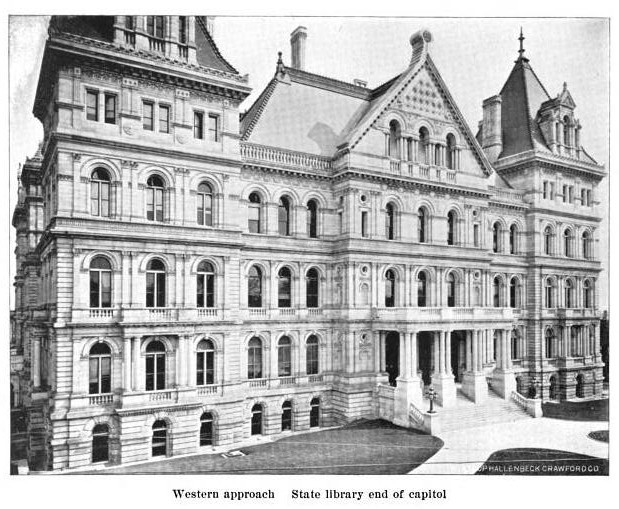
West Elevation, Pre-1911, State Capitol in Albany.

April 1, 1911, The Evening Post, Page 2, Column 1, SALVORS OF STATE PAPERS,

SEARCHERS IN CAPITOL RUINS FOUND REWARD.

Fire at Albany Passed Over a Number of important Dutch and English Colonial Documents, and After Much Labor These Were Recovered -- Washington's Sword Still Buried.

Although for the greater portion of the 300,000 manuscripts in the State Library are a total loss, as a consequence of the fire at Albany, a large number---besides the most valuable ones saved through the foresight of Dr. Andrew S. Draper, commissioner of education---were rescued from the debris after two days' work on the part of James I. Wyer, jr., director, and a corps of salvors.

By four o'clock yesterday afternoon the last of the drenched and charred manuscripts had been removed in baskets to a temporary asylum provided by the Rt. Rev. William C. Doune, bishop of Albany, in a house at No. 163 State Street. Arnold J. T. Van Laer, State archivist, to whom intimate knowledge of the exact location of the more valuable treasures was largely due the success of the work, announced that all the debris in the manuscript room had been gone over. For two days Mr. Van Laer and his assitants, including a squad of laborers furnished by the Governor and a guard of soldiers by Adjt.-Gen. Verbeck, had worked over the debris. When they started the books were still burning, and in spite of the liberal use of the hose fire kept breaking out among the papers. Twice Thursday night the soldiers on guard had to turn a stream on the debris dug up the day before, and even the manuscripts which had been removed by hand to the neighboring Senate Judiciary Committee room burst once into flame.

IMPORTANT RECORDS SAVED.

As a result of the two days' work about a hunderd of the most important early books of record, dating from the Dutch and English period, were saved intact, and several hundred more or less charred, but capable of restoration. In addition to these, many hundred books and documents were taken out, from which valuable material may be recovered. Three bucketfuls of medals and coins were also recovered. Stored with the manuscripts were five memorial swords. Four of these, those presented to Gen. Worth in the war of 1812, were rescued, but the fifth and most valuable, that presented to George Washington by Frederick the Great, was not found up to a late hour last night, although four men spent all day digging for it.

I. N. Phelps Stokes, an architect of this city, whose interest in old New York records led him to offer his services to the New York Public Library, went to Albany Thursday to report on the situation, and assisted Mr. Van Laer in the direction of the work.

"When we first looked over the burned building," said Mr. Stokes, "we thought it would be impossible to get into the manuscript room at all from the inside. The usual approach from the main library was entirely blocked by debris. We decided we should have to get in by a ladder to one of the third floor windows. Through Mr. Ware, the State architect, we had already obtained from the fire chief permission to do this when we discovered we could get in through a seldom-used side door.

"The manuscript room is about twenty by forty feet, divided into three stories by mezzanine floors. The bottom floor had apparently been used as an office or reference room, while the bulk of the valuable manuscripts were stored in shelves and bookcases on the second floor.

BIG CORPS AT WORK.

"It was about noon when we finally got into the room. The whole place was filled with smoke, and the fire was by no means all out, in spite of a steady stream of water from a fire hose which had been fastened to the doorr. Dragging the hose with us, we climbed up by a ladder---the wooden stairs had been burnt out---to the second floor. It looked at first a pretty hopeless job. The smoke here was so thick you could not see the length of the room, and the debris, which was piled six feet deep in the aisles, was still actively burning.

"We soon found that some of the books along the wall were still intact---slightly charred, but otherwise in good condition. That encouraged us. We went back and got the firemen and soldiers and the twenty men the Governor had given us. All material dug out of the aisles by the men was passed along by a line of soldiers to the Senate Fudiciary Committee room, where it was piled on the floor and roughly sorted. Mr. Van Laer had given instructions that nothing was to be thrown away, and everything was passed on personally by him before it was discarded.

"We started work in the aisles. The room had evidently been a regular flue, and the flames that swept along the ceiling had completely consumed all the material on the upper shelves. The lower shelves, however, had been protected by a heavy counter, as well as by the stuff which had fallen from above. It was from these that we generally obtained practically all the material that was saved.

"Every once in a while we had to stop work to play the hose. It was not always easy to keep the men working. They got discouraged by the steady rain that poured down on them from the hoses that were being played on the floors up above. Finally we had to ask permission to have the water temporarily turned off above our heads. The water in the corridors was by this time everywhere ankle deep, in spite of the efforts of the vacume cleaner, which had been going all day sucking the water out.

"Before night we had removed most of the books from the lower shelves. These were among the oldest and most valuable of the material saved. This was all stored temporarily in the committee room, left for the night under guard of soldiers and firemen. Twice during the night the fire broke out again in the manuscript room, in spite of its long soaking, and the material not yet removed had to be still further damaged by another flood. Even the material that had been removed started smouldering again during the night.

"The work was continued yesterday. The most valuable manuscripts were carried in baskets, two soldiers to each, down to a house at No. 163 State St., where space was put at the disposal of the library by Bishop Doune for temporary quarters. Stacks were built in the basement with shelves of laths, so as to allow a free circulation of air. On these the manuscripts were spread out, one at a time.

"Meanwhile, excavation was still going on in the manuscript room. Many more early records were discovered, notably one of the earliest books af Dutch patents, dating from about 1640, and some few of the Clinton and Johnson papers, all of which had been reported as lost. By four o'clock everything had been removed, and roughly sorted. To-day the rest of the material will be taken down to the temporary quarters in State Street, and the work of reassorting will be begun."

VALUABLE PAPERS THROWN AWAY.

ALBANT, April 1.—The State historian, Victor H. Paltsits, states that many valuable records in the State Library have bean lost through the haste of workman in casting debris from the burned Capitol into the street. Mr. Paltsits says he picked up yesterday about 500 feet from where the papers were being thrown from the building, a conveyance af land in the town of Groton bearing tha date of 1723. The writing was intact, and the State historian asserts that many of the papers which now litter the streets in the vicinity of the Capitol may have been documents of great value. Mr. Paltsits has tendered his services to the State librarian, Mr. Wyer, in the work of rehabilitating the library.

Commissioner Draper of the State Education Department estimates that only 10 per cent. of the 300,000 historical manuscripts will be salvaged from the wreckage of the library. The debris-strewn streets have become so unsightly that the city authorities asked John Bowe, State superintendent of public building., if something could not be done to prevent the paper from drifting about. Gov. Dix at once instructed Superintendent Bowe to arrange some other method for removing the wreckage.

The law provides that the court of claims may sit in any county in the state, and the sheriff of the county is expected to find adequate quarters. The Court of Claims rooms was one of those swept by the flames, and the judges have decided to hold their next term on April 17 in Syracuse. While it is planned to hold terms in various parts of the State until the repairs to the courtroom are completed, the clerical force will make its headquarters in Albany.

Relic hunters have become so active since the fire that all passes to the Capitol have been revoked and new ones are issued only to those who have business within the building.

Tuesday, November 29, 2011

March 29, 1911, The Evening Post, Page 1, Column 5, RUIN IN CAPITOL,

Damage $5,000,000 or More by Fire

THE STATE LIBRARY DESTROYED

Priceless Documents, Relics, and Manuscripts, Besides 600,000 Volumes, Burned—Costly Grand Staircase, Assembly and Senate Chambers, and Many State Departments Badly Damaged -- Court of Appeals Escaped -- Flames Raged Four Hours Before Being Controlled -- No Fire-Fighting Appliances to Quell Outbreak, Trifling at Start.

(Special Dispatch to The Evening Post )

ALBANY. March 29.—Defective insulation in the Assembly Library on the third floor of the State Capitol started a fire early this morning that destroyed the west wing of the $27,000,000 building. The State Library was completely destroyed, and both the Senate and Assembly chambers burned out. The loss is variously estimated at between $5,000,000 and $8,000,000, but in some respects it is incalculable, for many of the records and documents in the State Library can never be replaced.

One watchman, Samuel Abbott, who was assigned to the State Library, is missing, and is believed to have lost his life. Several firemen were overcome with smoke, or injured by falling stones from the walls.

LACK OF MEANS TO FIGHT FIRE.

It cannot be too emphatically stated that, had there been any provisions whatever in the Capitol against fire, the loss would have been relatively small, and the fire itself could easily have been confined to the room in which it started. The Evening Post's correspondent was one of four men on the third floor when the fire was discovered, and was one of the first to reach the room in which the blaze started. At that time only a desk and book-case in the Assembly library were ablaze, and the fire could have been extinguished by a couple of hand-grenades or a few bucketfuls of water. But there were no grenades, no fire buckets, and no fire hydrants, save a few small ones on the sixth floor for sprinkling.

There was delay also in getting streams of water on the fire, even after the firemen arrived, and it was fully twenty-five minutes after the alarm was turned in before a fireman reached the floor where the fire was burning. It was almost three-quarters of an hour before the firemen had streams playing on the fire from the interior of the building. The firemen had the excuse, to be sure, that the fire was a difficult one to fight, and that it was a problem how to get the fire hose up to a point where it could be effectively used. But to the total lack of fire appliances of any sort is due the enormous and irreparable loss which the State will be called upon to sustain.

HISTORY OF THE FIRE FROM ITS START.

Here is the story of the fire, as seen by the Evening Post's correspondent from his point of vantage within the burning building:

At 2:20 o'clock the Capitol was practically deserted save for the night watchmen, who are supposed to be posted one to a floor; H. S. Gorham, the manager of the Postal Telegraph office in the Capitol. Dwight Gowey, a proof-reader to the Assembly, and two newspaper correspondents. At that time, Gowey, who had been working late in the Assembly document room, returned to the Assembly library, which was located in the rear of the Assembly chamber, and separated from it by the clerks' room and the stenographers' lobby. Gowey intended to close his desk, which was located in a corner of the library, and go home to bed. As he opened the library door he was met with a cloud of smoke, and saw that one of the high book-shelves, immediately behind his desk, was all ablaze. He rushed at once into the corridor, shouting for the watchman.

"What's the trouble," called one of the correspondents.

"There's a fire in the Assembly Library and I'm afraid it may be a bad one," Gowey called back.

Gorham and the correspondents ran around the corridor to the west wing of the building. Smoke at that time was pouring from the Assembly library, but it was possible to enter the room. When your corespondent caught a first glimpse of the fire. Gowey's desk was ablaze and the book shelves adjoining it were a mass of flames, which were rapidly climbing upward among the books, piled to a height of thirty feet from the floor. A balcony ran about the library, forming a sort of mezzanine floor some twelve feet from the floor itself, and the flames had already reached this balcony, although apparently nothing but the books were at that time on fire.

FIREMEN LATE AND HELPLESS ON ARRIVAL.

Meanwhile Gowey had found a watchman and he had turned in an alarm. It was fully twenty-five minutes before any firemen put in an appearance. By that time the fire had spread, with indescribable rapidity, among the book shelves; the electric light bulbs were exploding, and the whole room had the appearance of a furnace.

The firemen stood helplessly watching it for a moment, apparently unable to decide what to do. From the street, however, a feeble stream was soon playing against the Assembly library windows. Before the fire hose had been hauled up the winding million dollar staircase to the third floor, the flames had burst from the library into the hallway and lobby, and the firemen were forced back by the heat and dense, suffocating smoke before they could get a stream into the blazing library.

At this time, however, the fire chief expressed confidence that he would be able to confine the fire to the rooms adjacent to the Assembly chamber. He was emphatic in his statement that there was little or no danger of the fire extending to the State Library, which occupied the greater part of the west wing fronting on Capitol Place from the third floor up. Ten minutes later when the flames had already reached the head of the great western stairway and were swirling up the elevator shaft in that corner of the building, he changed his mind and declared that he feared the State Library was in danger.

STATE LIBRARY DESTRUCTION.

The fire entered the State Library wing by way of the binding room located on the fifth floor. But this was fully an hour and a half after the fire started, and, in that time, had there been anyone on hand to do the work, many of the priceless books and records in the library could have been saved. One of the most striking facts of the fire was the total inefficiency or inadequacy of the employees of the State superintendent of buildings. They stood about idly in groups on the first floor of the building, but they did not venture above stairs, and many thousands of dollars' worth of State property was needlessly sacrificed as a result.

Step by step the firemen were forced to retreat before the advancing flames, until, with a roar, the fire burst into the State Library. It was then a foregone conclusion that the whole library was doomed. The firemen confessed themselves helpless, and gave up any attempt to check the fiery advance. The books and papers, many of them resting on pine or walnut shelves, proved ready fuel for the flames, and within thirty minutes after the flames had passed the stone partitions, the library was afire from end to end.

At this time, with the entire west wing ablaze, the sight across the broad central court from the eastern part of the building was one never to be forgotten. The mass of flames reached higher than the eye could see from the windows looking out on the court. Within the court enclosure the sparks fell in showers. The smoke in the corridors was so thick that it was impossible to stand it long, and the few spectators on the third floor, as well as the helpless firemen, had to rush to the windows every few minutes for a breath of fresh air. It was impossible to recognize a person, even across the narrow corridors. The flames had driven the fire-fighters out of the western corridors altogether within five minutes after the spread into the library, and they were compelled to lay new lines of hose along the corridors running alongside the Senate chamber and on the fourth floor immediately above.

Here the fire was fiercest, and here the hardest and most successful fight against the advancing flames was waged. The fire chief realized that if the fire once got headway in the region above the Senate chamber the whole structure was doomed. But the fight was successful, and the fire was stopped before it had passed into the north wing.

NOTORIOUS ASSEMBLY CEILING ABLAZE.

On the Assembly side the fire, which had died down for a while, now broke out a new, and soon the notorious Sheehan papier-mache ceiling, which was the cause of so much scandal back in 1886, was seen to be blazing. A great section of it directly over the Speaker's desk, fell with a crash, and two of the enormous chandeliers fell with it. A body of volunteer firemen was organized among the half-dozen Assemblymen, Senators, and newspaper correspondents who had by this time put in an appearance, and a line of hose was hoisted and pulled in through the windows, and a stream of water was soon playing on the crumbling papier-mache. Almost every part of the building was soon flooded with water, and the loss from this cause is estimated to be extremely large.

IMMENSE LOSSES: NO INSURANCE.

The State architect roughly placed the loss on the structure alone at between $3,000,000 and $5,000,000. The loss on furnishings is many thousands if not a million, and that on the library and other public records is incalculable. A conservative estimate places the entire loss at $8,000,000. The State carried no insurance on any part of the Capitol or its contents.

Andrew S. Draper, commissioner of education, said that while the loss on the State Library was deplorable and included many documents and manuscripts which it would be impossible to replace, some of the more priceless of the States historic possessions, such as Washington's Farewell Address and other papers, and Lincoln's Emancipation Proclamation, had been removed to his fireproof safe on the first floor of the building and were unharmed.

W. T. A.

Monday, November 28, 2011

Roasting Dix, April 27, 1911

Sung to the tune of "A Big Night To-night."

The Big Fire That Night.

Young Goldberg said to Levy: I have a fond desire.
Things are very quiet here, why don't we pull a fire.
We must have some excitement, what is it that we can do?
Why don't we send a lot of bills a-blazing up the flue?
Then Levy smiled with joy--a match is Aaron's toy.

Chorus--

O! it was grand how the fire burned that night.
Big light that night, big night that night;
O! but it was such an elegant sight.
Yes, it sure was a grand fire that night.

McCabe rolled out of slumber and gazed up at the flames,
Then he got his little notebook out and started writing names.
Of forty-seven hundred Albanians who would get
Some needed places on the works before the fire was wet.
As flames ate up the place, there was joy in Packy's face.

Chorus--

It looked to Pack, like a big night that night.
Big night that night, any thing that night;
He sat and sang: "There'll be work for the gang.
They'll be grateful for this fire to-night."

A million books were burning and they made lively fuel,
Including Draper's essays on "Why children go to school;"
The firemen worked like heroes, and smoke and flame endured,
Then when the stuff was all burned up they had it all insured;
And Levy said: "We guess--the fire's a big success."

Chorus--

O! it was grand how the fire burned that night.
Beautiful sight, O! what a sight.
And since, Packy's crew has had plenty to do,
It sure was a big night that night.

April 28, 1911, Albany Evening Journal, Page 9, Column 1, GOV. DIX GOOD ON TAKING JOKES,

Saturday, November 19, 2011

Many Valuable Papers Saved at the Capitol.

March 31, 1911, New-York Tribune, Page 3, MANY VALUABLE PAPERS SAVED AT THE CAPITOL,


WRECK OF THE STATE LIBRARY IN THE CAPITOL AT ALBANY.

(Photograph by the American Press Association)

Commissioner Draper Gives Out List of Priceless Historical Documents Recovered.

TALK OF LARGER BUILDING.

Abbott's Body Not Found -- Bayne Accuses Firemen of Inefficiency -- Assembly and Judiciary Records Gone.

(By Telegraph to The Tribune.)

Albany, March 30.--With the firemen still pouring tons of water into the smouldering ruins of the broad western section of the Capitol building to-night, the whole imposing front of the great structure was brilliantly lighted, an effect which dispelled, in a large measure, the gloom which hung over Capitol Hill the night before. Hundreds of workmen were employed in cleaning up the debris in the fireswept rooms where the floors had held and were not dangerous to work on. They threw the blackened and charred remnants of thousands of volumes from the Senate law library in shovelfuls out of the gaping windows. The yard and streets adjoining the western end of the Capitol were covered with the white remnants of documents and book leaves.

A more thorough examination to-day of the sections of the building in the fire zone by State Architect Ware and his corps of assistants found many of the inside walls in danger of falling, and the order went out to the workmen not to venture into the main section of the west wing where the state library was located and the roof had fallen in. There was also danger, it was said, of parts of the outside walls on the northwest corner falling. The police lines were extended and pedestrians not allowed to pass on that side of the building through State street. The massive tower on that corner of the structure crumbled and fell during the fire. The families occupying houses in State street opposite the Capitol were not allowed to reenter their homes.

A score of employes of the State Educational Department were rewarded in their explorations to-day of the outlying galleries of the great state library, where some of the many state archives and priceless historical documents were found to be intact.

Dr. Draper Greatly Pleased.

Dr, Andrew S. Draper, Commissioner of Education, was highly pleased over the rescue of even a small portion of these irreplaceable records. He was hopeful that other books and records would be found in a fair state of preservation as the search was continued. Twenty-three volumes of the documentary records of the War of 1812, which had an inestimable historical value, were recovered practically unharmed. Fifty volumes of the Stevens set of facsimiles of English papers, bearing on the history of relations of the colonies and England, were also recovered.

But the great bulk of books and documents stored in the library were destroyed.

Dr. Draper gave out a complete list of the articles and manuscripts which were saved in this way. They include many valuable New York State documents of the seventeenth and eighteenth centuries. The various constitutions of the State of New York, beginning with that of 1777, were among them. There were also the autographs of the signers of the Declaration of Independence in a bound volume; the famous Major Andre papers., Washington's opinion of the surviving generals of the Revolution, written in the winter of 1791-92, various other Washington documents, and the invaluable Van Rensselaer papers.

The perilous condition of the Capitol ruins makes systematic search for the body of Samuel J. Abbott, the veteran night watchman of the State Library, who was lost in the fire, impossible. Mr. Abbott's son, who, with his sister, came here from West Newton, Mass., led the search to-day with several workmen who have been assigned to him for that purpose by Governor Dix. They dug all day on the edge of the pile of stone and twisted iron which fell to the third floor with the roof over the State Library. It is thought that Abbott was first suffocated by the smoke near his desk in the library and then buried there under the falling stone and iron. The searchers had to proceed cautiously on account of the danger of weakened floors and walls where they worked. No trace of the body had been found to-night.

Plans for Restoration.

With the various state departments, whose offices in the Capitol were rendered useless by the fire, fairly well settled to-day in new and temporary quarters, the wheels began to move in the direction of plans for the restoration of the damaged part of the building. An emergency appropriation bill for $100,000 for immediate repairs for the building and the tearing down of such walls as are in a dangerous condition, was introduced in both houses of the Legislature. The bills will be reported favorably by the Finance committees of the two houses, and will pass without delay. The State Trustees of Public Buildings, who are empowered to expend the appropriation, met this afternoon to consider the most pressing needs for which the money can be used.

Many suggestions by legislators and others as to what the state may do relative to rebuilding the burned portions of the Capitol are being made. Some believe that the state should acquire all the property as far west as Swan street, a block beyond the present Capitol grounds, and extend the Capitol to the present western limits of the park. They point out that the state departments are constantly spreading out and taking more room in adjacent buildings, and that even after the new Education Building is completed and occupied it will be found that the Capitol will be too small to accommodate all the requirements of the state departments.

State Architect Ware isn't concerned with these various suggestions, but is going ahead with immediate plans to remedy the present condition of the building. It was said that probably the building itself could be restored to its original condition at a cost of about $4,000,000. This is somewhat under the estimate made by the State Architect yesterday, before he and his men had an opportunity to make a more careful examination of conditions.

It is said that an appropriation of this size would practically wipe out the estimated surplus remaining in the State Treasury at the end of the present fiscal year. The state cannot bond itself for this rebuilding, and the money must be taken directly from the treasury.

State Architect's Statement.

The following statement was given out to-night on behalf of Mr. Ware as a result of to-day's examination of the burned portions of the Capitol.

The exterior walls of the pavilions on the northwest and southwest corners and the westerly gables appear to be plumb. Some of the interior walls of the library are in a very dangerous condition and should be shored up immediately. The dormers on the southwesterly pavilion are also in a dangerous condition and will require immediate shoring or tearing down. The State Architect gave instructions to the Superintendent of Buildings to keep all cellar drains and manholes open so as to afford easy outlet for the tons of water which are being poured into the building. All of this water is being taken off by the sewers, and, , so far as it can be ascertained, none of it can affect the foundations.

Examination of the Assembly ceiling made by the State Architect this morning shows that the westerly portion of it has been badly damaged by fire and water. The damage affects primarily the panels between the beams, which can be taken out and replaced, although in a few instances the beams themselves will have to be renewed.

The State Architect conferred with William Church Osborn, the Governor's counsel, regarding suitable steps to be taken by the trustees of public buildings to shore up the unsafe portions of the building, remove valuable furniture, manuscripts, etc., of the various state departments that have not been damaged, remove the rubbish and close off the damaged portion of the building pending the preparation of plans for reconstruction.

Governor Dix was at the Capitol early to-day and spent several hours at his office. He conferred with State Architect Ware and other state officials. The Governor, it was said, expressed the wish for an early investigation or inquiry into the causes which led up to the great destruction done by the fire. Senator Howard R. Bayne, of Richmond County, suggested on the floor of the Senate, when it met in the City Hall to-day, that the majority leader of the upper house should take steps to institute an investigation of the fire by the Legislature.

Senator Bayne, who was on the scene of the fire early and joined with the firemen in fighting the flames inside the Capitol, said to-day that the local fire department showed a serious inefficiency in handling the fire. They appeared to be utterly unable, with the equipment they had and from a lack of experience, to cope with a sizable fire like that at the Capitol.

Senator Bayne asserted that it was some time before other firemen appeared on the scene. They found that the hose was too short to reach the vital points of the fire after they got it in the building, he said.

Several of the state officials declared to-day that a rigid investigation should be made forthwith in order to provide better means for fire protection at the Capitol in the future. The Secretary of State, Mr. Lazansky, advocated the erection of a fire-proof vault in which to keep valuable documents. He suggested also the creation of a separate fire department to guard the Capitol against fire.

The destruction of the records of the Judiciary Committee of the Assembly will delay legislation more seriously than was at first realized. This committee had many of the most important bills introduced at the present session, including the direct nominations and women suffrage measures and all constitutional amendments. The committee will now have to consult each member of the Senate and Assembly to get a record of their bills before it, and it has no way of learning the objections to bills or of requests for hearings from outside organizations unless these organizations again communicate their requests and objections to the chairman of the committee. It may take two or three months to do all this, it was said.

The loss of the Assembly library will not handicap the lower legislative house to any great extent, since the files of bills can be replaced from the duplicates kept in the Senate library, which escaped unscathed. This applies only to the bills of the current session. The files covering the legislation of the last twenty years were kept on the Assembly side and were destroyed.

Elmer Blair, who was Deputy State Superintendent of Public Buildings until last February, gave out a statement declaring that his department had called attention to the inadequate wiring of the building in several of its annual reports, but that an appropriation for rewiring had been steadily denied.

"The electric wiring in the Capitol was installed years ago," said Mr. Blair, "and is out of date. I do not believe there is an insurance company in the country that would have taken insurance on a building wired as the Capitol was."

Thursday, November 17, 2011

The colonial journals were turned over to the State Library 10 days before the fire.

April 3, 1911, Albany Evening Journal, Page 1, GUARD DOUBLED AT THE CAPITOL

James I. Wyer Jr., director of the state library, said, relative to the building up of a new library:

"I believe the state of New York will went to perpetuate the state library as one of the greatest libraries of the world. It was third in size and importance in the United States. To do that a large appropriation must be forthcoming at the outset to put this library on a working basis when it goes into the new state education building, If the staff of the library is to be kept intact, and the state library school eventually retained in Albany, this appropriation must come speedily, and the work of the rebuilding of the collection must be pushed with all dispatch."

The colonial journals which have been in the custody of the secretary of state since their publication, were turned over to the state library 10 days before the fire. They are believed to be entirely lost.

Transcript:

From Capitol Stories, by C. R. Roseberry (1982)

From Capitol Stories, by C. R. Roseberry (1982)
page 119
Meanwhile the Assembly library had become a furnace. Flames exploded through its glass transom and also through rear windows to leap catercorner across an air-shaft into the State Library corridor. A wooden mezzanine which had been erected above the north portion of that corridor for extra book shelving took fire on the instant. The two newsmen beat a retreat to where the Senate corridor turns off at right angles, and watched from there.

page 120
Until now, Fire Chief William W. Bridgeford was confident of keeping the fire out of the State Library. The stone partition was thick between the corridor and the library, the only breach being the central door to the main reading room and a high row of window panes above it. Firemen played three streams into the wall of fire, expecting to confine it to the north half of the corridor. Chief Bridgeford had Mullins go back downstairs and fetch an emergency key to the library. Mullins was fumbling with the key at the heavy oaken door when a sheet of flame swept along the arched ceiling of the corridor. The high window panes burst and a strong draft seemed to suck the flames into the library, where they leaped from shelf to shelf. The Chief ordered his men to get inside the main reading room and work their way south, heading off the blaze, “if it were possible to live there.” They tried to rush in, but heat scorched their hands so they couldn’t hold on to their nozzles.

Once the fire had invaded the reading room, it was clear that the State Library would have to be written off. Its own carefully prepared firefighting apparatus was worthless. “A tidal wave of water was needed then,” wrote one observer.
According to Roseberry, the fire began in the Assembly library, (which is the room marked 346 on the plan below) then the "[f]lames exploded through its glass transom and also through rear windows to leap catercorner across an air-shaft into the State Library corridor." However, this would not have been simultaneous. The fire would have first had to break through the glass transom over the doorway to Room 346, and then enter into the east/west hallway that leads from the rear of the Assembly chamber to the Assemblymen's lavatory, indicated on the plan by a row of stalls. The flames would then have had to break through the small window fenestrating the lavatory into the air shaft, just north of the Great Western Stairway, in order to jump "catercorner" to break through the larger windows between the air shaft and the corridor marked on the plan as Room 344. However, at this point fire wouldn't have entered the State Library proper, those rooms to the west of the corridor marked 339 and 340 on the plan, and separated by thick masonry wall, and, one assumes, heavy oak doors. According to Roseberry's scenario, the fire extended out from Corridor 344 to enter into the stone hallway of the Great Western Stairway to the east of the entrance to the Main Reading Room of the State Library, marked as Room 338 on the plan (but most often referred to as Room 35 in the various literature about the Capitol and Library,) where "a sheet of flame swept along the arched ceiling of the corridor [and the] high window panes burst." This would be the fourth set of windows that the flames were able to penetrate. However, there is no indication that such "a high row of window panes" existed above the main door of the State Library.


In fact, within the highly limited body of historic imagery extant in the public record of the State Capitol and State Library, where very little else can be proven with any assurance, the absence of such a row of window openings between the Main Reading room of the library and the stair hall to the east can be ascertained with a great deal of certainty.


Even after fire had burned away the bookcases and mezzanine, we see nothing but the solid masonry wall which stood between the library and the stair hall.


March 30, 1911, The [Syracuse NY] Post-Standard, CAPITOL FIRE-SWEPT; PRIDE OF THE STATE IS QUICKLY A WRECK. COULD HAVE PUT OUT FIRE WITH A PAIL OF WATER
ALBANY, March 29.—L. M. Howe, one of the legislative correspondents, who was in the Capitol when the fire started, gave this description of it:
"At about 2:15 this morning another newspaper man and I were working on the third floor of the Capitol, when the clerk of the Assembly Judiciary Committee, accompanied by one of the night watchmen, ran through the corridor, shouting:
"There is a fire in the Assembly library!"
"Rushing over to the room," said, Mr. Howe, "which is in the rear of the Assembly, we looked in the room and saw the desk in the southwest corner a mass of flames. 
"The fire at this time could have been easily put out with a pail or two of water. We searched in vain for anything to serve the purpose, and finally decided to close the door and keep out the draft. The night watchman ran downstairs to sound the alarm, there being no alarms in the building.
Flames Spread Rapidly. 
"While we waited for the department we could see the flames through the glass transom rapidly filling the entire apartment, but we were helpless to do anything. By the time the department reached the building the room where the desk was located was a roaring furnace, but at that time it had not spread into the hall or adjoining room.
"Before a hose could be brought into use the fire, with a loud explosion, burst simultaneously through the transom into the hall leading to the main entrance to the State library; the transom of the door leading to the room immediately east of where the fire started; and through the large plate glass window into the street.
"The tongue of flame which swept out over the transom opening into the hall appeared to instantly set fire to the underside of the wooden floor, forming the mezzanine floor that occupies the northern half of the library corridor. So fast did the fire spread over this floor that we were obliged to escape to the Senate entrance to escape being caught by the flames. In less than twenty minutes the State library had caught and the flames were shooting through the roof at the northwest angle."

Wednesday, November 16, 2011

March 30, 1911 Trenton Evening Times,

March 30, 1911 Trenton Evening Times, Page 1, Column 2, GUARDING CAPITOL WELL FROM FIRE,

New Jersey Carries Insurance on All of the State Institutions

The New Jersey State Capitol is kept constantly insured $450,000 and if it should be attacked by flames, as was the New York State House, the State would not have to stand a total loss. All buildings of the state institutions are similarly kept insured.

The Jersey State House is also completely equipped with an auxiliary fire alarm system, with fire boxes in all sections of the big building so that if a fire should break out, no matter in what part, it would only take a few steps to a box, and the pulling of a lever would instantly summon the city fire department.

There Is also a full equipment of fire extinguishers, and under the direction of State House Custodian J. W. Weseman, fire drills are held to instruct the laborers in the building in the use of the extinguishers and fighting fire in other ways.

Recently, upon the recommendation of Mr. Weseman, the Suite House Commission had fire doors placed in the huge basement, dividing it into three compartments. Now, if a fire broke out in the basement the doors could be quickly closed, confining the smoke and flames, at least for long time, to the one compartment.

During the past four or five years the old electric wiring has been overhauled and modernized, most of the wires having been placed in iron conduits, so that fire from defective wiring, it is believed, has been made practically impossible. Mr. Weseman has held several conferences during the past two or three years with Fire Chief Allen asking him for suggestions as to the better safeguarding of the State House.

Saturday, November 12, 2011

The Associated Press, March 30, 1911

March 30, 1911, Middletown [N.Y.] Times. CLEANING UP THE REFUSE AT THE STATE CAPITOL WHILE BUSINESS IS HALTED.
Pumps, Brooms and Vacuum Cleaners Are at Work.
RUGS ARE SOAKED.

(By Associated Press.)

Albany, March 30.—The work of rehabilitating the fire-swept state capitol was continued to-day with increasing vigor. The first efforts were directed to drying out portions of the great building untouched by fire, but thoroughly soaked by the tons of water poured upon the conflagration.

The Legislative leaders to-day' expected to confer with Gov. Dix and State Architect Ware regarding the appropriation necessary to repair the building.

Repair—$4,000,000.

Unofficial estimates place the cost of reconstruction at close to $4,000,000. The appropriation of this sum, it is said, would practically wipe out the estimated surplus remaining in the state treasury at the end of the present fiscal year. The state cannot bond itself for this rebuilding, and the money must be taken directly from the treasury.

The whole building except the offices and east front, are as damp as an underground cell.

The costly velvet carpets, specially woven with the state's coat of arms, are like saturated sponges. It may be necessary to purchase entire new furnishings for the Assembly chamber.

Several hundred men worked with brooms, cloths and vacuum cleaners in drying out the building. In some places the water was so deep it bad to be pumped out of the windows.

It is doubtful if any investigation will be made to learn the cause of the disaster. Whether the fire started from a glowing match end, cigarette or cigar butt tossed in the Assembly library, or from defective wiring, may never be ascertained.

Flames Still Alive.

Several fire engines pumped water into the ruins of the state library,all day, to-day. Twice the flames burst out afresh in the smoldering stacks of books, but were quickly subdued.

State Architect Ware told Governor Dix that until the ruins cooled he could not make an exact report on the situation.

A systematic search is being made for the body of Night Watchman Samuel Abbott, believed to be buried in the debris.

Workmen found large quantities of books in a good state of preservation. Some only stained on the outside by smoke and water, the pages being intact. These can be rebound. Contents of the library will not be a total loss.

Driven from Quarters.

Driven from their quarters in the capitol, the employes of several of the state departments are temporarily stationed in private office buildings, the city hall and residences in the vicinity of the capitol. The state education department has found quarters at the state normal college; the department of the adjutant general at No. 25 Washington avenue; the state tax commission at 102 State street; the state library staff at 162 State street: the state treasurer's department at the Buick automobile building, corner of Swan street and Washington avenue; the state superintendent, of weights and measures at the city hall; certain employes of the state excise department at 48 Eagle street.

Books from the public service commission department, which were removed Wednesday morning to the offices of the commission on Washington avenue, were later brought back to the capitol. Owing to the fact that the hearing room was flooded, hearings before the commission will be held for the present in the county court chambers in the county building.

Court of Appeals in New Place.

The Court of Appeals convened Wednesday in the court room of the Appellate Division, third department, but half an hour later than the usual hour of assembling, and four appeals were argued. The bench was designed for five judges and two extra chairs were brought in and a full bench of seven judges sat during the afternoon, although they were somewhat crowded.

The Court of Claims found refuge in Sheriff Platt's private office and Secretary of State Lazansky will share Judge Addington's office to-day

City Hall Crowded.

The city hall was crowded with homeless state officials. Mayor McEwan offered the use of the building to Governor Dix before 8 o'clock, and within a short time every available office was occupied. Lieutenant Governor

CLEANING UP REFUSE

(Continued from Page One.)

Conway used the mayor 's office and Speaker Frisbie took possession of the outer office, but will move into Justice Rudd's chambers on the next floor to-day. The fiscal supervisor's office was established In City Marshal Moran's apartments.

The senate met in the Common Council chamber and the assembly in the Supreme Court room, and both rooms were used for committee hearings during the afternoon. In the witness waiting room, off of the court room, the public service commission is holding its sessions. State Treasurer Kennedy has taken the recorder's court room and Attorney General Carmody the supervisors' room above. The court library is used as the senate post office and boxes are arranged by numbers on pieces of paper pasted on the long tables.

Luke McHenry, assembly clerk, is in the city comptroller's office, while the financial clerk of the assembly uses the office of the president of the Common Council

Senate Pages Dance.

The annual ball of the pages of the senate was held Wednesday evening in Odd Fellows' Hall, and neither the weather nor the conflagration failed to prevent a good attendance.

Women in Gloom.

There was a general feeling of gloom among the women of Albany yesterday for the appalling calamity that had befallen, not only the state but the city, in the burning of the capitol had left a deep impression and the affairs scheduled for yesterday were in many instances postponed and those taking place were inactive affairs, for it was the fire that was the topic for discussion and in spite of the bright sides and the apparent spring weather the “day was cold and dark and dreary," for the big building on the hill, which had been the pride of every woman in town, was seen crumbling away. There were groups and groups of women, either employed in one or other of the departments, standing about the building watching the great tongues of flame as they shot out of the windows where, perhaps only the day before, their offices, had been located. Then there were gatherings of other women huddled together and weeping as they saw the bricks and mortar fall with a crash to the street below and the great streams of water dash like a waterfall off of the once gabled towers and the red tiled roofs.

There they stayed from early morning until the darkness compelled them to go home, fascinated by the spectacular scene, and reminiscing over the capitol. the older ones telling to eager listeners the pride and the glory they felt in this wonderful building, with its impregnable buttresses which stood sentinel-like over the entire city and which was the first indication of the capital city as one came up the river either by the boat or the train. One old woman, scantily clad and with a shawl pulled over her head, made the statement that the hand of the Lord was in it, for now the state of New York could begin all over again and build its walls on a sure and firm foundation."

John H. Harrington's Editorial in The Lowell Sun in the Aftermath of the New York State Capitol Fire

March 31, 1911, The Lowell [Mass.] Sun, Editorial, [John H. Harrington, Proprietor] Page 12,

THE GREAT FIRE PERIL

In the fire horror of New York city and the subsequent destruction of the capitol at Albany not only the state of New York but the entire country has an object lesson in the need of greater vigilance in the matter of providing protection against fire. Where the laws are lax and officials still worse, there is ever present the danger of such disasters as have visited New York state during the past week. How can such calamities be averted in the future? By strict laws to minimize the danger, to promote preventive measures and to maintain well disciplined fire departments. Unless heroic measures are adopted we may find some great conflagration such as that of Chelsea, Chicago or San Francisco to wipe out an entire city. The fire peril is becoming more dangerous as the years go by, and it would seem that legislative bodies are mainly to blame for the unguarded state of affairs in many cities and states.

That any state capitol should be left in such a dangerous condition as was that of New York, is beyond comprehension. That the priceless records of the city and state should have been exposed to loss by fire at any moment shows criminal negligence. There is a bad odor about the state capitol, not because of the fire, for this odor has attached to it for many years, in fact since the capitol was built. The structure has been the scene of many grafting schemes. The very construction of the building was the pretext for all kinds of swindling operations, mismanagement and incompetency. The building itself is located on a quicksand and parts of it have been sagging and sinking for years. The building was left without a tower on the assumption that this would be added later, but subsequently it was found that the foundation and supports were not strong enough to carry a tower. Is it any wonder that the building was an accumulation of botchery when the first architect after starting the work was dropped, the second abandoned it as a bad job and the third endeavored to make the best of the tangle. The New York capitol, it may he said, represents the work of many administrations, each of which sought to make money out of the job. Much that was badly done by one administration seemed to inspire other administrations to do something still worse until by the time the capitol was finished it had cost the state $25,000,000 and was not worth half the amount. But bad as it was known to be, nobody supposed it was a fire trap that would burn up in a few hours in spite of all the efforts of fire companies.

There is here a sorry spectacle in the work of public construction and fire protection. How could sane men construct and furnish a state capitol without a safety vault for the preservation of valuable records? There may have been some apology of this kind, but it did not save the records from destruction. The whole affair is a disgrace to the state and especially to the political bosses and leaders, from Lucius Robinson to John A. Dix and including Theodore Roosevelt, Tom Platt and David B. Hill. It would be difficult to say now just where the weight of the blame lay for making the state capitol a tinder box, but it is quite probable that one party is as much to blame for this result as the other. Both apparently shared in the extravagance, mismanagement and incompetence that produced the monstrosity.

It is stated that $4,000,000 will repair the damage. In all probability the expense will be more nearly $10,000,000, and then the capitol will be still a mass of defects, a building scarcely sufficient to support its own weight. Many New York citizens have cause to regret that the building was not destroyed outright so that a capitol might be built to meet all requirements in a decent way and so that the state might eventually have a state capitol that in architecture and convenience might compare with some of the best in the country.