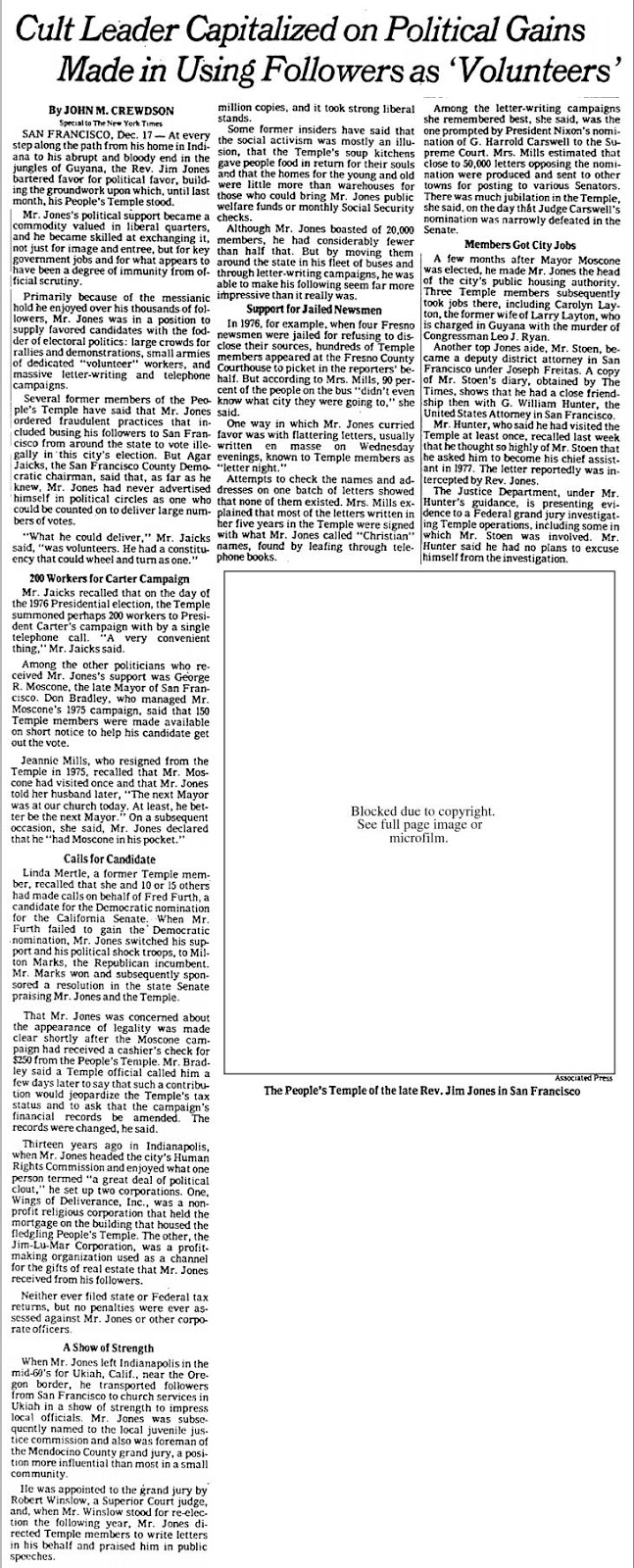
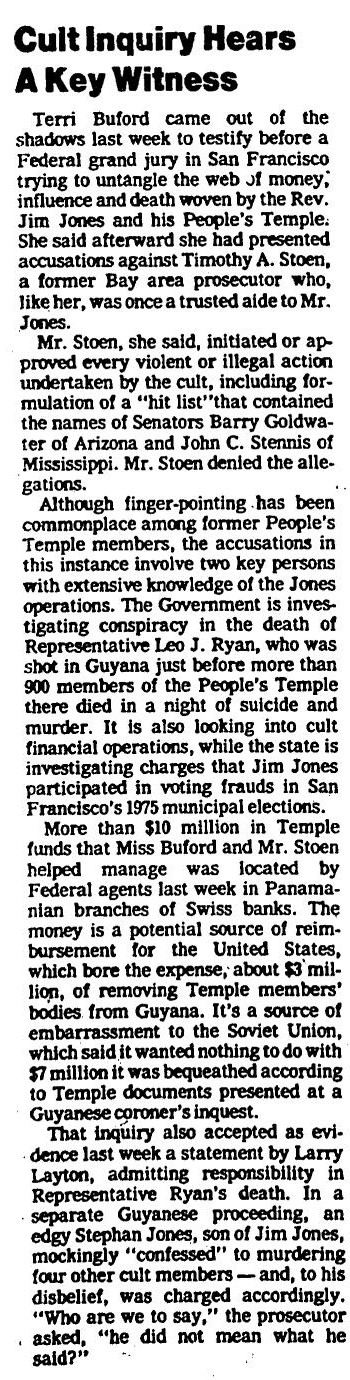
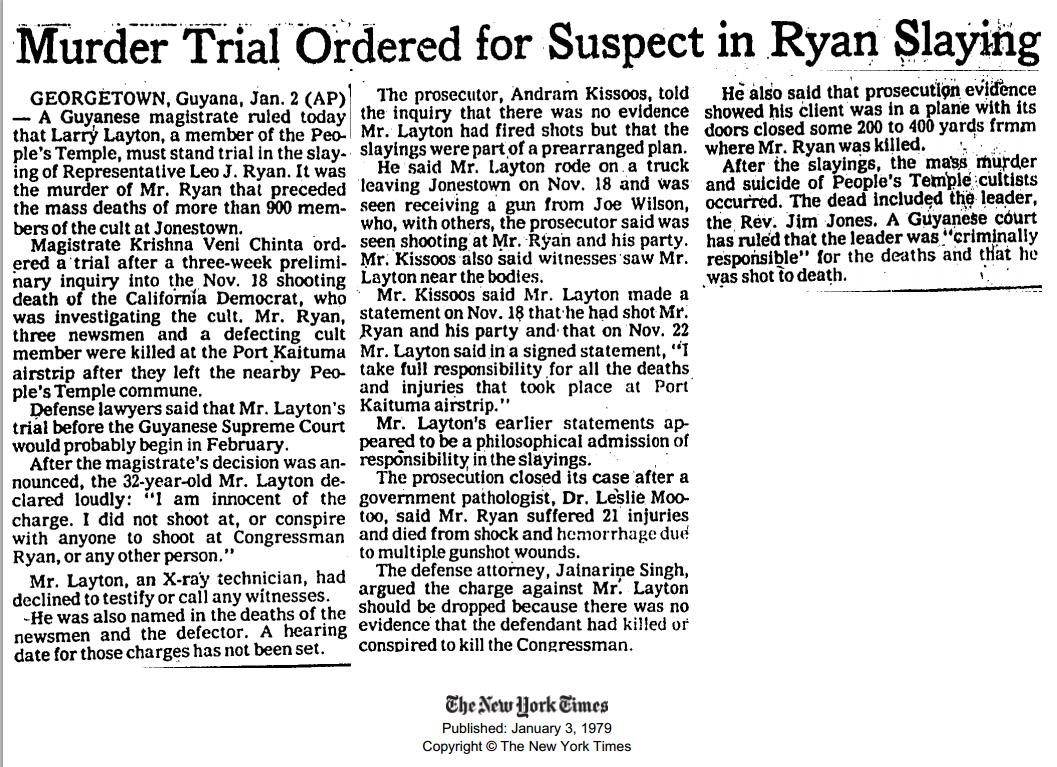
, by Joseph B. Treaster,
, by Joseph B. Treaster, [
, by John M. Crewdson,
, by Joseph B. Treaster,
, by John M. Crewdson,
, by Joseph B. Treaster,
, by Joseph B. Treaster,
, by Lawrence K. Altman,
, by John M. Crewdson,
, by Joseph B. Treaster,
, by Joseph B. Treaster,
________________________________________________________________________________
_________________________________________________________________________________
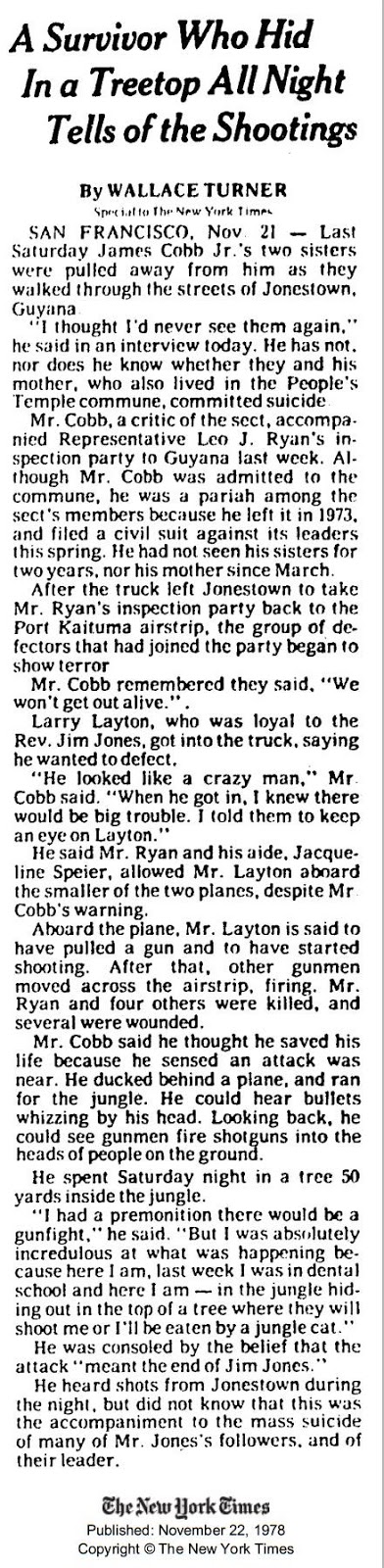
Larry Layton, who was loyal to the Rev. Jim Jones, got into the truck, saying he wanted to defect. "He looked like a crazy man." Mr. Cobb said. "When he got in,
________________________________________________________________________________
_________________________________________________________________________________
, by Joseph B. Treaster,
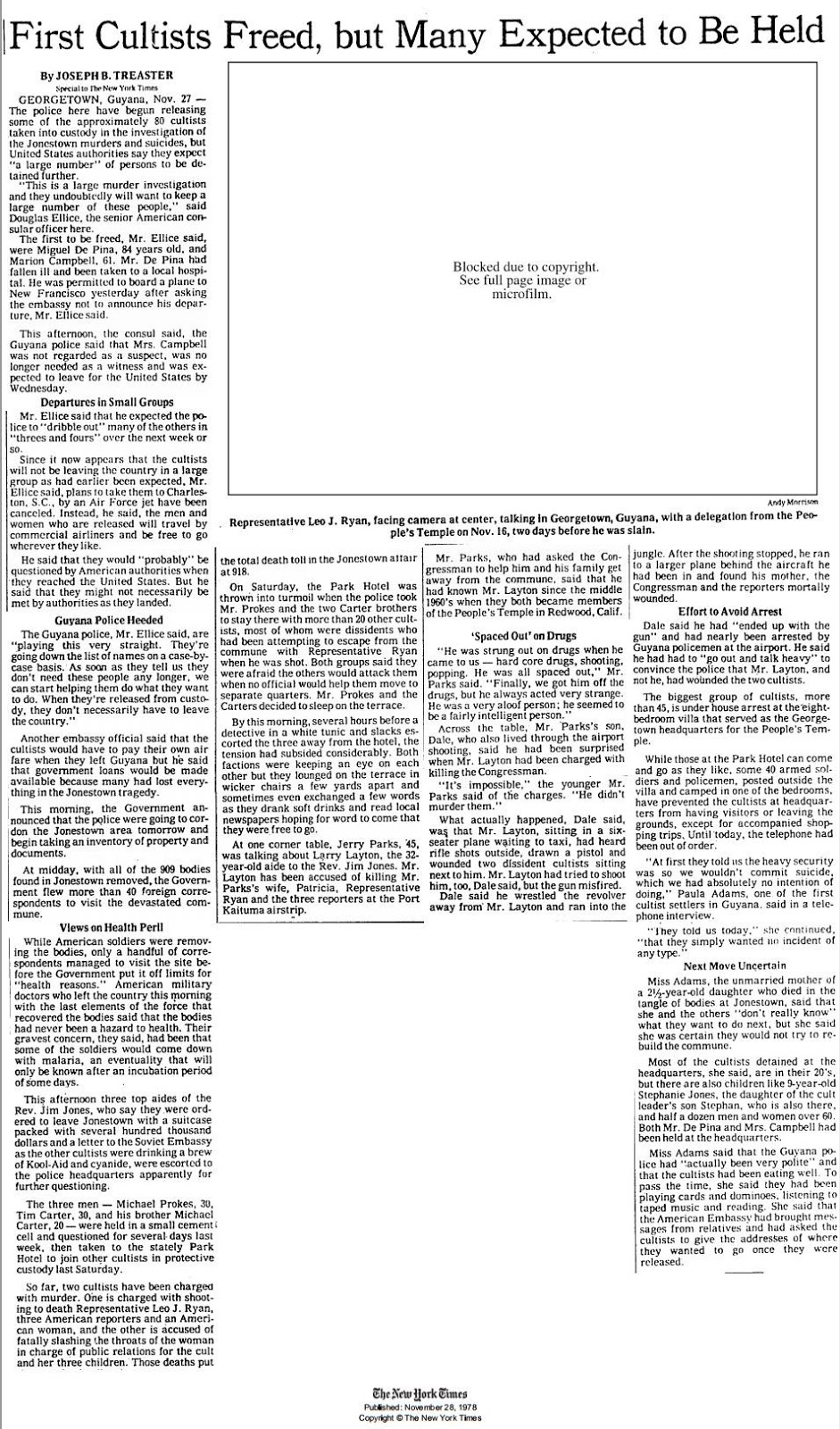
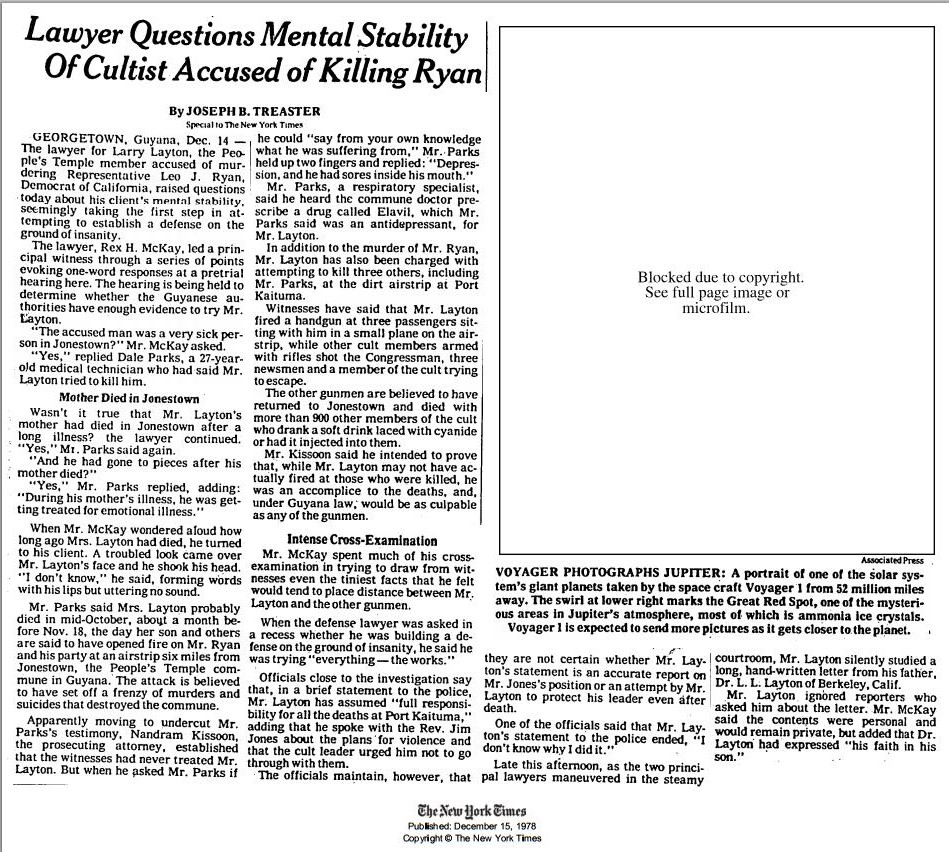
At one corner table, Jerry Parks, 45, was talking about Larry Layton, the 32 year- old aide to the Rev. Jim Jones. Mr. Layton has been accused of killing Mr. Park's wife, Patricia, Representative Ryan and the three reporters at the Port Kaituma airstrip.
Mr. Parks, who had asked the Congressman to help him and his family get away from the commune, said that he had known Mr. Layton since the middle 1960's when they both became members of the People's Temple in Redwood, Calif.
"He was strung out on drugs when he came to us --- hard core drugs, shooting, popping. He was all spaced out," Mr. Parks said. "Finally, we got him off the drugs, but he always acted very strange. He was a very aloof person; he seemed to be a fairly intelligent person."
_________________________________________________________________________________
, by Joseph B. Treaster, [
_________________________________________________________________________________
Mrs. Blakey is the sister of Larry Layton, who is being held in connection with the slaying of
_________________________________________________________________________________
; A Plot Is Suspected, by John M. Crewdson, [
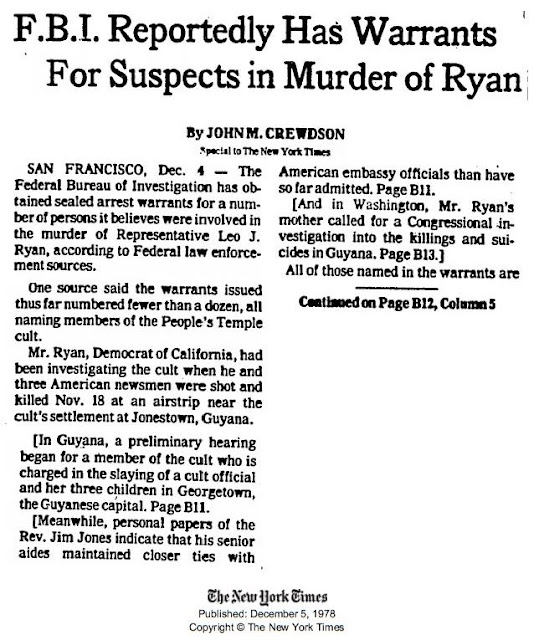
"Larry Layton, a member of the Temple and until two weeks ago a top aide to the Rev. Jim Jones, the sect's founder and leader, is being held by the Guyanese authorities on murder charges in connection with the death of Mr. Ryan, three American newsmen who accompanied him on a fact-finding trip to Jonestown and a woman who was trying to defect from the sect."
________________________________________________________________________________
, by Joseph B. Treaster,
_________________________________________________________________________________
, by John M. Crewdson,
__________________________________________________________________________________
, by Joseph B. Treaster,
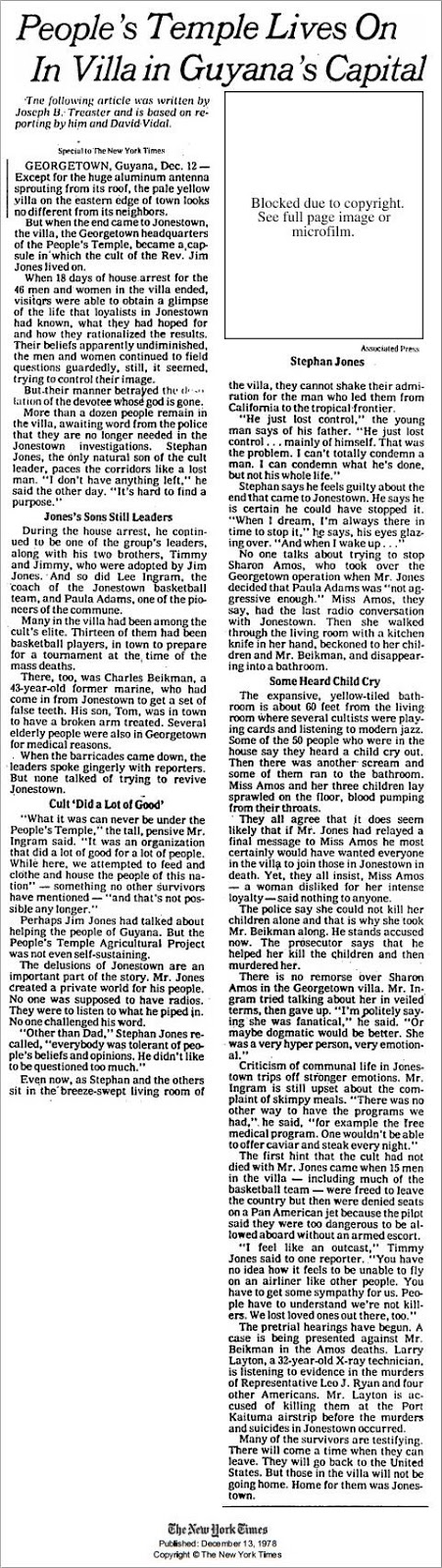
GEORGETOWN, Guyana, Dec. 4-- Moments after she finished what is believed to be the last radio conversation with Jonestown, Sharon Amos walked briskly through the living room of the People's Temple headquarters here with a knife in her hand, witnesses said today.
__________________________________________________________________________________
___________________________________________________________________________________
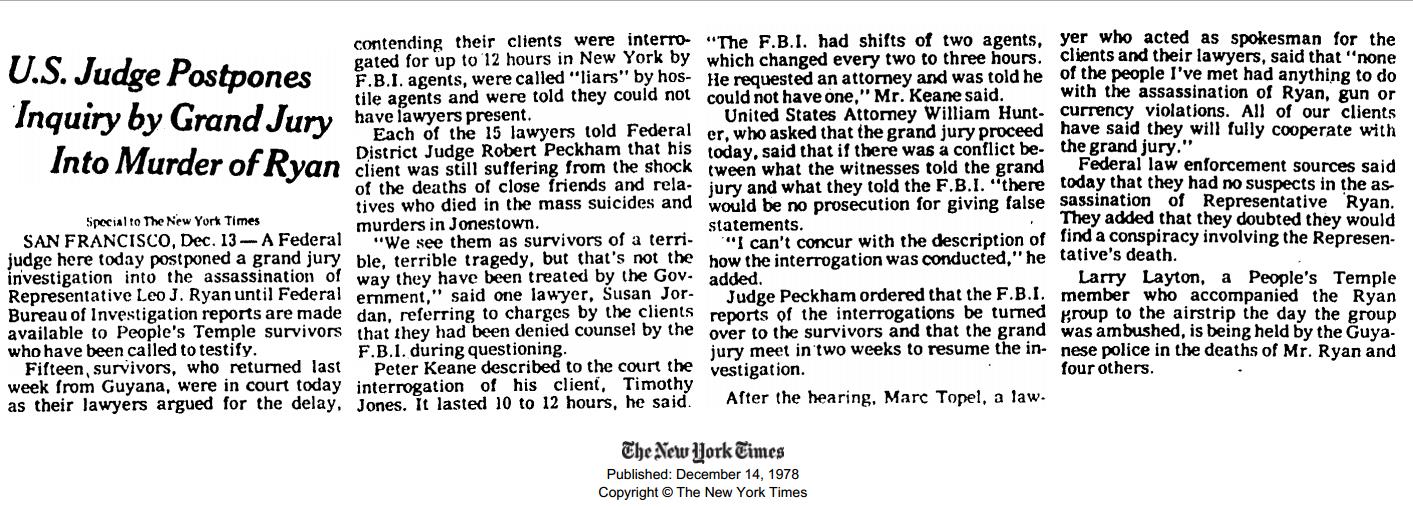
SAN FRANCISCO, Dec. 13--A Federal judge here today postponed a grand jury investigation into the assassination of Representative Leo J. Ryan until Federal Bureau of Investigation reports are made available to People's Temple survivors who have been called to testify.
Larry Layton, a People's Temple member who accompanied the Ryan l;roup to the airstrip the day the group was ambushed, is being held by the Guyanese ...
___________________________________________________________________________________
, by Joseph B. Treaster,
___________________________________________________________________________________
, by Lawrence K. Altman,
__________________________________________________________________________________
, by John M. Crewdson,
___________________________________________________________________________________
The only man accused in the death of Mr. Ryan, a Californian, is Larry Layton, a 32-year old member of the People's Temple, a sect led by the late Jim Jones.
___________________________________________________________________________________
, by Joseph B. Treaster,
Two cultists, Larry Layton and Charles E. Beikman, were previously charged Continued on Page 9, Column 1 Guyana Coroner's Jury Finds Jones Murdered
_________________________________________________________________________________
__________________________________________________________________________________
___________________________________________________________________________________
The defendant, Larry Layton, 32, has been charged with firing the bullet that i killed Mr. Ryan on a small airstrip near the cult s jungle settlement in Jonestown.
___________________________________________________________________________________
__________________________________________________________________________________
__________________________________________________________________________________
February 28, 1979, New York Times Magazine,
People's Temple Member Facing Murder Charges in Guyana Today,
After two delays and an abortive attempt at plea-bargaining, Larry Layton will face a jury tomorrow on charges that he killed Representative Leo J. Ryan and four __________________________________________________________________________________
March 8, 1979, New York Times - AP,
New Hearing Is Ordered For Ryan Death Suspect,
GEORGETOWN, Guyana, March 7 (AP) A judge dismissed murder charges today against Larry Layton, the People's Temple member who was accused of ...
___________________________________________________________________________________
March 11, 1979, New York Times,
The Nation: Run-off Is Forced For Ryan’s Seat,
...Chief Justice of the Guyana Supreme Court last week dismissed murder charges against Larry Layton, sole surviving member of the People's Temple ambush

___________________________________________________________________________________
October 11, 1979, New York Times, page A-1,
A Forlorn Jonestown Slumbers As Guyana Seeks Only to Forget, by Joseph B. Treaster,
___________________________________________________________________________________
November 4, 1979, New York Times,
Follow Up on the News; In Jail in Guyana, by James Gleick,
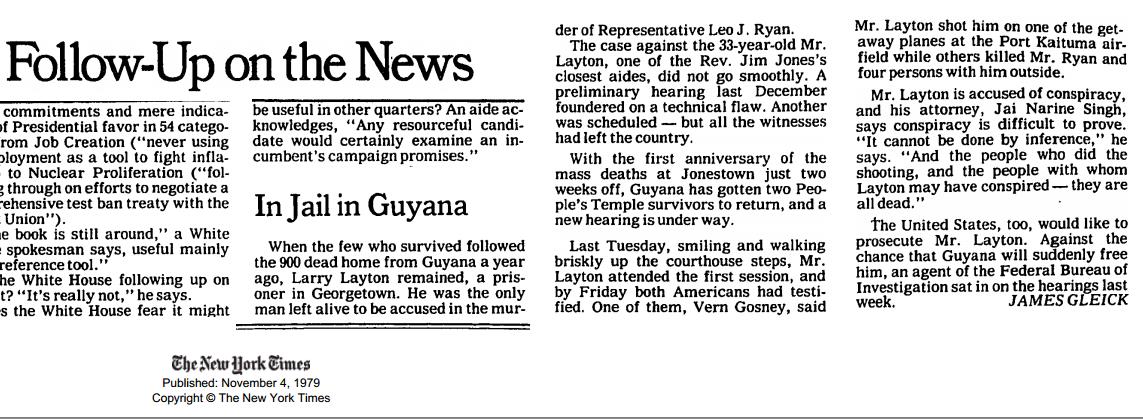
When the few who survived followed the 900 dead home from Guyana a year ago, Larry Layton remained, a prisoner in Georgetown. He was the only man left alive to be accused in the murder of Representative Leo J. Ryan.
___________________________________________________________________________________
November 18, 1979, The New York Times Magazine,
Jonestown: The Survivors' Story: Jonestown, by Nora Gallagher,
_________________________________________________________________________
November 18, 1979, New York Times,
Californians, a Year Later, Still Question Guyana Massacre Events, by Wallace Turner,
SAN FRANCISCO, Nov. 17--A year after Jonestown was wiped out by mass murders and suicides, feeling is still strong here that the events leading to the tragedy at the religious commune in Guyana have not been fully explored and that the role of the United States Government still remains untold.
___________________________________________________________________________________
May 25, 1980, New York Times, Week In Review,
Verdict in Guyana,

___________________________________________________________________________________
May 23, 1980, New York Times - AP,
People's Temple Member Acquitted in Guyana,
_________________________________________________________________________________
May 25, 1980, New York Times, Week In Review,
Verdict in Guyana,
_________________________________________________________________________________
October 10, 1980, New York Times,
People's Temple Figure Reported Coming to U.S.,
__________________________________________________________________________________
November 22, 1980, New York Times,
Member of Peoples Temple Returns to Face U.S. Charge,
Larry Layton, a member of the Rev. Jim Jones' Peoples Temple, was returned to the United States under
___________________________________________________________________________________
November 23, 1980, New York Times,
Ryan Slaying Suspect Back From Guyana for Trial,
___________________________________________________________________________________
November 25, 1980, New York Times,
Suspect in Ryan Slaying Near People's Temple Pleads Not Guilty; Statutes Covering Officials No C.I.A. Involvement Seen, by Wallace Turner,
Larry Layton, one of the few survivors of the People's Temple religious cult, pleaded not guilty in Federal District Court here today to charges that he conspired to
_________________________________________________________________________________
December 5, 1980, New York Times,
Ex-Aide of Cult Leader Is Assigned 2 Attorneys,
Because of the complexity of the case, a Federal judge appointed two attorneys today to represent Larry Layton, who is charged with conspiracy in the slaying of
_________________________________________________________________________________
December 16, 1980, New York Times,
Trial of Peoples Temple Member On Murder Charge Is Set for May,
The trial of Larry Layton on charges he conspired to murder Representative Leo Ryan, Democrat of California, and four other persons who were slain at a jungle
_________________________________________________________________________________
February 21, 1981, New York Times - AP,
People's Temple Member Seeks Dismissal of Charges,
_________________________________________________________________________________
March 19, 1981, New York Times, - AP,
Layton Trial Is Kept on Coast,
SAN FRANCISCO, March 18— A Federal judge ruled today that the murder conspiracy trial of Larry Layton, a former member of the Peoples Temple, would be held in San Francisco, not in New York City as Mr. Layton had sought. Defense attorneys had argued that Mr. Layton's trial in the 1978 shooting death of Representative Leo Ryan at an airstrip in Guyana should be in New York.
___________________________________________________________________________________
April 2, 1981, "Special to the New York Times",
Former aide of people's temple confessed 5 killings at Guyana airstrip,
SAN FRANCISCO, April 1— A written statement in which Larry D. Layton assumed ''full responsibility'' for the slayings of Representative Leo J. Ryan and four other persons in Guyana in 1978 was produced by the prosecution in a pretrial hearing here today.
Attorneys defending Mr. Layton opposed the Government's request to be allowed to use the statement at his trial, scheduled to open July 9, in which he is accused of conspiracy in killing Representative Ryan, a California Democrat, and aiding and abetting murder. He was also indicted on the charge of attempting to kill Richard Dwyer, the United States deputy chief of mission in Guyana.
The defense lawyers argued before Federal District Judge Robert F. Peckham that Mr. Layton gave the statement to the Guyanese authorities under duress. A hearing on their motion to bar it as evidence will be held July 9. They have previously lost motions that challenged the Government's right to try Mr. Layton here for crimes allegedly committed in another country.
Shootings Preceded Mass Suicide
The shootings occurred on Nov. 18, 1978, at the Port Kaituma airstrip in a remote jungle area of Guyana. The airstrip was near Jonestown, where most members of the People's Temple cult led by the Rev. Jim Jones committed mass suicide a few hours after the shootings.
The statement that Judge Peckham has been asked to allow the prosecution to use says:
"I, Larry Layton, take full responsibility for all the deaths and injuries that took place at the Port Kaituma airstrip. I had begged the Bishop Jim Jones that I be allowed to bring down the plane, but he disapproved of my reason for suggesting this was because I felt that these people were working in conjunction with the C.I.A. to smear the People's Temple and to smear Guyana. I got a gun from a friend of mine, one Pancho, and I went to the airport intending to bring down the plane, but when the shooting started I also started shooting. I thought I was too late. I don't know why I did it."
With their motion to suppress the handwritten statement, Mr. Layton's attorneys filed his affidavit, which said the statement was not "voluntarily, knowingly or intelligently made and given." The affidavit said Mr. Layton was kept in handcuffs for three days, deprived of food and had only three glasses of water. He was not allowed to speak to an attorney or to anyone from the American Embassy in Georgetown, Guyana, the lawyers said.
Mistreatment Is Charged
He was kept in an unlighted cell, which was infested by insects, Mr. Layton's affidavit said. It said he was told that members of the People's Temple had been shot and that he would be shot if he did not make a statement, which he said he made on his fourth day of confinement after being awakened from deep sleep.
The shootings occurred when Mr. Ryan and an inspection party prepared to leave after an overnight tour of Jonestown. In the group were television and newspaper reporters, cameramen and photographers, Mr. Ryan's staff members, personnel from the American mission in Guyana, relatives of people living in Jonestown and some cult members who were trying to leave under the protection of the Ryan group.
A photographer from The San Francisco Examiner, two NBC News reporters and a cult member trying to leave Jonestown were killed in the shooting, which began with the arrival at the airstrip of an armed group from Jonestown. Mr. Layton was on one of the two planes used by the group, and, according to witnesses, pulled a gun and began shooting. Mr. Ryan was at the other plane.
When the attackers returned to Jonestown, according to witnesses who were present there, Mr. Jones ordered his followers to commit suicide by drinking a mixture that included cyanide. The authorities later counted 913 bodies, including that of Mr. Jones, who had died of a gunshot wound to the head.
__________________________________________________________________________________
May 7, 1981, New York Times - AP,
Court Upholds U.S. Right to Try Ex-Member of People's Temple,
SAN FRANCISCO, May 6— The United States can try Larry Layton, a former member of the People's Temple cult, on conspiracy charges in the death of Representative Leo J. Ryan, even though the slaying occurred in another country, a Federal appellate court has ruled.
The United States Court of Appeals for the Ninth Circuit yesterday upheld a ruling by Federal District Judge Robert F. Peckham that "there is no lack of power on the part of Congress" to pass laws protecting Congressmen while they are out of the country.
The ruling cleared the way for Mr. Layton's trial in Federal District Court, now scheduled to start on July 9.
Mr. Ryan, a California Democrat, and four other persons were were shot in November 1978 at a remote jungle airstrip near the cult's settlement in Jonestown, Guyana. The Congressman was on a factfinding mission into alleged abuses of cult members from California.
__________________________________________________________________________________
July 21, 1981, New York,
Murder Conspiracy Trial to Begin For a Member of Peoples Temple, by Wallace Turner,
SAN FRANCISCO, July 20— The People's Temple horror story will be told again, beginning tomorrow, at the trial of Larry Layton, who is accused of plotting a murderous attack as his last job for Jim Jones, the religious leader who later led most of his flock into suicide.
Last October, a Federal grand jury indicted Mr. Layton, 36 years old, on charges of conspiring to murder United States Representative Leo Ryan, Democrat of California, and conspiring to attempt to murder Richard Dwyer, deputy chief of the United States mission to Guyana. All those accused in the indictment of being Mr. Layton's coconspirators died at Jonestown, the religious cult's jungle settlement in Guyana.
Mr. Layton is being tried under a Federal statute governing assassination attempts against Congressmen and "internationally protected persons," such as Mr. Dwyer. The Government's position, which has been challenged by the defense lawyers, is that the statute applies even outside the United States. The prosecution will not seek the death penalty, although the statute allows it.
Jury selection will begin tomorrow in
the closed Federal district courtroom of Chief Judge Robert Peckham. Picking the jury is expected to take three weeks, slowed by the wide publicity that the People's Temple tragedy received, and the trial is expected to last about three months.
A Flurry of Gunfire in 1978
The events of Nov. 18, 1978, at the airstrip at Port Kaituma, Guyana, will be the central issue. It was there that Mr. Ryan and four others died, and 11 persons were wounded in a flurry of gunfire.
The shooting occurred as Mr. Ryan was departing with an inspection party he had brought to Guyana and Jonestown in response to the assertions of relatives and friends that members of the cult were being held prisoner.
Almost all the People's Temple members were from the San Francisco Bay area, where Mr. Jones had operated his cult from a church within sight of the towers of the financial district.
As the Ryan party was preparing to leave in two medium-sized chartered planes, some of Mr. Jones's followers pulled up on a tractor and trailer. They began to fire rifles at people around the planes.
According to evidence presented at Mr. Layton's trial in Guyana, where he was acquitted of being an accomplice in murder, Mr. Layton was aboard one of the planes, posing as a defector escaping from Jonestown. Mr. Ryan was killed outside the other plane.
Also shot to death that day were Greg Robinson, a photographer for The San Francisco Examiner; Don Harris, a reporter, and Robert Brown, a cameraman, for NBC News;
and Patricia Parks, who was in fact a defector. There are no charges pending against Mr. Layton in these deaths.
Meantime, Mr. Jones began to prepare his followers for the mass suicide that he had repeatedly drilled them to use when, as he often predicted, the cult's enemies would mount a threat that could not be fought off.
913 Found Dead in the Jungle
Two lawyers, Charles R. Garry of San Francisco and Mark Lane of Memphis, had gone to Jonestown at Mr. Jones' request to be present when the Ryan party arrived.
They heard the start of the suicide ceremonies before they slipped away to hide all night in the jungle.
Next day Jim Jones was found dead of gunshot wounds and his followers were found dead of poisoning. They had drunk a mixture of cyanide and a soft drink prepared by a medical doctor who had been educated by the cult and whose body was found among the 913 sprawled in the jungle.
A tape recording that carried their leader's final exhortations was found with the dead. That and other tape recordings found at Jonestown are expected to figure in Mr. Layton's trial as his attorneys argue that he acted under the domination of Mr. Jones. Thousands of letters and other pieces of paper fluttered in the wind along the muddy earth when bewildered officials arrived next day. Some of these will also be evidence.
Mr. Layton will be defended by Tony Tamburello, who was appointed by the court,
and by Frank Bell, a deputy Federal public defender. The prosecution will be by Sanford Svetcov, Robert Dondero and Dennis M. Nerney, all assistant United States Attorneys.
About $2 billion in claims remain to be settled against the estate of the People's Temple and in lawsuits brought against the cult.
Illustrations: Photo of Larry Layton
___________________________________________________________________________________
August 18, 1981, New York Times,
Layton Guyana 'Confession' Is Ruled Admissible By Judge,
SAN FRANCISCO, Aug. 17— A Federal District judge ruled today that a disputed confession by Larry Layton, a former member of the People's Temple, can be used in Mr. Layton's trial for murder and conspiracy.
Judge Robert Peckham said he believed the statement, in which Mr. Layton took responsibility for the deaths of Representative Leo Ryan, Democrat of California, and four others ambushed at a Guayana jungle airstrip in November 1978, was made voluntarily to the Guyana police after other members of the cult died in mass murders and suicides.
Lawyers for the 35-year-old former aide to the Rev. Jim Jones, leader of the People's Temple, had asked Judge Peckham to block the introduction of the statement, which was made after Mr. Layton's arrest in Guyana. Mr. Layton contended that he had been threatened with death if he did not sign the statement.
Judge Peckham delayed until tomorrow the viewing of videotapes taken at the airstrip during the attack. He is to determine how much should be shown to the jury of seven women and five men.
Testimony by Layton
Mr. Layton testified at a daylong hearing Friday that the Guyana police forced him to confess through beatings and death threats. "I was constantly awakened, kicked, slugged and threatened by police," Mr. Layton told the court. "I had heard everyone I cared for was dead, and I didn't care anymore. I was told I would be killed if I didn't sign" the admission.
Guyana officials denied that Mr. Layton had been coerced, and Federal officials said State Department interviews with Mr. Layton indicated no complaints about his treatment by the Guyana authorities.
Mr. Layton is charged in a four-count indictment with conspiracy to murder Representative Ryan and the attempted murder of an internationally protected person, Richard C. Dwyer, then deputy chief of mission for the United States in Guyana. Mr. Dwyer was unhurt.
Cleared in Guyana
Mr. Layton was acquitted on related charges by a Guyana court. Also at issue before Judge Peckham was how much of the television videotapes taken by an NBC News cameraman, Robert Brown, of those slain in the airstrip attack, should be shown to the jury.
Mr. Ryan, Mr. Brown, Greg Robinson, a San Francisco Examiner photographer, Don Harris, a reporter for NBC News, and Patricia Parks, a Temple defector, were killed in the airstrip attack.
___________________________________________________________________________________
August 21, 1981, New York Times - AP,
Cult Defector Testifies In 1978 Guyana Ambush,
SAN FRANCISCO, Aug. 20— A defector from the Peoples' Temple cult testified today that his suspicions were aroused when Larry Layton, on trial for conspiracy to commit murder, joined a party leaving the cult's settlement in Jonestown, Guyana.
Harold Cordell said he was apprehensive when he saw Mr. Layton board the vehicle carrying defectors to the Port Kaituma airstrip near Jonestown, where Representative Leo J. Ryan and others in his party were ambushed.
"I said I don't know why he's here," Mr. Cordell said, referring to Mr. Layton. "I don't believe he's a defector." Mr. Cordell, a longtime temple member, described the Nov. 18, 1978, attack in which Mr. Ryan, a California Democrat, and four others, including three journalists, were killed. Shortly after the ambush, more than 900 members of the cult joined their leader, the Rev. Jim Jones, in a mass murder-suicide ritual.
__________________________________________________________________________________
August 23, 1981, New York Times,
Killings in Guyana Recalled in Court, by Wallace Turner,
SAN FRANCISCO, Aug. 22— In the staid formality of a Federal courtroom here, four witnesses have been recreating the horrors of the jungle airstrip in Guyana where Representative Leo J. Ryan and four other persons were slain by members of the Peoples' Temple almost three years ago.
The issue before a jury of seven women and five men is whether Larry Layton, 34 years old, a longtime member of the Rev. Jim Jones's cult, acted as part of a conspiracy to kill Mr. Ryan, a California Democrat, and Richard Dwyer, deputy chief of the United States mission to Guyana, who was wounded in the hip.
Mr. Ryan was slain Nov. 18, 1978, while leading a group of journalists and relatives of cult members to Jonestown, the Peoples' Temple jungle retreat. After the attack, more than 900 cult members committed suicide or were slain.
Testimony this week at the start of the trial included graphic descriptions of sudden death.
Aide Helped Legislator
Jackie Speier, administrative assistant to Mr. Ryan, , said she saw blood before the legislator said, "I've been shot." Miss Speier was shot as she tried to help Mr. Ryan.
Another witness was
Ron Javers, who was then a San Francisco Chronicle reporter and who now works for Philadelphia magazine. He said Bob Brown, an NBC-TV photographer, saw a truck tow a group of Jonestown men with guns onto the airstrip and said, "Oh, boy, this is it!"
Within minutes, Mr. Javers testified, he was shot in the shoulder and ran into the jungle. From there, he watched a gunman, whom he could not identify, walk up to Mr. Brown and to Don Harris, an NBC reporter, as they lay wounded on the ground and "blow their heads off."
Harold Cordell, a member of the Peoples' Temple for 23 years and once its chief of security, used the Ryan visit as a means of escaping Jonestown. He said Patricia Parks, another defector, was shot to death at his side.
Reporter's Description
Tim Reiterman, a San Francisco Examiner reporter, told of being shot in the left arm and wrist. Greg Robinson, a photographer for The Examiner, was also killed.
Of the cultists who used guns that day, only Mr. Layton survived to be tried. He was acquitted in Guyana of attempted murder.
Mr. Layton had been aboard one of the waiting planes with some defectors. When the shooting started outside, he produced a gun he had concealed and wounded two women who had defected.
No evidence has been presented to show that Mr. Layton fired at Mr. Ryan or Mr. Dwyer, both of whom held positions protected by United States law even though they were outside the country.
The recreation of the murder scene came as the Government began to weave its conspiracy case.
Conspiracy Theory
The Government's theory, as outlined in the opening statement by the prosecutor, Robert Dondero, is that from the time Mr. Ryan began his trip to Jonestown a conspiracy existed to kill him and others. The original plan, Mr. Dondero said, was that Sharon Amos, manager of the cult's office in Georgetown, Guyana, would get aboard the plane and cause it to crash.
Mr. Cordell testified that before the Ryan party arrived, Mr. Jones told his followers,
"They are going to come, and maybe the plane will just fall out of the sky."
Miss Speier testified that Mrs. Amos had insisted that she be given a seat on the plane but was crowded out because none were available. Mrs. Amos was found dead in her Georgetown quarters after the Jonestown suicides. Her throat was slit, as were the throats of her children beside her.
Change of Attitude
Miss Speier said Mr. Layton first approached her speaking as a Temple loyalist, defending the cult and its leader. As the truck was leaving to take the Ryan party and some defectors back to the airstrip, however, he came forth and demanded to be taken to the plane so that he could leave Jonestown, she said.
"He was nervous, jittery, showed a degree of anxiety and was somewhat spaced out," Miss Speier said. Mr. Javers testified that when Mr. Layton got on the truck, the defectors aboard "physically cowered - they were scared to death." Mr. Layton's defense is that whatever else he might have done, he was not a part of any conspiracy to harm Mr. Ryan or Mr. Dwyer.
Leader's Control Described
In the opening statement for the defense,
Frank Bell, assistant Federal public defender here, described Mr. Layton as totally controlled by Mr. Jones. He said the cult leader took as mistresses Mr. Layton's first wife, Carolyn, and later his second wife, Karen.
On the day of the shootings, Mr. Bell said, Mr. Layton was given a gun and told to go to the airport, get aboard the plane and bring about a crash. Mr. Bell said Mr. Layton had no knowledge of any plan to harm Mr. Ryan or Mr.Dwyer and was surprised when the shooting started.
Federal District Judge Robert Peckham of Northern California, who is presiding at the trial, has approved Government plans to show Mr. Brown's television tapes of the action as the shooting began. He has also agreed to allow the jury to hear tape recordings of Mr. Jones' last speeches to his followers.
___________________________________________________________________________________
August 25, 1981, New York Times - AP,
Around the Nation - U.S. Diplomat Testifies In Layton Murder Trial,
SAN FRANCISCO, Aug. 24— Richard Dwyer, an American diplomat, testified today that he had urged Representative Leo J. Ryan to leave the People's Temple cult settlement at Jonestown, Guyana, for his own safety, but that Mr. Ryan wanted to stay another night to encourage others to leave.
Representative Ryan, Democrat of California, was killed the next day in a Nov. 18, 1978, ambush at a remote jungle airstrip outside the settlement.
Mr. Dwyer, former deputy chief of the American Mission in Guyana, testified in the Federal trial of Larry Layton, a former member of the cult.
Mr. Layton, 35 years old, is charged with conspiracy to murder Mr. Ryan and conspiracy to harm Mr. Dwyer, who was wounded in the attack. Representative Ryan, three journalists and a temple defector were killed in the airport ambush.
___________________________________________________________________________________
September 8, 1981, New York Times,
Layton Defense Set to Begin in Cult Murder Trial, by Wallace Turner,
SAN FRANCISCO, Sept. 7— Larry Layton, a onetime top aide to the Rev. Jim Jones and a survivor of the murders and suicides of more than 900 members of Mr. Jones's People's Temple cult in a Guyana jungle, is to open his defense tomorrow to a charge that he conspired to murder Representative Leo J. Ryan, Democrat of California.
After two and a half weeks of presenting evidence, the Government ended its case Thursday by introducing a signed statement that said, "I, Larry Layton, take full responsibility for all the deaths and injuries" that occurred when Mr. Ryan and four other persons were slain at a jungle airstrip in November 1978.
Mr. Layton, 35 years old, testified in a pretrial hearing that he signed the document after being mistreated and starved in a jail in Georgetown, Guyana. While the prosecution was permitted to present the statement to the jury in Mr. Layton's trial in Federal Court here, it was barred from playing a tape recording of Mr. Jones's last speech of exhortation to his followers before the mass deaths, including his own, soon after the airport slayings.
Assistant United States Attorney Sanford Svetcov calls the tape "critical" to the prosecution. On it Mr. Jones, the founder of the People's Temple, said that Mr. Layton was carrying a gun on the day of the airport slayings. Mr. Ryan and the others who were ambushed were in Guyana to conduct an inquiry into the cult and reports that some of its members were being held against their will.
Proving There Was Conspiracy
Mr. Layton is the only survivor among the seven persons, including Mr. Jones, who are named by the Government as conspirators. Showing that Mr. Jones knew Mr. Layton had a gun would have helped establish the conspiracy, Mr. Svetcov argued.
Federal District Judge Robert F. Peckham explained that he had refused to admit the tape and testimony of statements by Mr. Jones because the cult leader could not be cross-examined and because his truthfulness while alive was questionable.
Only Mr. Layton has been charged in connection with the deaths in 1978. He was tried in Georgetown, Guyana, on charges of attempted murder in the shooting of Monica Bagby and Vernon Gosney, two People's Temple defectors who were trying to leave Jonestown. His successful defense maintained that he had been brainwashed by Mr. Jones.
A Federal grand jury indicted him here in October 1980 on four charges. Under a law protecting members of Congress, he was charged with conspiring to murder Mr. Ryan and aiding and abetting in the slaying.
Attack on Diplomat
He was also charged with conspiracy and aiding and abetting in the attempted murder of an internationally protected person, Richard C. Dwyer, then deputy chief of the United States Mission to Guyana, who was wounded but survived.
There was no evidence that Mr. Layton shot either Mr. Ryan or Mr. Dwyer. Evidence showed that he pulled out a concealed gun and began firing it at people with him aboard a plane when other members of the cult began firing at Mr. Ryan and the group clustered at a second plane.
In the Layton case, the Government is relying on suspicious actions, not on testimony of a co-conspirator or a written record, the usual basis of evidence in conspiracy trials.
Witnesses said that at the airstrip where the shootings occurred, Mr. Layton was greeted effusively by a man who died later that day. Prosecutors believe that the man passed a gun to Mr. Layton, who concealed it under a poncho he was wearing until the general attack started.
Mr. Layton faces a possible death sentence or life in prison in the slaying of Mr. Ryan; life in prison in the attempted murder of Mr. Dwyer, and terms up to 20 years each on the aiding and abetting charges.
Legal Challenges by Defense
Defense attorneys also have challenges pending on the site of the trial and on the prosecution's use of the two statutes under which the charges were filed.
James Hewitt, the Federal public defender here, contends that the trial should be held in Federal District Court in Brooklyn because Mr. Layton returned to the United States through Kennedy International Airport.
A statute passed in 1790 provides that a person accused of violating a United States law while outside the country should be tried in the district where he re-entered the country. In 1963 Congress amended the law to provide for indictment of a person still abroad by a grand jury in the district of his last known address, or in the District of Columbia. But the provision for trial in the district of re-entry was not changed. Judge Peckham will rule Tuesday on a defense motion for dismissal on that basis.
Validity of Charges
Defense attorneys contend that the statute protecting Congress members does not apply when they travel abroad. They say that the "protected person" statute used to cover the attack on Mr. Dwyer is not applicable because it was drawn to combat hijacking, piracy and drug smuggling.
Robert Dondero, an Assistant United States Attorney, argued that the laws were designed to protect officials in their travels and to insure punishment for anyone who attacked a member of Congress anywhere.
Judge Peckham rejected these defense motions before the trial opened, holding that Congress meant to pass statutes that protected the people named. The defense team sought to block the trial by an order from the United States Court of Appeals for the Ninth Circuit, but that court delayed considering the issues until after the trial.
Illustrations: Photo of Larry Layton
___________________________________________________________________________________
September 9, 1981, New York Times,
Layton Defense to Rest Case in Guyana Conspiracy, by Wallace Turner,
SAN FRANCISCO, Sept. 8— Lawyers for Larry Layton announced today that the former People's Temple member would offer no defense to charges that he conspired to kill Representative Leo J. Ryan and Richard Dwyer, deputy chief of the American Mission in Guyana.
"We do not believe the evidence has established the charges beyond a reasonable doubt," Frank Bell, deputy Federal public defender, said as court opened. "We will offer no further evidence in this case and we will rest."
"Do you mean you literally are not going to put on any evidence?" asked Federal District Judge Robert Peckham. Mr. Bell assured the judge that was the intention.
After several hours of conferences in his chambers, Judge Peckham called the jurors, who were not in court to hear the defense announcement, and told them to be ready to return Thursday or Friday.
When Mr. Bell was asked what was happening, he said, "Remember, nothing is official until the jury has heard it," an answer that led to speculation of further change in plans.
The prosecutors, led by Sanford Svetcov, Assistant United States Attorney, appeared as surprised by the defense move as Judge Peckham.
Diminished Capacity Claimed
Earlier, Mr. Layton's lawyers said the defense would show that he was acting under diminished capacity, brought on by drugs and the Rev. Jim Jones's control over his will, when Mr. Layton began shooting at persons aboard an airplane parked on the airstrip at Port Kaituma, Guyana, on Nov. 18, 1978, near Jonestown, the People's Temple jungle retreat. Mr. Ryan and Mr. Dwyer were waiting to leave Guyana after inspecting the camp.
No evidence has been presented to show that Mr. Layton shot at either man. Evidence has indicated that shots fired by others killed Mr. Ryan and wounded Mr. Dwyer. Nor has there been testimony to show a conspiracy between Mr. Layton, Mr. Jones and others to harm the two men. Except for Mr. Layton, all others who took part in the shootings died in the murders and suicides that took 913 lives at Jonestown the same day.
The Government's conspiracy case was based on the testimony of survivors about Mr. Layton's actions and his talks with Mr. Jones before the shootings. His shots wounded two People's Temple defectors, but he was acquitted of attempted murder in a trial in Guyana.
Although the Government closed its case last week, prosecutors produced three documents today to show that Mr. Layton's last address was in the Federal court district here. This was to meet technical arguments about indicting Mr. Layton for a crime that is supposed to have occurred in another country.
___________________________________________________________________________________
September 16, 1981, New York Times,
Prosecution Rests in People's Temple Guyana Plot, by Wayne King,
SAN FRANCISCO, Sept. 15— Larry Layton, the former People's Temple member accused of helping to plan and carry out the murder of Representative Leo J. Ryan and the wounding of an American diplomat, calculatedly passed himself off as a defector from the cult in an attempt to get close enough to shoot Mr. Ryan, the prosecution maintained today in final arguments.
In his statement,
Assistant United States Attorney Dennis Michael Nerney said prosecution testimony had shown the defendant "spying and skulking in the pavilion area" of the cult's Jonestown settlement while Representative Ryan and several defectors from the cult led by the Rev. Jim Jones prepared to leave Guyana.
Mr. Nerney, in summing up prosecution's view of the events leading to the fatal shooting of Mr. Ryan and the wounding of three others, which in turn led to the mass suicides and murders of 900 cult members at Jonestown, said that Representative Ryan had told those who wanted to leave, "You are in no danger, you have the Congressional shield of the United States."
Little did he know," Mr. Nerney said. The prosecution's statement appeared to be aimed at showing that Mr. Layton was fully aware of what he was doing and that he took a leading role in the assault at the jungle airstrip.
Layton Facing Four Charges
Mr. Layton faces four charges, two counts of conspiracy in the murder of Representative Ryan and the attempted murder of Richard Dwyer, deputy chief of the American Mission in Guyana, and two counts of aiding and abetting those two acts.
If convicted of the murder conspiracy charge, he could receive the death sentence, although the prosecution has indicated it would not press for the death penalty. Conviction of conspiring in the attempted murder of a diplomat such as Mr. Dyer, described in Federal law as ''an internationally protected person,'' is punishable by a maximum sentence of life in prison.
Conviction on the other two counts, aiding and abetting the murder and attempted murder could result in prison terms of up to life imprisonment.
The closing prosecution statement began shortly after the Federal District Court jury was told for the first time that the defense would rest without presenting any testimony. Some members of the panel appeared surprised by the announcement.
Move Revealed Last Week
The defense announced the unusual move to the prosecution and the judge last Wednesday, while the jury was out of the courtroom.
Frank Bell, deputy Federal public defender contended at the time that the prosecution had not established the charges beyond a reasonable doubt.
Judge Robert Peckham had asked Mr. Bell,
"Do you mean you literally are not going to put on any evidence?" Although the defense had subpoenaed about 80 witnesses, Mr. Bell affirmed that there would be no defense testimony and that he would only present the defense's closing argument.
That statement is scheduled for tomorrow morning. A defense brief and courtroom statements indicate that in addition to the contention that the prosecution had not proved its case, Mr. Layton's lawyers would also rely on an argument that Mr. Layton
"lacked substantial capacity to appreciate the wrongfulness of his conduct or to conform his conduct to the requirements of the law."
Mental State May Play Role
Defense attorney's are expected to argue that the defendant's mental state resulted from what amounted to brainwashing by Mr. Jones.
The case is expected to go to the jury tomorrow afternoon after the defense statement and one-hour rebuttals by both sides.
Although prosecution witnesses testified that Mr. Layton had fired repeatedly into an airplane parked on the airstrip, striking some of those aboard, there has been no direct evidence that he shot at either Representative Ryan or Mr. Dwyer. The evidence has been that the shots that struck the two men were fired by others.
___________________________________________________________________________________
September 17, 1981, New York Times,
Cult Member Cries Over Plea to Jury,
__________________________________________________________________________________
September 18, 1981, "Special to the New York Times",
Conspiracy charges in guyana slayings sent to a coast jury,
SAN FRANCISCO, Sept. 17— The Government's case against Larry Layton, a People's Temple survivor, went to a Federal court jury tonight for a decision on whether he conspired to murder United States Representative Leo J. Ryan and to try to murder Richard Dwyer, deputy chief of the United States mission to Guyana.
After two hours of deliberations, the jury retired for the night.
Deliberations are to resume tomorrow morning. Robert Dondero, Assistant United States Attorney, argued for the prosecution that Mr. Layton's "role began with deception and ended with violence" on Nov. 18, 1978, when Mr. Ryan and four others were shot and killed at the Port Kaituma airstrip after an inspection visit to Jonestown, Guyana.
Tony Tamburello, a defense attorney, argued that Mr. Layton, 35 years old, was being made a scapegoat for society's horror at the murder-suicide deaths of 913 people at Jonestown.
The defense offered no evidence in Mr. Layton's behalf.
Explanations for Behavior
Mr. Tamburello began his jury summation yesterday and concluded it this morning by offering explanations for Mr. Layton's behavior that day.
The Government relied in part for its proof of conspiracy on descriptions of Mr. Layton's conversations with the Rev. Jim Jones, the People's Temple leader, and on his having smuggled a gun aboard a small airplane where he shot two defectors.
The six other temple members who were named as co-conspirators are dead.
Mr. Dondero, pointing at his colleagues at the prosecution table in Federal District Judge Robert Peckham's courtroom, said, "The people at this table are not prosecuting a scapegoat." He brushed off the defense contention that the State Department was being protected by prosecuting Mr. Layton by saying,
"We are not lackeys for some other agency."
__________________________________________________________________________________
September 26, 1981, New York Times - AP,
Jurors Deadlocked on People's Temple Case,
Jurors in the murder-conspiracy trial of Larry Layton, a former People's Temple member, announced today that they were deadlocked, but the ...
__________________________________________________________________________________
September 27, 1981, New York Times,
Trial of Cult Member Ends with Jury Deadlocked, by Wallace Turner,
SAN FRANCISCO, Sept. 26— The trial of Larry Layton on charges growing out of the cataclysmic last hours of the People's Temple cult ended in a mistrial in Federal District Court here this afternoon.
Mr. Layton, 35 years old, a former member of the cult, was tried on four charges. He was accused of conspiracy to murder Representative Leo Ryan, a South San Francisco Democrat, and of conspiracy to attempt to murder Richard Dwyer, chief of the United States Mission to Guyana.
Mr. Layton was also charged with aiding and abetting the attacks on Mr. Ryan, who was killed, and Mr. Dwyer, who was wounded, both at Port Kaituma airstrip near Jonestown, the People's Temple jungle settlement in Guyana.
The 12-member jury began deliberating Sept. 17. Yesterday its members told Judge Robert Peckham of Federal District Court that they were hopelessly divided. He told them to continue deliberating. When defense counsel moved today for a mistrial, Judge Peckham granted the request.
Jurors Avoid Reporters
The jurors left the Federal building in vans minutes after the mistrial was declared.
They refused to talk to reporters. Government prosecutors said a decision on a retrial would be made in Washington.
On Thursday, at the next hearing in the case, defense attorneys will request that bail be set. Mr. Layton has been held without bail since he returned to the United States last year after his acquittal on charges of attempted murder in a court in Georgetown, Guyana. Four others were killed and
13 wounded by gunfire as members of the People's Temple attacked the party led by Mr. Ryan.
Only Mr. Layton survived to be brought to trial.
Special Statutes Involved
The prosecution was under two special statutes. One protects members of Congress and the other protects diplomats. The Government argued that Mr. Layton's role as a conspirator had been shown when he posed as a defector from the People's Temple settlement at Jonestown. He abandoned his pose when the shooting started, and, before his gun jammed, wounded two members who were true defectors.
Although no evidence was offered by the defense, Mr. Layton's attorneys argued to the jury that because Mr. Layton had attacked others, not Representative Ryan and Mr. Dwyer, he was not a part of the plan to kill them. All the men who shot the two officials died that same day in the mass murder and suicide that took 913 lives, including that of the Rev. Jim Jones, the People's Temple leader.
The Government's evidence pictured Mr. Layton as a vocal defender of the temple until a few minutes before he suddenly announced that he wanted to leave with the Ryan party. Prosecutors argued to the jury that this switch had come about because Mr. Jones had directed Mr. Layton to take part in a plan to kill all the visitors to the jungle colony.
Reminders of Guyana Trial
Defense lawyers reminded the jury repeatedly that Mr. Layton had been tried and acquitted in Guyana of attempted murder, charges that grew out of his wounding of two defectors
aboard the plane where he was to be a passenger. Mr. Ryan and Mr. Dwyer were shot as they stood around the other airplane.
The verdict
closed another chapter in the People's Temple story. In the 1960's, Mr. Jones led his followers from Indiana to Redwood Valley about 100 miles north of here. Once established there, Mr. Jones began evolving a communal style that was to characterize his cult until it disappeared in tragedy at Jonestown.
Many of Mr. Jones's followers were drawn from the black communities here and in Oakland. Mr. Layton and one of his sisters were among the sizable number of
young, white liberals who were drawn by the promise of a better, more equitable world.
After the attack on Mr. Ryan's party and some People's Temple defectors, most of Mr. Jones's followers committed suicide by drinking cyanide at his orders. He died of gunshot wounds to the head.
___________________________________________________________________________________
November 4, 1981, New York Times,
U.S. Seeks Retrial in Guyana Deaths, by Wallace Turner,
SAN FRANCISCO, Nov. 3— The Government moved today to retry Larry Layton, 35 years old, on charges growing out of the attack at a remote airstrip in Guyana against a party led by United States Representative Leo Ryan of California, one of five persons shot to death.
Chief Judge Robert Peckham of the Federal District Court for Northern California will rule on the motion later. He presided at the first trial, which ended Sept. 27 when a jury was unable to agree.
Members of the jury said the vote was 11 to 1 for acquittal on the charges that Mr. Layton conspired to murder Mr. Ryan and to harm Richard Dwyer, chief of the United States mission to Guyana, who was wounded.
The jury was divided 7 to 5 for conviction on the charges that Mr. Layton, a member of the People's Temple led by the Rev. Jim Jones, had conspired to aid and abet in the attacks on the two men, these jurors said.
'Not Sufficient Evidence'
Some lawyers who followed the case had expected the Government to announce that it would not pursue the indictment against Mr. Layton. "There is not sufficient evidence to have another trial,'" said James Hewitt, the Federal public defender, in support of a defense motion for dismissal of charges against Mr. Layton.
Robert Dondero, a Federal prosecutor, argued that Mr. Layton's oral statements to law enforcement officers in Guyana and a statement he signed there had shown his complicity in the gunfire attack on the party led by Mr. Ryan. Mr. Dondero said there had been "choreographed activity and a concert of action" in which Mr. Layton had been a participant.
Excluded Evidence Barred Again
Judge Peckham again denied a prosecution attempt to use evidence that was excluded from the first trial. This included statements made by Mr. Jones in his final speech to his cult members before 913 of them, including Mr. Jones, died as suicide and murder victims.
Judge Peckham indicated that the retrial, if it comes, would begin Dec. 1 with jury selection, but with no evidence to be presented until after Jan. 1.
Mr. Hewitt predicted that the trial would be delayed by a Government appeal of Judge Peckham's order excluding the evidence. He also refused to discuss what Mr. Layton had been doing
since he was released from custody on Oct. 2. He had been in custody, first in Guyana and then here, since a few hours after the shooting on Nov. 18, 1978. He was tried and acquitted of attempted murder in Guyana.
___________________________________________________________________________________
November 5, 1981, New York Times - AP,
Jonestown Inquiry Cancelled by House Panel,
WASHINGTON, Nov. 4—
Citing legal complications, a House subcommittee today canceled its plans to hold a public inquiry into the performance of State Department officials in connection with the mass murders and suicides three years ago in Jonestown, Guyana.
Representative Dante B. Fascell, Democrat of Florida who is chairman of the House Foreign Affairs Subcommittee on International Operations, said the panel had been ''very anxious'' to proceed with the Jonestown investigation as part of two days of hearings on United States consular services provided to Americans abroad.
However, Mr. Fascell said he decided to defer indefinitely the Jonestown-related portion of the hearings in view of pending legal
cases.
Representative Andy Ireland, Democrat of Florida, and other members of the House had planned to ask detailed questions about the State Department's handling of the Guyana affair.
State Department Assailed
Yesterday Mr. Ireland said,
"It's clear to me that the State Department has refused to face up to the institutional breakdowns which helped to produce the Jonestown tragedy."
He contended that the department had failed to assess responsibility for problems in its handling of the Guyana affair and added,
"We hope through these hearings to analyze in detail who knew what at State, when they knew it and what they did about it."
At Jonestown, Jim Jones, the leader of the People's Temple, and 912 of his followers took part in a ritual of murders and suicides Nov. 18, 1978.
Hours earlier, Representative Leo J. Ryan, Democrat of California, three journalists and a defector from the cult had been shot to death at a nearby airstrip.
Larry Layton, a former People's Temple member, is expected to stand trial a second time in San Francisco Dec. 1 in the shootings at the Port Kaituma airstrip. His first trial ended in late September when the jury could not agree on a verdict.
In addition, several civil lawsuits brought by families of Jonestown victims are pending.
Officials Already Testified
Mr. Fascell noted that most of the State Department officials the subcommittee wanted to hear from either had already testified in the legal proceedings or were expected to be subpoenaed.
"I don't see any way we can put that on the public record without jeopardizing either the prosecution or the individuals," he explained.
In testimony prepared for the hearing,
Diego C. Asencio, Assistant Secretary of State for consular affairs, said the Jonestown deaths had been a
"baptism of fire" for efforts that were just beginning then to upgrade services for citizens living or traveling abroad.
___________________________________________________________________________________
November 8, 1981, New York Times, Week in Review,
Headliners - Jonestown Revisited,
___________________________________________________________________________________
July 4, 1983, "Special to the New York Times",
Tragedy of Jonestown Cult is Shifting From Courts to History,
SAN FRANCISCO, July 3— The stark wording of the final legal document filed by the State Attorney General barely suggests the magnitude of the tragedy.
"Because of the possibly historical significance of the events surrounding Peoples Temple on or about Nov. 18, 1978," it says, "we deem it appropriate that information gathered by the Receiver not be destroyed but rather preserved for the use of historians and the general public."
"The events" were the murder of five people, including a United States Congressman, and the
wounding of 11 others at Port Kaituma, Guyana, and the deaths of more than 900 followers of the Rev. Jim Jones, the leader of the Peoples Temple, at the cult's nearby outpost, Jonestown.
The temple's headquarters in San Francisco was sold years ago and, for a time, became the Korean Central Presbyterian Church. The boxes of index cards and metal files, the American flag and the mothballs, even Mr. Jones's oak pulpit, have all been auctioned. So have the duplex in Richmond, the bungalow in Watts, the vacant lot in Pasadena, all donated to the cult by members.
This month
Robert H. Fabian, the man who has attended to every detail of the liquidation of the temple's assets, is to file his final report and deposit all his records and files with the California Historical Society.
With the filing of the report, legal action on the civil claims will come to a close. The plan for the safekeeping of the records was proposed by Mr. Fabian and approved by the Attorney General and the Superior Court in San Francisco. Mr. Fabian, a retired lawyer when he was appointed four and a half years ago to act as receiver of the cult's assets, closed out its bank accounts on June 30 after issuing the last checks in the total $9,485,760 awarded to 577 claimants.
The "real challenge" and "the most emotional factor" in settling the cult's business was dealing with
the shipment and burial of 545 bodies that were returned from Guyana to California, Mr. Fabian said. Nearly 300 remained unclaimed and were buried in Oakland.
Mr. Fabian then turned to the monumental detective work of locating and consolidating the temple's assets and settling the $1.4 billion in claims against the estate. The bulk of the money, more than $7 million, was in Panamanian banks. Another $535,000 was gained for the estate from more than $1 million found in Guyana.
Because the money was brought into that country in violation of its currency regulations, it was technically contraband and subject to forfeiture. Mr. Fabian traveled to Guyana twice and filed five lawsuits before negotiating a settlement with Guyana's Government.
U.S. Sought $4.3 Million
More than 70 lawsuits were filed against the estate, including one by the United States Government, which sought $4.3 million as reimbursement in expenses for recovering and transporting the bodies of temple members back to this country. Mr. Fabian was able to settle the claim for $1.4 million in actual costs to the estate.
The Federal Government also laid claim to temple assets in the form of unpaid taxes, successfully arguing that the organization had forfeited its tax-exempt status because of activities "contrary to public policy." Although Federal tax agents spent nine months in his office going over records, income losses caused by the expense of moving the Peoples Temple and its members to Guyana meant that no Federal income taxes were owed, Mr. Fabian said.
In evaluating individuals' claims, Mr. Fabian said he did not attempt to investigate or assess fault for "the events" in Guyana. And because the claims far exceeded the assets of the estate, he negotiated a compromise amount for each one. The largest awards went to people wounded at the Port Kaituma airstrip and the families of those killed there. To evaluate those claims, Mr. Fabian reviewed extensive medical records and even viewed color photographs of the victims' wounds.
The single largest award went to one of those wounded, Jacqueline Speier, an aide to Representative Leo J. Ryan of California, who was shot to death on the airstrip. Miss Speier, now a member of the Board of Supervisors for San Mateo County, was granted about $360,000.
Mr. Ryan's five adult children received lesser amounts, as did the survivors of three journalists who had accompanied the Congressman on his fact-finding trip.
Two cult defectors who were shot at the airstrip also received awards.
Larry Layton, a Peoples Temple member, was acquitted of attempted murder charges in connection with the shooting at a trial in Guyana. He was returned to the United States and tried in San Francisco on Federal charges of conspiring to murder Mr. Ryan and attempting to kill Richard C. Dwyer, the United States Deputy Chief of Mission to Guyana, who was wounded.
That case ended in a mistrial on Sept. 26, 1981, when the jury was unable to reach a verdict.
The Government has reserved its decision on whether to try the case again, pending an appeal of some of the trial judge's rulings on evidence. Mr. Layton, according to one of his lawyers, is working and attending college.
________________________________________________________________________________
August 11, 1983, New York Times - AP,
Evidence to Be Allowed In New Jonestown Trial,
_______________________________________________________________________________
February 26, 1984, New York Times,
Retrial Is Set In Guyana Slaying,
______________________________________________________________________________
October 11, 1986, New York Times - UPI,
Retrial Opens for Man Accused in Cult Slayings,
______________________________________________________________________________
November 19, 1986, New York Times,
Retrial of Conspiracy Charges in Jonestown Case Nears End, by Katherine Bishop,
______________________________________________________________________________
December 2, 1986, New York Times,
Survivor is Convicted of Murder Plot at Jonestown, by Katherine Bishop,
They also found the former cult member, Larry Layton, guilty of conspiracy in the attempted murder of a United States diplomat who was ...
________________________________________________________________________________
March 4, 1987, New York Times,
1978 Cult Figure Gets Life Term in Congressman's Jungle Slaying, by Katherine Bishop,
________________________________________________________________________________
March 8, 1987, New York Times,
Headliners: Jonestown Epilogue
In a flashback to a horror tale, Larry Layton, a onetime follower of the Rev. Jim Jones, a California cult leader, was sentenced to life in prison ...
__________________________________________________________________________________
March 31, 1987, New York Times,
Judge Orders Release of Man Convicted in Guyana Death,
Larry Layton, a former member of the People's Temple cult, is to be released on $250,000 bail pending an appeal of his conviction last December for aiding and abetting the murder of Representative Leo J. Ryan in Guyana in November 1978.
Chief Judge Robert F. Peckham of Federal District Court ordered the release Friday, saying that Mr. Layton had met the burden of showing that he was unlikely to attempt to flee or be a danger to others. On March 3, Judge Peckham had sentenced Mr. Layton, 41 years old, to life in prison with the recommendation that parole be considered after five years.
Judge Peckham noted in his order, made public today, that Mr. Layton has strong family ties in the area
and remained free on bail for more than five years after the 1981 mistrial in the case. The judge said, "All of the evidence in this case suggests that the crimes committed by the defendant were committed under circumstances that are unlikely ever to arise again."
The charges stemmed from an ambush of Representative Ryan's fact-finding group by members of the People's Temple near their jungle outpost of Jonestown. Representative Ryan, three journalists and a defector from the cult were killed and 11 others wounded.
After the killings, the cult's leader, the Rev. Jim Jones, and 912 followers
committed mass suicide and murder by drinking or injecting others with poison.
Mr. Layton was convicted of conspiracy to murder Representative Ryan, who was a California Democrat, as well as aiding and abetting the murder. Mr. Layton was also convicted of conspiracy and aiding and abetting in the attempted murder of Richard C. Dwyer, the deputy chief of the United States mission to Guyana, who was wounded at the airstrip.
___________________________________________________________________________________
June 4, 1987, New York Times,
Cult Figure Denied a New Trial,
A Federal district judge has refused to grant a new trial to a former member of the People's Temple on charges of aiding and abetting the murder of a Congressman in Guyana in November 1978.
Hours after the murder, more than 900 members of the cult, led by the Rev. Jim Jones, committed suicide or were murdered in Jonestown.
The defendant, Larry Layton, who was convicted last December, had sought a new trial on the grounds that his attorneys did not know, and thus failed to inform him, that he faced a mandatory sentence of life in prison if convicted on the count of aiding in the murder of Representative Leo Ryan. Mr. Layton said that he would have taken the stand in his own defense had he known he was facing life in prison.
He also argued he had not had proper representation because his attorneys failed to present an insanity defense.
In rejecting those arguments, Judge Robert F. Peckham, who presided over Mr. Layton's trial, said that Mr. Layton's attorneys had shown both competence and dedication in their representation.
He also rejected the argument that a psychiatric defense should have been presented.
''The record is replete with evidence that Layton himself was adamantly opposed to a psychiatric defense and that he was insistent on not testifying,'' Judge Peckham wrote.
On March 3, Judge Peckham sentenced Mr. Layton to life in prison as required by law, but ordered that he be considered for parole in five years, saying that Mr. Jones was ''primarily responsible'' for the killings.
Robert R. Bryan, Mr. Layton's new attorney, said today's ruling will be appealed.
___________________________________________________________________________________
September 19, 1988, New York Times - AP,
Newly Released Letters Etch Life in Jonestown,
Eight boxes of correspondence and memorandums from the People's Temple commune at Jonestown, Guyana, where 913 members of the American cult people died by suicide or murder 10 years ago, have become available for scholarly review.
Among the documents are dozens of scribbled notes from members suggesting methods of taking revenge on people who defected from the group,
proposals that included selling them poisoned Christmas candy.
The records were unsealed recently by a court-appointed receiver and deposited at the California Historical Society in San Francisco.
_________________________________________________________________________________
Uganda Cult Toll, at 924, Passes Jonestown.jpg)
.jpg)