Wednesday, August 17, 2011

Photographer Edward N. Jackson

One figure can help us tie together three notable episodes of American corporate terrorism, ranging from the attacks on the World Trade Center on September 11th, 2001, to a precursor skyscraper building collapse, that of the Equitable Life Assurance Building on January 9, 1912, an event which in both its outline and in many of its details stands eerily as the template for the later New York City disaster.

In between these two structural failures, was the Wall Street bombing of September 16, 1920, which took place in the street out front of the headquarters of J.P. Morgan & Company.

The history of Edward Jackson, as it is found online, is itself an example of an apparent system of information management organized around a government-military-media-university axis. His story is told primarily by his putative biographer, Joseph Caro, whose book, "Edward N. Jackson ~ Prince of News Photography," was supposed to have been released in 2009, but which remains unknown at Amazon.com as of mid-2011.

Caro is reported to be responsible for the major online resource for information about Jackson, a web page "which supports the author's forthcoming book on Eddie Jackson." That information comes from a second source, a web page posted by a Professor of History at Northern Virginia Community College by the name of C.T. Evans. There we also find a link to a third web source, now defunk, but still available at archive.org, which appears to be a graduate thesis by a student at Southern Nazarene University, in Bethany, Oklahoma. An entry at Wikipedia for Jackson, seems for the most part, to be directly lifted from Caro's web site.

In the absence of a more public profile for Jackson, we must consider that each of these three sources carry privileged information, and while none verify the important facts found in the other by which I assemble my argument, they do not contradict each other, and we're left with no option but to take them at their word.

The home page link to Caro's web site on Jackson is broken, but we can go directly to his "Free Lance News" page on the Equitable Building Fire-1912. There Caro tells us that
One of Eddie's first free-lance photo opportunities before working for the American Press Association, was the New York Equitable Building eight-alarm fire in the financial district on Pine Street in January, 1912.
And as Caro editorializes:
Eddie Jackson had an instinctive eye for photo composition as these early pictures taken in the 1912 Equitable Building fire clearly show. With no formal training in photography or composition, Eddie shows us and his photographic peers of the era his ability to construct a photograph to a high dramatic level---even during the excitement of the scene as it unfolds. As Eddie Jackson stated later in life "a good photograph is worth 10 columns of copy."
Caro does us a service by posting four images taken at the fire and its aftermath. Since none of the dozen or so competing daily newspapers in that era published bylines or personal photo credits for the work appearing in their pages, it would be impossible to reconstruct Jackson's credits today without high-level editorial and archival help.


Each of the four images found on the Edward Jackson page displays evidence of doctoring and manipulation of a type found consistently throughout the image record of September 11th, but that is a technical analysis to be saved for later. The actionable image for my purposes here is the following, which to my knowledge is the product of the single photo opportunity allowed from inside the burned-out building at 120 Broadway. On page 5 of the January 11, 1912, edition, the New York Times published a reverse image of this statue credited to the Brown Bros. agency, a photo which is very difficult to reconcile with Jackson's image. (See: MENACE IN RUINS OF THE EQUITABLE; or, if you subscribe:http://timesmachine.nytimes.com/browser/1912/01/11/P5 )


In 1912 Jackson was a 27-year-old from a dirt-poor background in Philadelphia. Caro tells us that as a child he and his family were often forced to resort to eating in soup kitchens. Although Jackson had begun apprenticing with a studio photographer at age 15 in Philadelphia, moving with the firm to Atlantic City in 1903, and at some point later to New York City, his status at the time of the Equitable fire was clearly that of a "free lance" photographer. Caro contradicts himself here, telling us first that the Equitable fire was "[o]ne of Eddie's first free-lance photo opportunities before working for the American Press Association," but on his bio page, Caro says Jackson was "work[ing] for the American Press Association in the photo engraving department in 1912 where he also became a free lance news photographer."

In any event, what is clear is that Jackson would have lacked the professional credentials to have gotten through police cordons blocks away, let alone into the Equitable Building itself. It is difficult to find a modern analogy to what the Equitable Building represented in its time--although Fort Knox would be a close second. The Equitable Building was literally a treasure house, being the repository for the equivalent in hundreds of billions of dollars in securities, stocks, bonds and cash; holding the fortunes of the likes of the Harrimans, the Belmonts, the Goulds, Russell Sage, and Thomas Fortune Ryan; as well as the corporate holdings of the Mercantile branch of the Bankers' Trust, the Equitable Trust Company, Kuhn, Loeb & Co., William A Read & Co., and Kountze Bros. bankers. J.P. Morgan had purchased the controlling interest in the Equitable Life Assurance Society in 1909.

The Equitable Building was the most secure building in America. The idea that Jackson could launch an enormously successful career off of his privileged access at this "scene as it unfolds" indicts the system of action photojournalism as participating in a foreknowledged manipulation of events.

His career took off after the Equitable fire. Caro tells us:
Eddie's first foreign assignment as a fledgling photojournalist for the APA was to travel to Panama to photograph the Panama Canal before its official opening in 1914

Three months before the United States entered World War I (April, 1917), she continued, reluctantly, to have a trade status with Germany and allowed their ships to enter U.S. ports. When the German Submarine Deutschland arrived in New London, Conn. on a cold, dark January night in 1917, Eddie 'borrowed' a canoe and paddled around to take his photograph.

In 1915 Jackson was invited by his friend Thomas Alva Edison, newly appointed as President of the Naval Review Board, to document the inspection of a highly secret United States submarine “E-2” in the Brooklyn Navy yard. The United States had not entered WWI and did not want the warring nations to know about the development of submarine capability. Two weeks later the submarine mysteriously exploded killing several personnel. Eddie Jackson's clandestine photograph of the U.S. E-2 Submarine Explosion in dry-dock after the explosion that killed several sailors, happened in the battery room that Thomas Edison inspected two weeks earlier. Jackson’s forbidden photograph of the damaged submarine appeared in all of the New York papers.

Many years past the draft age, Jackson joined the Army Signal Corps (reserves) at the age of 32 and reported for training at Camp Alfred Vail in Little Silver New Jersey on October 22nd 1917. Due to his extensive photographic experience he was promoted to 1st. Lieutenant and was assigned the title as "Official War Photographer." Several months later he was selected to be President Woodrow Wilson’s official photographer:


Maybe the most famous picture of the Paris Peace Conference, the "The Big Four" (27 May 1919) was taken by Edward N. Jackson, a photographer with the Army Signal Corps and Wilson's official photographer in Europe.
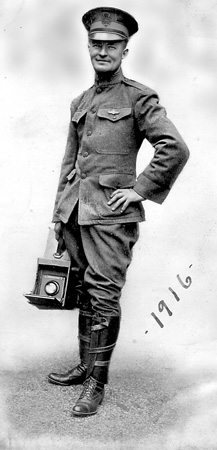


Eddie Jackson in his army uniform
Returning from France a seasoned, recognized professional news photographer, Jackson was offered many employment offers. He decided to work with Joseph Mendill Patterson and his cousin Robert R. McCormick, who were co-publishers of the Chicago Tribune and wanted to start a New York tabloid newspaper The New York Daily News. Launched on June 26, 1919 with Edward N. Jackson as their lead photographer, the publishers wanted large and prominent photographs of city news, entertainment and sports events and local city coverage, all of which was assigned to Jackson. The New York Daily News is today the sixth largest newspaper in the country and has won ten Pulitzer prizes.

"A photographer's photographer" quote by First Lady Mrs. Warren G. Harding who stated the Edward Jackson's photograph of her was "the best photo ever taken." The photo ran on the entire front page of the February 5, 1921 New York Daily News.


The unnamed writer from Southern Nazarene University in Bethany, Oklahoma, whose work, tentatively titled, "20s & 30s" Tabloid Journalism - Mankind's Obsession for Sensationalism, appears four times at archive.org, from Nov. 17, 2007 to Oct. 5, 2008, takes over from here:
One of the first exclusive picture opportunities for the tabloid occurred on September 16, 1920. Captain Edward N. Jackson of the Daily News was on a routine assignment in Wall Street when a dynamite bomb in a horse-drawn wagon went off, killing thirty people and injuring a hundred. Jackson went to work, capturing the best pictures of the disaster. Other photographers soon arrived on the scene, but by then the police had already drawn lines about the explosion area. Jackson consequently was the only journalist to escape with on-the-scene pictures of the victims and first aid work. In cases such as this, history influenced the paper to cover the story, and the paper’s pictorial coverage augmented history by supplying pictures that would have otherwise never existed.
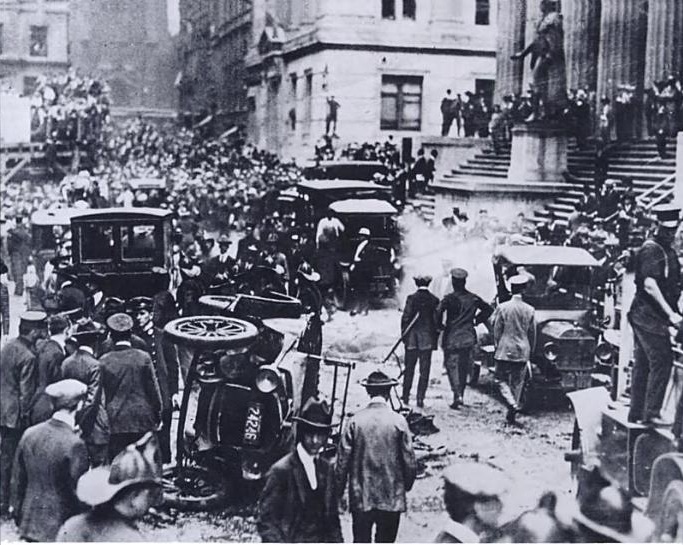

That Jackson could have been at this locale by luck, or chance, or happenstance is an absurdity. The 1920 Wall Street bombing has all the earmarks of a politically motivated catalyzing event---and not one likely to benefit the BOLSHEVIST OR GUILDSMAN, let alone the anarchists, communists, or militant socialists.

Chose your boogeyman via the New York Times:
REV. D.D. IRVINE'S THEORY.; Says "Vatican Created Atmosphere" That Caused Bomb to be Thrown.

THINKS GERMANS SET BLAST; HEARD THREAT; Teuton in Wall Street Uttered Warning Just After the Tragedy, ...

DENY UNION MEN SET WALL ST. BOMB; Federal Agents and Police Discredit Theory That LaborFight Cau

RED PLOT SEEN IN BLAST;

BANKERS THREATENED IN RED PUBLICATION

PLANS SEDITION LAW TEST.; Seymour Stedman Speech to Fores Issue In Kentucky.

LEE SAYS EXPLOSION WAS AN ACCIDENT; Socialist Asserts His Belief That Bomb Story Is a Capitalistic Inven
Of course, on the 17th, the Times reported that EXPLOSIVE STORES ALL ACCOUNTED FOR,

but on September 20th the lead story becomes EXPLOSIVES FOUND TO BE MISSING IN HUNT FOR BOMB PLOT CLUE;

Did they forget what they published on September 15?

FEEL DU PONT BLAST.; 3,000 Pounds of Powder Shake Wide Region in Pennsylvania.

Or that on June 13, 1915, General T. Coleman DU PONT BUYS EQUITABLE LIFE; Gets 502 of Society's Total of ...

New-York Tribune. September 17, 1920

Explosives Expert Declares Blast Was No Accident
[page 5, Columns 1 & 2]
Investigation Eliminates Licensed Wagons of Two Concerns, Only Ones With Right to Haul Dynamite

An investigation into all deliveries of dynamite made here recently was begun immediately after the explosion yesterday by the Bureau of Fire Prevention of the Fire Department.

Twenty inspectors were detailed to the work of checking up deliveries and the movements of dynamite wagons under Dr. William F. Doyle, chief of the bureau, and John F. Dixon, chief inspector of combustibles.

The inquiry resulted in eliminating the E. I. de Nemours Cornpay's truck from any possible responsibility for the explosion. At the same time the only other legitimate dealer licensed to deliver the explosive was eliminated.

It resulted also in the statement being made that it was unlikely that surreptitious shipment or delivery was the cause, as this practice does not obtain, owing to the stringency of the regulations governing the handling of explosives.

Explosives Trucks Bonded

The Dupont Company is licensed and bonded to deliver dynamite with an electric truck. This was in its garage at the time of the explosion and had not made a delivery below Sixteenth Street yesterday, according to both officials of the company and the word of inspectors. The vehicle which may have contained the explosive and was destroyed was horse drawn.

The only one other dealer in dynamite who also is licensed to sell and deliver the explosive in New York City is Carl H. Dittmar, of 102 West 130th Street. He operates two horse-drawn vehicles. Neither of these had been below Forty-eighth Street during the day, inspectors were told.

The Du Pont Company has two trucks, but only one is operated at a time, as only one is bonded. The other is kept for emergency reasons and is out of commission at present, it was said at the company's office in the Equitable Building.

C. C. Moore, an official of the company, said the truck had made no deliveries below Sixteenth Street during the day and was in its garage at the time of the blast. Chief Inspector Dixon said it was unlikely that the explosion could have been caused by a surreptitious shipment of dynamite, as contractors must make a sworn statement daily of the amount on hand. Each stick of dynamite is numbered and the magazines are inspected daily.

Check Kept on Explosive?

All blasting is done by licensed men and a check in kept upon the explosives. There is no such thing as an attempt to evade the laws governing their sale and delivery, according to Dixon.

Dixon, who is the Fire Department expert on explosives, said that if all of the experts in the country were brought here, in his opinion, not even three of them would be able to agree as to the form of explosive used and the quantity.

"I do not think it was an accident," he said, after his inspection of the scene.

The bureau turned over window sash weights and other pieces of metal found to the Police Department.
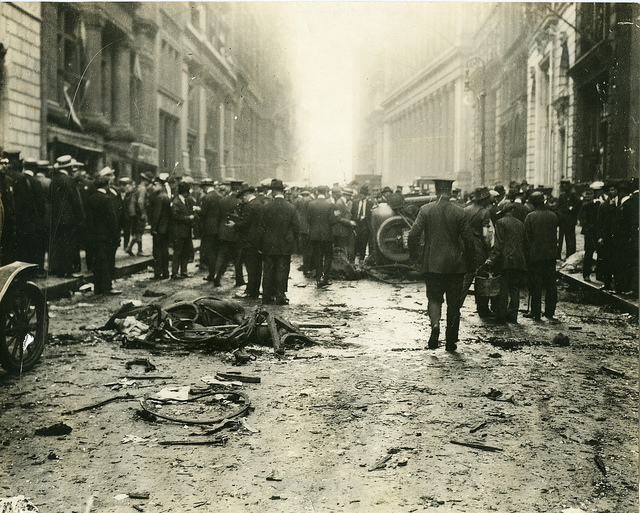

Supposedly the bomb sent metal projectiles through windows 32 stories up, but it couldn't even blow up a goddamn horse.

The Wall Street bombing slipped down the memory hole for one reason--it was no good as manufactured reality.

Do I need to make the painfully obvious associations with 9/11?

My 16,963-word transcript of reporting on the bombing in the
New-York Tribune. September 17, 1920,

Thursday, July 28, 2011

Somehow it Always Looked Bigger in the Lobby


John Quincy Adams Ward's bronze statue of Henry B. Hyde, unveiled in the ground-floor arcade of the Equitable Building, at 120 Broadway on May 2, 1901, on the second anniversary of Hyde's death, and which remained there until a fire and building collapse devastated the building on January 9, 1912, was then given by the Equitable Life Assurance Society of the United States in 1972 to the Metropolitan Museum of Art in New York City, where it remains not on view. It stands 21 inches in height, and otherwise measures seven-and-a-half inches by six-and-a-quarter inches.

See also: May 3, 1911, New York Times, "Tribute To Henry B. Hyde, Statue of Equitable Life Assurance Society's Founder Unveiled."

Note the luncheon guests listed in the 2nd paragraph:

Before the brief ceremony that preceeded the pulling of the string which let fall from the bronze its canopy of Stars and Stripes, a meeting was held in the board room of the society, up stairs. Senator Chauncey M. Depew and James W. Alexanderr, who is now President of the Equitablem, made speeches. Among those present were Louis Fitzgerald, E.H. Harriman, H.G. Marquand, Melville E. Stone, T. Jefferson Coolidge, Jacob H. Schiff, Sir William C. Van Horne, Col. John Jacob Astor, A.J. Cassatt, John A. Stewart, Levi P. Morton, August Belmont, Adolph S. Ochs, Cornelius Bliss, Gage E. Tarbell, William Alexander, Col. John J. McCook, G.B. Post, J.Q.A. Ward, Thomas T. Eckert, W.H. McIntyre, Samuel M. Inman, V.P. Snyder, Brayton Ives. C. Ledyard Blair, C.B. Alexander, Thomas D. Jordan, Marcellus Hartley, William A. Wheelock, and George H. Squire.


The above photograph was taken in 1912 by Edward N. Jackson. Joseph Caro's website, www.edwardnjackson.com, which supports his forthcoming book on Eddie Jackson, tells us that
One of Eddie's first free-lance photo opportunities before working for the American Press  Association, was the New York Equitable Building eight-alarm fire in the financial district on Pine Street in January, 1912.
Eddie Jackson had an instinctive eye for photo composition as these early pictures taken in the 1912 Equitable Building fire clearly show. With no formal training in photography or composition, Eddie shows us and his photographic peers of the era his ability to construct a photograph to a high dramatic level-even during the excitement of the scene as it unfolds. As Eddie Jackson stated later in life "a good photograph is worth 10 columns of copy."
Jackson went on to a distinguished career during WWI as personal photographer of President Wilson. Afterward, he worked for the New York Daily News, as an archive.org page tells us:
One of the first exclusive picture opportunities for the tabloid occurred on September 16, 1920. Captain Edward N. Jackson of the Daily News was on a routine assignment in Wall Street when a dynamite bomb in a horse-drawn wagon went off, killing thirty people and injuring a hundred. Jackson went to work, capturing the best pictures of the disaster. Other photographers soon arrived on the scene, but by then the police had already drawn lines about the explosion area. Jackson consequently was the only journalist to escape with on-the-scene pictures of the victims and first aid work. In cases such as this, history influenced the paper to cover the story, and the paper’s pictorial coverage augmented history by supplying pictures that would have otherwise never existed.
Jackson put it best himself perhaps:
Human history in its writing is fairly authentic – but I would offer that photographic history has an element of certainty about it that is indisputably authentic. The picture tells its own story – and proves it, is corroborative, and records details that are often lost in writing. Edward N. Jackson (1932)


The fire and collapse at the Equitable Building on January 9, 1912, was an early use of a nearly identical template as was later used on September 11th, 2001. The eerie parallels between the two events point out the manipulated and false-flag nature of much of what we take to be organic reality, especially as it comes to the powerful, and those who record and serve them.

Sunday, June 12, 2011

Security Officer Memorial Fund Newsletter, May 2004

Found maintained at archive.org, the newsletter posts a copy of a New York State Senate Resolution, No. 3788, adopted March 9, 2004, which intended to pay "tribute to the lives of the 36 Security Guards who perished during the September 11, 2001, World Trade Center terrorist attack."

However, if you count the names and professional affiliations found in the text, you'll see listed forty of these supposed "fallen," whose "heroic courage" in facing "unspeakable atrocities" and "unprecedented tragedy" led to their "ultimate sacrifice" while working as security apparatchiks on 9/11. Foot soldiers for a corrupt corporatocracy, they served the political fascism underlying a false-flag Casus belli for war of aggression. And in the fog of the aftermath, they came out of the woodwork to take credit.


These are the security-officer fatalities listed on the resolution:
  1. Wesley Mercer, New York City, Director of Security for Morgan Stanley Dean Witter;
  2. Rick Rescorla, Head of Security for Morgan Stanley Dean Witter;
  3. Titus Davidson, Bowles Corporate Services, New York;
  4. Godwin Forde, Bowles Corporate Services, New York;
  5. Charles Laurencin, Bowles Corporate Services, New York;
  6. Nolbert Salomon, Bowles Corporate Services, New York;
  7. Jorge Velaquez, Bowles Corporate Services, New York;
  8. Patrick Adams, Brooklyn, New York, Security Officer, Fuji Bank;
  9. Andrew J. Bailey, New York, New York, Security Supervisor, Marsh & McLennan;
  10. Barry Kirschbaum, Staten Island, New York, Security Manager, Marsh & McLennan;
  11. Francisco Bourdier, New York, New York, Security Guard, Deutsche Bank;
  12. Charles Gregory John, Security Officer, Royston and Zamani;
  13. Alexander Ortiz, Security Guard, Grubb & Ellis Inc.;
  14. Francis Joseph Trombino, Clifton, New Jersey, Security Guard, Brinks;
  15. Anthony Luparello Jr., Security Guard, American Building Maintenance;
  16. Sara Manley, New York, New York, Vice President and Senior Security Analyst, Fred Alger Management;
  17. Mohammed Jawara, MAS Security;
  18. Edward Calderon, Jersey City, New Jersey, Security Guard, Port Authority;
  19. Mannie Leroy Clark, New York, New York, Security Guard;
  20. John R. Fisher, Bayonne, New Jersey, Security Consultant, Port Authority of New York and New Jersey;
  21. Douglas G. Karpiloff, Mamaroneck, New York, Security Director, Port Authority;
  22. John P. O'Neil, Security, Silverstein Partners;
  23. Godwin Ajala, New York, New York, Security Officer, Summit Security Services;
  24. Larry Bowman, New York, New York, Security Officer, Summit Security Services;
  25. Francisco Cruz, Staten Island, New York, Summit Security Services;
  26. Denease Conley, New York, New York, Summit Security Services;
  27. Samuel Fields, New York, New York, Security Officer, Summit Security Services;
  28. Ervin Gailliard, New York, New York, Security Officer, Summit Security Services;
  29. Jorge Luis Morron Garcia, New York, New York, Security Officer, Summit Security Services;
  30. Ronald Hoemer, Massapequa Park, New York, Security Manager, Summit Security Services;
  31. Daniel Lugo, New York, New York, Security Officer, Summit Security Services;
  32. Leon Lebor, Security Guard, Summit Security Services;
  33. Esmerlin Salcedo, New York, New York, Security Officer, Summit Security Services;
  34. Robert Martinez, Long Island City, New York, Security Officer, Summit Security Services;
  35. Lawrence F. Boisseau, Freehold, New Jersey, Fire Safety Director, OCS Security;
  36. Richard Fitzsimons, Lynbrook, New York, Fire Safety Inspector, OCS Security;
  37. Philip Thomas Hayes, East Northport, New York, Fire Safety Director, OCS Security;
  38. William Wren, Lynbrook, New Jersey, Resident Manager, OCS Security;
  39. Robert J. Mayo, Marlboro, New Jersey, Fire Safety Director, OCS Security;
  40. Stanley McCaskill, New York, New York, Security Guard, Advantage Security;


If you assemble a list of all such names floated in the media record, the numbers in this category of faked fatality soon climbs to an absurd total.


Monday, June 06, 2011

FDNY Firefighter Rich Kane & President Barack Obama

The Staten Island Advance article from August 29, 2001, "Firefighter Felled By Apparent Heart Attack At Auto Shop Blaze," by Frank Donnelly and Ryan Lillis, a copy of which recently made a reappearance online, contains several pieces of unique information concerning the fire that claimed the life of rookie firefighter Michael Gorumba two weeks before the tragedy of September 11. In a previous blog, Rudi Giuliani, Michael Gorumba, and What the Talmud Teaches, I highlighted one such single-source reference: that Gorumba's body had been found by a New York City plainclothes police officer, slumped over the steering wheel of his company's Engine truck during the opening chaotic minutes of an "immense blaze that leveled" the business at 41 Rector Street, between Richmond Terrace and Castleton Avenue on Staten Island.

The fire was called in at 2:32 p.m., with other news sources specifying the second alarm was called in 13 minutes later, at 2:45 p.m.; eight minutes after that, the third alarm rang at 2:53 p.m., Ultimately 138 firefighters from 33 units were at the scene. But we're told the fire developed so rapidly that "after only a few minutes, half the building collapsed." The article goes on
"Port Richmond-based Engine Co. 157 was the first on the scene, rolling up in front of the entrance to the shop. A few seconds later, Gorumba's Engine Co. 163 arrived from its headquarters on Jewett Avenue in Westerleigh, pulling up behind the other engine, in front of a fire hydrant."
It would be impossible for Engine 163 to arrive only a matter of seconds after Engine 157, as the first engine had to travel only 1.4 miles, while the second company was located 3.6 miles from the fire.

From the firehouse for Engine 157 and Ladder 80, at 1573 Castleton Avenue in Port Richmond, to 41 Rector Street: 1.4 miles.

View Larger Map

From the headquarters for Engine 163 & Ladder 83, at 875 Jewett Avenue, in Westerleigh, to 41 Rector Street: 3.6 miles.

View Larger Map

And why didn't the house ladder companies respond with their engines to the first alarm? Don't Ladders do number one? We're told that the fire sent "a 75-foot wall of smoke into the air"--- ultimately firefighters "hosed the fire from ladders high above the blaze." But apparently, during the first, critical moments of the fire, when rookie Gorumba---on the job for all of a single month---took sick, went AWOL, and then was located by a passing New York's finest, with the brave firemen on the scene, members of these two, five-men engine crews, somehow failing to spot him.

Weirdly, the Advance article tells us that two
"emergency medical technicians who were injured had been on the other side of the fire building and were running across the area to aid the medics who were attending to Gorumba when they became engulfed in smoke and spray from fire hoses, a source said."
Somehow that reminds me of Bull Conners in Birmingham in 1963.

The New York Times' coverage provides some sense of the scene:
"Fire officials said the blaze appeared to have started in the rear of a sprawling set of interconnected buildings that make up the auto body shop."
Since the Advance article is specific that Engine 163 pulled up behind Engine 157 at the curb, it's unlikely they were leading a second front on the fire down some alley. The fire was being attacked by the men of 157 who had entered the front of the garage. How did EMT medics get "on the other side of the fire building," causing them to run through "smoke and spray from fire hoses," to the point of injury and becoming the object of rescues themselves?

Isn't the fact of such a swift-moving fire beginning in the nether reaches of a labyrinthine structure itself cause for investigator's interest? It sounds like a set up, and textbook arson to me. But the narrative logic, or lack thereof, gets even worse:
"Firefighters from Engine 157 were spraying the out-of-control fire when a 'mayday' call came over the radio, stating a firefighter was unaccounted for. Panic struck the emergency crews.

"You think, 'Where is he and how do we get him out?'" said Firefighter Rich Kane, an Annadale resident who was on a one-day assignment with Engine 157."

As Engine 157 kept fighting the blaze, several firefighters combed the area for Gorumba. A police officer who was nearby approached the 163 fire truck to find Gorumba -- in full gear -- unconscious inside the truck, fire officials said. He had never entered the garage.

"Member found, member at the rig," blared the fire radio.

"The truck's driver and the police officer began to give Gorumba cardiopulmonary resuscitation and medics from a St. Vincent's ambulance nearby were summoned. Gorumba was quickly placed in the ambulance and taken to St. Vincent's.
This is the first mention of Engine 163's chauffeur, who is never named in the public record. Where was he while Gorumba---who supposedly had been part of a two-man team manning a firehose before he took ill---backtracked to the truck's cab to die? Why would the men of 163 put out a radio announcement that alarmed the men of 157, who were working at the heart of the fire, doing what they are supposed to do---"spraying the out-of-control fire" with w a t e r! OK, Helen Keller?

Even if Gorumba went missing, it's absurd he'd be near the action, with the first arriving company at an inferno, so why was 157 radioed at all, after somebody in Engine 163 failed to supervise his newbie partner? 157's chauffeur should also have been outside by the curb; by the hydrants and the engine trucks and 163's chauffeur. The radio report was inaccurate to boot: "Member wasn't found," at least not by a brother fireman; and "member was dead at the rig," not the "all-clear" that was sounded.

What makes the happenstance of Gorumba's being found by an undercover cop amid what the Times described as "a stretch of low-slung commercial buildings," (but what shows up on Google satellite as being a gritty auto-repair-shop district,) all the more interesting, is the guileless, gratuitous, but utterly transparent information found in the Advance article concerning Firefighter Rich Kane---a temporary fill-in member, who "was on a one-day assignment with Engine 157." It turned out to be such a special day out in the boonies of Staten Island. Did he go out on a call because someone had called in sick? His regular, higher-tone gig is in midtown Manhattan. Just ask Barack Obama, who greeted Kane and his cohorts when he came to town recently to publicize the United State's offing of Osama bin Laden.


Source SI Live image, Obama and Rich Kane

It seems certain that Kane's quote in the Staten Island Advance wasn't an elaborate ruse on some grand chessboard. Other quotes in the same article back up Kane's as being exceptions to the taciturn flow of public information that normally issues out of this hierarchal "brotherhood," one which is beholden to the same rules of order and discipline and secrecy as the military services.

Opinions outside the usual chain of command describe Gorumba as being fantastically fit:
"Disbelief," was how Battalion Chief John Calderone of the 22nd Battalion described the scene.

"I mean, I hate to use the word routine, but this really was a routine fire," said Deputy Chief Theodore Goldfarb of Division 8. "[Gorumba] was in excellent shape. He was one of our fine young products."
Recently, I have been studying the newspaper record of New York City firefighter fatalities going back over 30 years, and I've never encountered such anecdotal, and contradictory, commentary in any other case. Which is not to say that other previous line-of-duty deaths in the department are necessarily real---in addition, I should clarify, to the soap opera fiction known as 9/11. Little appears to be what we are told it is in recent years, being either faked death, or in some cases, sacrificial, occult, or "collateral," murders. Not that we can't find contrast in the authentic response when real tragedy strikes---like the legitimate Deutsch Bank fiasco that took two beautiful men's lives.

When I saw Rich Kane's "one-day assignment" quote in the Staten Island Advance article, which only recently resurfaced, my skeptical eyebrow went up. Then I saw the photograph of Kane and Obama shaking hands as part of the president's recent firehouse tour, (which I found posted online at SI Live---it may be in the print edition of the Advance too,) I recognized a strong connection between these two occasions, but I interpreted it's meaning wrongly at first, I believe, as only some sort of sinister showing off.

Then I began to see a direct parallel between the Kane/Obama image and another photograph published of President Obama greeting Beverly Eckert at a White House function, taken less than a week before her sudden death in a airplane crash, which was caused by something other than the blind-fate coincidence we are told is its only significance. This image is used at Wikipedia to illustrate her entry, and it is both beautiful and profound.


I have never been able to tell clearly the good guys from the bad guys in the 9/11 drama, and its coverup, which doesn't reflect a moral relativism in me, just an average naivety and hopeless narcolepsy. But I just went back and reread a blog I wrote about her, Given Beverly Eckert's Death, it Behooves Us to Ask the Question: Could the Jersey Girls Possibly Be False Flag Agents of the Conspiracy? from Feb. 14, 2009, as well as a supporting piece, Continental Connection Flight 3407, from February 18,2009, but I did so with dread. I expected to be mortified that I'd gotten so much wrong in long ago "experimental" work, but I was pleasantly surprised to find that I'd gotten it just about right. Our collective consciousness is rising, and developing, from all the strain we are putting it through.

I've concluded that it's hard to know the truth about reality, and there's nothing to be afraid of in that. Since money never offered what it promised, neither will death I bet. Maybe Rich Kane is a good guy, who on August 28 was working, like Maxho the Russian---who flew over the Pentagon on August 25, 2001, and down the Hudson on September 11 at 9:03 a.m. A spy maybe, a witness certainly, a taker of pictures, or the subject in pictures.

They can't get away with unjust murder. My friend Russ J. was Chief Oreo Palmer's aide for quite some time. He tells me that I would have really liked Chief Palmer if I'd ever had the chance to meet him. Who knows?

(Oh rats. I may have gotten Rich Kane exactly backwards. Read this Staten Island Live article from last month, "15 who never came back are unseen guests as Obama lunches at 9/11 firehouse," by Stephanie Slepian, for the most maudlin crap. It closes with this line: "It provides some closure for 9/11," said Kane, who hasn't been to Ground Zero since March 2002 -- the day one of the firehouse's rigs was found."

The rig was parked on the street, wasn't it? Can they mean to say that some portion of the surrounding streets wasn't cleared off for six months, enough to bury a whole, even flattened, firetruck, and not even a corner of it poked through? Maybe they'd want to get in there and look for some pf those old stinky body parts? You see, without an iota of objective truth to fall back on, it's just all B-movie screenwriting. Drat, and fie on them!)

The following two compendiums organize some of the research :

News Articles Concerning the LODD of FF Michael Gorumba

Worksheet on the LODD of FDNY FF Michael Gorumba,

The forum page for "Engine 054 / Ladder 004 / Battalion 009 - Manhattan," at www.fallenbrothers.com, has done some heavy lifting for this house where Kane dined; famous for loosing 15 of their comrades in lasagna and schnitzel.

So why do they list 17 names? Am I missing something?

ENGINE 54
FF. Jose Guadalupe
FF. Leonard Ragaglia
FF. Christopher Santora
FF. Paul Gill

LADDER 4
CPT. David Wooley
LT. Daniel O'Callaghan
FF. Joseph Angelini, Jr.
FF. Samuel Oitice
FF. Michael Haub
FF. John Tipping II
FF. Michael Lynch
FF. Michael Brennan

BATTALION 9
BC. Edward Geraghty
BC. Denns Devlin 
FF. Alan Feinberg 
FF. Carl Asaro
FF. Charles Garbarini

So far, I've only looked up David Wooley, which the Times profile said had a sideline putting up wallpaper. He even took a job putting up the wallpaper in the post-presidential Westchester home of Bill and Hillary Clinton, whom he describes as "very nice." Who could make this stuff up?

Tuesday, May 24, 2011

Chaplains


FBI Chaplain Paul Wierichs
September 11, 2006, Palm Beach Post, "FBI chaplain recalls unparalleled havoc," by John Lantigua
Wierichs worked for 14 years as the Catholic chaplain to FBI agents in New York City. He bolstered them as they investigated the first World Trade Center bombing in 1993, which killed six and injured more than 1,000. He offered them spiritual support as they scoured the grisly remains of TWA Flight 800, which crashed on Long Island in 1996, killing 230 people.
During the following week, Wierichs recalls, 18 people were pulled alive from the wreckage, but hundreds and hundreds were brought out dead, day and night.
"The fire department guys always insisted on carrying their own," he says. "Everyone would stop and salute and I would step forward and anoint them."
He also discovered a makeshift morgue established nearby in a Brooks Brothers men's clothing store.
"They had no body bags yet, so they used Brooks Brothers apparel bags to hold the body parts," he says, with a shake of the head and, even now a look of disbelief.
One day he went to nearby St. Patrick Church, where more bodies had been taken. Lying right in front of the altar was a corpse covered by a blanket and a priest's stole draped over it. The stole is the narrow vestment a priest wears over his shoulders for certain ceremonies.
The body was that of the Rev. Mychal Judge, a fire department chaplain who had died with his men inside the World Trade Center.

September 28, 2005, The Maple Leaf (Canadian National Defense) "The humanity of inhumanity: September 11 revisited," by Kristina Davis,
Senior Federal Bureau of Investigation (FBI) Chaplain (New York Division) Stephen Unger.
The "pastor of disaster"
The traffic was gridlocked in Manhattan as he snagged a ride toward the towers with three NYPD officers. Ironically, they were trying to get to the chaos as hundreds and even thousands of people streamed from the downtown. One officer, Scott, who Chaplain Unger describes as "a little excitable” decided he would clear the traffic—waving his 9 mm in the middle of the street.
Though the tactic worked, Chaplain Unger turned to the officer and said: “Scott, you know I’m a chaplain and that’s not good for my image. Next time, you can borrow my crucifix if you’d like.”
He speaks about Father Mychal Judge the New York City Fire Department chaplain who died of a heart attack shortly after the first tower was hit. Truly loved, his death certificate bears the number 00001, making him the first official casualty of the attacks on the World Trade Center.
Chaplain Unger was one of the men who came upon Father Judge’s body, lovingly laid in the 163-year-old St. Peter’s Church. He had been carried there in a chair by some of New York City’s finest and laid at the altar—his body covered by a sheet, his head surrounded by his own blood, and his credentials—as they are called—placed on the sheet.
And while it was erroneously reported that Father Judge died while giving last rites to a firefighter, Chaplain Unger confirms he did die of a heart attack. And he died first, the firefighters who loved him say, so he could be there to greet them at Heaven’s gate.


Dr. Michael K. Haynes is the President and Founder of The Faith Based Counselor Training Institute. Michael is a prolific creative writer and the author of 60 books in addition to curriculums for FBCTI, Canyon Creek Seminary and numerous other schools. Dr. Haynes also founded Crisis Chaplaincy Care following his year of service at Ground Zero in New York City during the aftermath of the terrorist attacks of9/11. He is a licensed pastoral counselor having served as a senior pastor for 16 years. He also operated a private counseling practice and center for several years following. Dr. Haynes has been in the ministry since 1969.


Bishop David Hartman has an extensive background in crisis intervention. He was appointed by Mayor Rudolph Giuliani to oversee the entire crisis clergy coordination at Ground Zero in New York City following the terrorist attacks of 9/11. He is a 22 year veteran retired detective with the New York Police Department and over sees over 200 churches around the world. He holds a Ph.D. in counseling and is a highly sought after speaker. Dr. Hartman and Dr. Haynes became close friends as they worked for over a year together helping the victim’s family's of 9/11. He is also heavily involved in developing the churches of Nigeria.

The Spirit of the Law,
Spiritual Resources For Law Enforcement,

Dr. Steven Davis spearheaded SpiritoftheLaw.org website as a resource for Law Enforcement Administration, EAP units,

Steven L. Davis, Ph.D., is an FBI Chaplain, assigned to Washington, DC and Quantico, VA. In this capacity he is a resource provided by the Bureau to the employees and families of the agency. FBI chaplains work in cooperation with the Employee Assistance Program, and are available for call outs 24 hours a day, seven days a week to provide critical incident debriefings, to help employees and their family members find direction in solving personal, family and emotional problems. He was called out to the PentBomb site for the first several days after the terrorist attacks in September 2001. The presence of a Chaplain is requested at critical incidents, such as the 9-11-2001 attacks in New York and the Pentagon, as well as to ERT, death notifications and on an as-needed basis at the request of an employee or of the Bureau.

Sunday, May 22, 2011

Rudi Giuliani, Michael Gorumba, and What the Talmud Teaches

Starting back in 2004 and 2005, Ray Ubinger, along with other researchers, analyzed the Naudet brothers/James Hanlon-produced documentary film, 9 11, and laid out a case that it constituted a coded portrayal of a sinister subtext underlying the attacks of September 11, 2001. Ubinger calls it "a snuff film."

In a December, 2005 thread at Democratic Underground, Strange Death of Michael Gorumba, he spells out this position:
"I posit that the Naudet-FDNY team had Michael Gorumba MURDERED (on August 28, 2001), maybe with a heart-attack-mimicking drug, for the specific purpose of advancing the plot and increasing the dramatic tension of the Naudet movie."
adding for good measure
"I am confident that Joseph Pfeifer and Jules Naudet had direct involvement in a murder against Mychal F. Judge, or/and filming Mychal F. Judge being murdered, inside WTC-1 on 9/11. I am strongly suspicious that James Hanlon and Eddie Fahey helped Pfeifer and Jules Naudet in this."
I subsequently looked into the case of Father Mychal Judge, and I am equally as confident as Ubinger that Judge's death was a premeditated, sacrificial murder executed by members of the New York City Fire Department for its value as public relations, and for the purposes of storytelling.

I hadn't looked into the death of Firefighter Michael Gorumba before now. He was the young probationary firefighter who died a line-of-duty death fighting a fire on Staten Island on August 28, 2001---just 13 days before the epochal attack that killed a further 343 of his brothers---and the story of his death serves in the film as a stylistic presage, or coded premonitory of what is to come.

In the DU thread, Ubinger mentions that
"He was reportedly found dead, alone in the firetruck, by a PLAINCLOTHES COP who just HAPPENED to be (wink, wink) passing by the scene of the fire."
In studying the media record available online, this reference remained a mystery to me---until recently, when by chance, I came upon a copy of the journalism that records it: an article in the Staten Island Advance from August 29, 2001, headlined, "Firefighter Felled By Apparent Heart Attack At Auto Shop Blaze," by Frank Donnelly and Ryan Lillis.

This article is both a primary and singular source for new information like this, elements which call into question the known media reporting on the event, and I have no doubt it was effectively suppressed by an active and determined agency for these past nine years. Its veracity can be judged by the standards of professional journalism, but in its effect it does more than further disintegrate the official narrative. By coming to light as it does now, it challenges our presumptions of how truth and reality can be known, which may be the ultimate lesson we have to learn from 9/11.

I have assembled a worksheet on Michael Garumba aimed at determining the facts of his death, as well as several other highly publicized uniformed-service fatalities, which taken together buttress a central point--- that the publicized demarcation between an individual's life and death can be manipulated by governments and authorities working in conjunction with a cooperative corporate media. In other words, death can be faked for political ends; with mock funerals for people still living but remaining in seclusion; or, with the help of agents and actors playing the roles of survivors and "family members," simulating the death of computer generated identities for consumption second-hand in newspapers and on television.

And nothing was more politically motivated than the 3,000 deaths on 9-11.

If death is faked to serve manipulative agendas, so are many aspects of life put to such use. Another reference from Ubinger's DU thread hints at this:
"In an intriguing side note, Rudy Giuliani scored political points by arranging for himself to give away Gorumba's sister at her wedding on September 15, 2001."
Ubinger is mistaken to classify Giuliani's performance following 9/11 as a political victory. The effect of his role was far deeper and more psychologically profound than that. A traumatized public needed a heroic leader to guide them in the aftermath, and who better to play the role than a foreknowledged participant who hadn't undergone the same traumatization process? A key player in front of the camera who likely had been given ample time and unlimited resources to prepare and rehearse for his role.

Not only was Giuliani immune from the psychic scorch of the millennial attack affecting the public, he was part of the operational planning, which for a scheme on the scale of 9/11 didn't stop when the second tower came down, or the third, for that matter. A road map for the aftermath was clearly set in place, at least until the Iraqi people stood up to the corruption of the American military occupation under Paul Bremer, and the tattered plans had to be recalibrated.

So the wedding of Michael Gorumba's sister, scheduled for the Saturday four days after the attacks, and the larger circumstances which necessitated a surrogate's role of escorting the bride down the aisle (in addition to her brother's death, her father and grandfather had both died within the year, with some accounts placing their deaths within the preceding few months,) afforded an opportunity that could function as a turning point, between the despair of the still yet undetermined losses, and a promised return to a hopeful normalcy. And what is more hopeful than a wedding?

Nothing in the 9/11 narrative has the fingerprints of psychologists and scriptwriters all over it as much as does Giuliani's wedding interlude.

And nothing could provide a more just irony than Giuliani, the man who informed his second wife he was leaving her by way of a city hall press conference, being fitted into such shoes.

It doesn't take the return of a prodigal-son newspaper article to make this case either. The record is replete with glaring inconsistencies and garish performances, which might have worked as public relations spin under the emotional shock of the moment, but it is startlingly galling to witness now.

A bride whose determined mother insists a wedding go forward two weeks after the sudden death of her 27-year-old, only son, with the loss of both her husband and father still fresh in memory, wouldn't let a little thing like 9/11 intervene, would she?

Is it normal to travel from this


to this, but while also sharing the communal experience of September 11th, only four days before?


Did this service that Giuliani volunteered to perform really require the presence of an international press corps there to record it? Supposedly, Giuliani's arrival outside the church caused the crowds gathered there to begin a chant of "USA! USA! USA!" that could be heard inside. His actual entrance as he walked down the aisle gave rise to spontaneousness applause by the attendees. Who exactly was doing whom a service in this scenario?

Only Giuliani Partners knows for sure.


I've spelled out the anomalous detail more fully here. But evidence of the writerly nature of this piece of the 9/11 narrative comes from another source---Mr. Giuliani himself.

He wrote about his experience in walking Miss Gorumba down the aisle in a first-person account that was included in a book Marlo Thomas edited, called, 'The Right Words at the Right Time." Published in 2004, it is a compilation of feel-good vignettes written by bold-face names, and Giuliani's fits in very nicely here. The beginnings of his story are available online at Google Books, and I've extracted small samples from the copyrighted work under provision of the Fair Use Act.

Because a problem presents itself. I found a second version of Mr. Giuliani's story online, on a page from the website of the Beth Tzedec Congregation of Toronto. Called Weddings and Funerals, Yom Tov and Yizkor, although no author's attribution is given, the page says it is copyrighted 2008, by the Beth Tzedec Congregation itself. I've also excerpted brief passages from it for the purpose of a comparison.

For it appears that one party is plagiarizing the other, in a classic case where long stretches are lifted directly from the same source, and while both follow an identical development, enough variation exists to hint that an attempt at disguise has been made.

EXAMPLE 1:

From: 'The Right Words at the Right Time, by Marlo Thomas & Rudolph Giuliani
Think about it. At this very moment I have two things in front of me: dealing with my son's death---which I have to do and will do---and dealing with my daughter's wedding. I choose to focus on the wedding. Why? Because life is a combination of great tragedy and great beauty. This family will deal with our tragedy. But we will also celebrate the beauty of this wedding with even greater joy.
**************************************
She told him: at this moment I have two choices in front of me: dealing with my son’s death — which I have to do and which I will do---and dealing with my daughter’s wedding. I choose to focus on the wedding because, she said, life is a combination of great tragedy and great beauty. We will deal with our tragedy. But we will also celebrate the beauty of this wedding and we will do so with even greater joy.”
From: Weddings and Funerals, Yom Tov and Yizkor, Beth Tzedec Congregation of Toronto,

EXAMPLE 2:

From: 'The Right Words at the Right Time, by Marlo Thomas & Rudolph Giuliani
The next day, I went to the wake. Mrs. Gorumba approached me with her daughter by her side. "This girl has lost all of the male relatives in her life," Mrs. Gorumba began, "and there's no one left to give her away on her wedding day. Even before this tragedy, our family admired you, so I want to ask you a favor: Could you walk my daughter down the aisle?"
"I would be honored," I told Mrs. Gorumba. I also said what was in my heart: "This was one of the most beautiful things anyone had ever asked of me.
**************************************
At the wake, Mrs. Gorumba came over to him, with her daughter. She said to him, “We have a favour to ask. My daughter has lost all of the male relatives in her life. In ten months she has lost her father, her grandfather, and now her brother. We have no one left in the family to walk her down the aisle. Our family has always admired you. I would like to ask you a favour. Would you walk my daughter down the wedding aisle, please?” Giuliani told her that this was one of the most beautiful things that anyone had ever asked him to do in his whole life. And he promised that he would be there.
From: Weddings and Funerals, Yom Tov and Yizkor, Beth Tzedec Congregation of Toronto,

I believe this represents the presence of a master underlying narrative script, which both versions use as their foundational source. I have long suspected that these sorts of scripts underlie the work of almost all the journalism written about 9/11. Thousands of such words could be churned out overnight, under the same conditions of shock and dismay then affecting the public. The authorial voice is remarkably consistent across different continents, with the same sappy sentimentality and lack of journalistic rigor crossing over socio-economic and educational divides. The message always stays on point, but nothing ever adds up or develops. It's as if they threw paint at a wall and saw what sticks and nobody ever called them on it.

I suppose it's possible, if unseemly, for the anonymous writer from the Toronto congregation to have lifted long sections from a 2004 copyrighted work to include in his or her own copyrighted work in 2008, but what links the two efforts is a deeper ideology, and definable agenda.

The well spring for the synthetic narrative development known as Giuliani's wedding march is unwittingly telegraphed at the close of the Beth Tzedec page, when wisdom from the Talmud is quoted:

"If a wedding procession arrives at a crossroads at the same time as a funeral procession, which goes first? The wedding procession. We always choose life."

Giuliani's wedding performance on September 15, 2001 was as much an intersection in our emotional manipulation as any literal traffic jam the Talmud proposes. So rather than being an intriguing side note to the murder of Michael Gorumba, as Ray Ubinger suggests, the story of the sister's wedding can be situated more centrally in the plot.


Michael Gorumba, with domestic partner Lori Campbell, and their son Andrew.


Time to memorialize the dead.


News articles on the LODD of FF Michael Gorumba, with full text and links to sources.

See also: www.spingola.com

"The Naudet film contains not one reference to the Fathers' Day fire: because it happened in June, just after they started filming, maybe it just was not as convenient to a Naudet script."

Not only was it not convenient---it was highly inconvenient!


Five years later, September 15, 2006, when Giuliani was running for President, he wrote a different version of the story on his presidential blog, Giuliani Blog-On the Road to the White House, "Rudy - Now More Than Ever: Promises Kept," Rather than asking him directly, an intermediary was involved:
"[Gail] Gorumba asked New York Fire Commissioner Tom Van Essen if he would ask Mayor Giuliani if he would do the honors.

"I would be honored to do it" Rudy replied instantly."

Tuesday, May 17, 2011

Was the NYC Fire Department Studying the Sociological Aspects of Mass Firefighter Fatality in Advance of 9/11?

"That sort of childhood experience never entirely goes away, said William Kornblum, a professor of sociology and an urban affairs expert at the Graduate School of the City University of New York. "There's this endless fascination we have with fire equipment and fire lore," Professor Kornblum said. "So the death of a firefighter reaches us in a very visceral way."
January 03, 1996, New York Times, "Why Deaths of Firemen Touch Public,"  by Frank Bruni,

Almost two years have passed since the tragedy at Ladder Company 5 in downtown Manhattan, but Lieut. Michael Warchola still fields sympathetic smiles and tender condolences from strangers on the street.

"How are you guys getting on?" someone will ask him and his fellow firefighters as they respond to routine calls in Greenwich Village or SoHo.

"You guys do a great job," someone else will say, and Lieutenant Warchola knows that beneath that simple salutation lies a powerful subtext: that the men at Ladder Company 5 do their jobs despite grave danger, which led to the deaths of three comrades in connection with one horrifying blaze in March 1994.

Before that fire, we felt that the neighborhood was somewhat indifferent to us," Lieutenant Warchola said yesterday. "But after, you wouldn't have believed all the flowers and cakes and the boxloads of cards. It touched every one of us deeply -- to a man. And it still does."

What Lieutenant Warchola saw back then, and what he said he has noticed repeatedly since, is the special outpouring of public grief that accompanies the loss of a firefighter in the line of duty.

That communal welling of emotion is occurring yet again with the death earlier this week of Lieut. John M. Clancy, 35, a firefighter killed when he stepped inside a burning house in Jamaica, Queens, to make sure that no one was stranded inside.

"It's because a person you don't even know is willing to put his life on the line for you -- it's the selflessness of it," said June Russo, one of more than 200 mourners who grimly filed into the Raynor & D'Andrea Funeral Home in West Sayville, L.I., near Lieutenant Clancy's home in Oakdale, for his wake yesterday afternoon. Surrounding Lieutenant Clancy's coffin were dozens of wreaths and bouquets; nearby, on a small table, sat a teddy bear in a miniature firefighter's uniform.

Ms. Russo knew the Clancy family personally; she taught school with Lieutenant Clancy's wife, Dawn, who is six months pregnant with the couple's first child. But the grief that Ms. Russo expressed over Lieutenant Clancy's death had both personal and public dimensions.

That was true as well for the many firefighters who came to pay their respects and who ruminated aloud about the wide reverberations of a death like Lieutenant Clancy's.

"People are petrified at the thought of fire, of being in a house that's on fire, and I think they kind of idolize the sort of people who walk into a burning house," said Firefighter Joseph Miccio of Ladder Company 127 in Jamaica, where Lieutenant Clancy was most recently assigned.

Firefighter Miccio and others said that Lieutenant Clancy's death carried especially tragic notes. It came, they said, at a moment in his life when so many good things were about to happen for him and his wife. The expected birth of the couple's first child in April represented the culmination of years of trying and hoping. The couple also had plans to buy some property soon and build a new house, friends said.

Those sorts of details have given Lieutenant Clancy's death resonance for many New Yorkers who neither knew him nor have any particular connection to the fraternity of firefighters.

"It hurt me personally because I have a son, and I would hate to be doing my job and be killed for that and not see my son grow up," said Larry Crawford, 24, a school bus driver who lives near Ladder Company 127.

A steady stream of neighbors stopped by Ladder Company 127 yesterday, as they did the day before, to drop off food or cards or simply to express their sympathy.

Sometimes, the City Fire Commissioner, Howard Safir said, the gestures grow much more extravagant than that. He said that one businessman who wished to remain anonymous had in the last two years pledged to provide four-year college scholarships to the children of every firefighter killed on duty.

After the fire that killed three of Lieutenant Warchola's colleagues, Commissioner Safir said, a well-known artist, Michael Molly, painted and donated a portrait of the men.

This widespread public affection for firefighters is attributable in part to the public's uncomplicated relationship with them, firefighters and other observers said.

While police officers can be a bane as well as a blessing, halting speeders and nabbing scofflaws, firefighters are almost solely associated with acts of kindness. They are the ones who, at least in legend, climb tall ladders to coax cats out of tress. And they are the ones who, in fact, show off their intricate equipment and blazing red chariots to bedazzled children.

"What's the first class trip you took when you were in school?" asked Harry G. Ryttenberg, a former spokesman for the New York City Fire Department. "To the firehouse."

That sort of childhood experience never entirely goes away, said William Kornblum, a professor of sociology and an urban affairs expert at the Graduate School of the City University of New York. "There's this endless fascination we have with fire equipment and fire lore," Professor Kornblum said. "So the death of a firefighter reaches us in a very visceral way."


Related question:

Did the FDNY study the implications of mock death on their personnel and their families in advance of 9/11, by staging fake fire department fatalities? Wouldn't this sort of study results have been required to effectively enlist hundreds of departmental members into a secret plot?


Colleague's Funeral Is a Lesson in Firefighters' Vulnerability

By FRANK BRUNI

Published: January 05, 1996

The traffic was light and the course was simple: a straight shot east for about an hour on the Long Island Expressway, with a few quick turns off Exit 62 to get to the church.

But for many of 22 New York City firefighters who left downtown Manhattan on a chartered bus yesterday morning, the journey could not have been more difficult.

Their destination was not merely the funeral of yet another fallen comrade, Lieut. John M. Clancy, 35, the ninth firefighter to be killed on the job in the last two years, grim ones for the Fire Department.

These passengers were traveling as well toward a renewed sense of their own vulnerability, toward a fresh appreciation of the flukes that decide which of them will get to watch their children grow tall and which will leave widows behind.

"It's always a long trip, and it stays with you for a good long while," Firefighter John Collins, 31, said of the sorrowful trek to a fellow firefighter's funeral. He has made it twice previously in just a year and a half on the job.

Each funeral is harder to shake, Firefighter Collins said. "The more time you have on," he said, "the more it hits you, because the more dangerous situations you've encountered, and you think back on each of them and wonder what made the difference -- why you came out O.K."

"Some things in life just happen," he added. "They're beyond our control."

That sense of an unpredictable destiny was deeply felt and widely shared among the men on the bus, as it surely was among all of the estimated 8,000 to 9,000 firefighters who arrived in their crisp dress blues at Our Lady of the Snow Roman Catholic Church in Blue Point, L.I., yesterday, for Lieutenant Clancy's funeral mass. Lieutenant Clancy, of Oakdale, L.I., died on Sunday when he entered a burning house in Queens to check for survivors and the floor collapsed.

Like the men on this particular bus, most of the firefighters, did not get seats inside the church to hear Mayor Rudolph W. Giuliani praise Lieutenant Clancy as a model of courage and dedication or to see Lieutenant Clancy's wife, Dawn, who is six months pregnant with the couple's first child, rub her swollen belly over and over again, as if comforting her unborn baby.

And most of them, like the majority of men on the bus, did not personally know Lieutenant Clancy.

But they went because they understood all too well that the figure inside the coffin could have been any of them. They came not just to pay tribute to the dead but to make a promise to the living: this is what we will do for you, should it ever come to that.

"You'd want that support for your family," said Lieut. James Rosenberger, one of the men on the bus. "If you died and 10,000 guys showed up for your funeral, wouldn't your parents think, 'Hey, my son was very important' ?"

The sad but spectacular pageant staged for Lieutenant Clancy yesterday was certainly the kind of farewell accorded a hero.

Shortly after 10:15 A.M., the thousands of firefighters in the street were called to attention. They stood in a rigid, dense phalanx facing the church, their breath rising in clouds in the frigid air. Stray coughs and sneezes could be heard as distinctly as gunshots.

Minutes later came the wail of bagpipes and the beat of drums, heralding the arrival of a fire engine that carried Lieutenant Clancy's exposed coffin, draped in a red and white Fire Department flag.

Eight firefighters carried Lieutenant Clancy's coffin into the church. It rested there at the front of an aisle separating Lieutenant Clancy's family members from the many city politicians and other prominent figures who came to pay their respects.

Addressing the congregation, Fire Commissioner Howard Safir spoke of how Lieutenant Clancy followed in the footsteps of his father, also a city firefighter, and of the valor Lieutenant Clancy showed.

"He did not stop to ask if the victims were black or white, rich or poor, young or old," Commissioner Safir said. "He stepped into harm's way, because that is the life he chose."

Mayor Giuliani told the congregation: "He understood the duty we owe as human beings to all of those who share our humanity."

But perhaps the most touching tribute came in the eulogy by Firefighter Jack Acierno, a longtime friend. "John was a perfectionist," he said. "They say that heaven is perfection. If it's not, Lord help them. John's coming."

Lieutenant Clancy's mother, Geraldine, broke down in tears, burying her face in her hands, but his wife, Dawn, sitting in the same church where the couple was married 10 years ago, was more composed, even managing a weary, proud smile now and then.

When the funeral ended around 12:30 P.M., Lieutenant Clancy's coffin was transported to Holy Sepulchre Cemetery in Coram, L.I., where he was to be buried alongside his father, Edward Clancy, who died in 1993.

The men on the bus from downtown Manhattan did not plan to follow Lieutenant Clancy that far. After the funeral, they said, they would attend an enormous gathering of firefighters to eat and maybe drink and begin the process of putting what happened to Lieutenant Clancy out of their minds, so that they can get on with their jobs.

That kind of forgetting has been particularly hard these last two years, said the men, most of whom work out of the firehouse at Avenue of the Americas and Houston Street from which the bus departed. This is the firehouse where three men killed in connection with a March 1994 fire on Watts Street in Manhattan worked. Those deaths ended a period, from 1988 to 1993, when no more than two city firefighters were killed on duty in any year.

In 1994, five firefighters died, and in 1995, four.


As the bus barreled down the highway on the way to the funeral, the men dealt with their journey in different ways. A few sat by themselves, hushed and introspective.

"A lot of us practice denial," said Firefighter David Clifford, in a voice that sounded both pained and frightened. "'It's not going to happen to me.' Everybody on this bus tells himself that. But we know better."

Other men chattered incessantly, and with a cheeriness that was perhaps too insistent, about the football playoffs, the relative merits of different suburbs -- anything but the funeral.

A few cracked open cold beers, and a few even cracked jokes.


"You're either laughing or you're crying," explained Firefighter Gregg Wasserman. He seemed about halfway between the two.

As the bus pulled into Blue Point, the men saw streets teeming with other men dressed just like them.

"When you understand the hurt that's involved, you understand the size of this ceremony," said Capt. Bill Youngson. "There, but for the grace of God, goes any one of us."


All of this sounds profoundly self-conscious to me, and not in the least bit grief stricken.


Read this series of news articles about the death of Lt. John M. Clancy, to see the facts don't add up. I think somehow Frank Bruni captured the subtext behind the event, even if he wasn't in a position at the time to imagine the text, let alone report on it.

January 1, 1996, New York Times, "Searching for Victims in Blaze, Firefighter Takes a Fatal Step," by Richard Perez-Pena,
January 02, 1996, New York Times, "Parolee Faces Murder Charge In Queens Fire," by Joe Sexton,
January 03, 1996, New York Times, "Firefighter Died in Building Once Marked as a Hazard," by Joe Sexton,
January 03, 1996, New York Times, "Why Deaths of Firemen Touch Public," by Frank Bruni,
January 05, 1996, New York Times, "Colleague's Funeral Is a Lesson in Firefighters' Vulnerability," by Frank Bruni,
January 09, 1996, New York Times, "For Widow, Fire Department's Support Is a Lifeline," by Richard Perez-Pena,
November 13, 1996, New York Times, "17 Years in Fatal Arson,"
October 31, 2000, New York Times, "Guilty Verdict Is Overturned In Fatal Blaze," by Shaila K. Dewan,
January 19, 2001, New York Times, "Man Gets 15 Years in Fire That Killed Firefighter,"
by Edward Wong,


Could it really be true that two tragic fires which bookend September 11th--the Watts Street fire in March 1994, which killed three firefighters, and the Deutsch Bank fire in August 2007, which killed Firefighters Joseph Graffagnino, and Robert Beddia---both involved Ladder Company 5 and Engine Company 24?