Wednesday, July 23, 2014

Guyana Image Uploads

20029
Mark Lane: Death As a Way of Life,


December 5, 1978, Spokesman-Review - AP, page 2, Guyana Consul Backed by State Department,

December 7, 1978, The Spokesman Review, page A6, U.S. backs up Guyana ex-consul,

WASHINGTON (AP) -- The State Department Tuesday strongly defended Richard McCoy, its former consul in Guyana, saying he "performed his duties in a manner consonant with the highest standards of professional competence and ethical behavior."

Department spokesman Hodding Carter also denied allegations that there was an improperly close relationship between members of the Peoples Temple cult and American officials.

Carter said those allegations were based largely on memos written by cult officials in Georgetown, Guyana, to cult leader Jim Jones.

The memos were acquired by The Associated Press in Guyana from one of the first persons to visit Jonestown after the mass suicided-slaying last month.

"These people had a stake in pleasing Jones. Their memos were based on selective, incomplete versions of normal business conversations  between McCoy and Peoples Temple representatives.


_______________________________________________________________________________


"Cult leader a genius Lane tells students," by Jennifer Hunter, Chicago Sun-Times columnist,


_______________________________________________________________________________

Cult leader a genius Lane tells students, by Jennifer Hunter, Staff writer

Jonestown, the site of a ritual suicide by 900 people last November, "was one of the 'great pioneering efforts made by Americans" says Mark Lane, the lawyer who worked for Rev. Jim Jones and his crew of People's Temple converts.

"They did it all by hand, cleared out that jungle," Lane told 600 Queen's University students, last night. "There were hundreds and hundreds of people who wanted to go down there.

"I talked to a black woman from one of the ghettos in Southern California and she said the reason she went there was because her three children didn't have the chance for a good education in Watts.

"The school facilities in Jonestown were superior to any school system in the United States.

'Jones was a genius'

"Poor black people from America went there to realize a dream that could never be realized for them in their native country.

"It's important to realize what the conditions were in the United States that led them to desperately try and find an alternative life style.

"Some of those people thought Jonestown was the greatest thing that ever happened to them."

Lane characterized the charismatic cult leader Jim Jones as a "genius" who was "brilliant in some ways but blinded by his desire for power.

"If you met him, I'm sure you would think he was a sympathetic man."

Later, when questioned by a student about these remarks, Lane retorted: "I have just finished talking about a man who was going mad. My God, you cannot be so dense."

He conceded Rev. Jones "was a strange man. He was a man who genuinely loved poor, black people and a man who genuinely loved to exploit them."

'Out to get him'

But he believed he was being exploited too. By the CIA. "He, thought they were out to get him," said Lane. "He was terrified."

In fact, Jones had been negotiating with the Soviet Union to seek asylum there. "The people in Jonestown realized they had failed. They could not make the ground productive. They felt if they could clear the jungle they could make anything grow. But the ground was not fertile.

"It was costing Jim Jones $500,000 a. year to support the people there. It was a dead end.

"Jones wrote a letter to the Central Intelligence Agency saying they had given up. But he was afraid that if they returned to the United States, they would be harassed by intelligence agents. He even told the CIA he'd pull an Eldridge Cleaver. He would tour for the State department and say America is the greatest country in the world." Meanwhile Jones continued his talks with the Soviet Embassy in Guyana.

If maverick Congressman Leo Ryan had postponed his trip to Jonestown "the confrontation would not have taken place," says Lane. Jones and his people would have moved to Cuba or the Soviet Union.

'I warned Ryan'

"I told Congressman Ryan that they would see his presence there as a provocation and in fact, I said to - him if you go there they might move prematurely to another country." Lane claims he is the only one who warned Ryan and places blame on the FBI and CIA for failing to counsel Ryan about the dangers.

"They knew how dangerous it was but they took no action," Lane said

Lane discounted allegations that he may be disbarred for failing to tell Ryan of the risks."I begged him not to go. I told him everything I knew. And I didn't know much."

He says Jones panicked when he heard Ryan was coming. The realization that some of his people wanted to return to the States sealed Jones' fate, Lane believes. "If I could see a death warrant in somebody's eyes that is what I saw in his."

The controversial lawyer, who made headlines with his theories of a conspiracy in the John Kennedy assassination, said he went along on the trip to Jonestown to act as a "moderator". He was imprisoned in a building at the east end of the Jonestown compound when the mass death took place.

'Dignity in death'

He claims it was murder not suicide because he could hear people protesting when Rev. Jim Jones suggested "there was dignity in death." Lane also says there were armed guards who threatened to shoot anyone who didn't take the fatal dose of Kool-Aid and cyanide.

Lane first met Jones when he was invited to Guyana to lecture on the assassination of Martin Luther King Jr. "Two months before the mass murder I had never heard of Jim Jones or the People's Temple but it all sounded intriguing."

Describing his own experiences during his last days in Jonestown, Lane referred to his heroism in preventing the stabbing of Leo Ryan when they first arrived. He also recalled, in vaudevillian style, that during the escape his colleague Charles Garry insisted on fleeing with a red hair dryer.

"He said 'I can't leave it behind it's a very good hairdryer. I told him I'd buy him a new one when we got back to San Francisco but he refused."

At the end of the rambling three hour speech, one student questioned Lane about his alleged "profiteering." Lane claimed he did not make "a cent" from his books or lectures and that all the money was put into The Citizens Commission of Inquiry, which he directs`.

This was greeted by loud guffaws from the audience. One person screamed: "Where did you get your nice blue velvet jacket from, Mark? What do you live on?"

Stephen Rosenbloom, another spectator, said Lane was too evasive in his account of the Guyanese incident. "He must be hiding something," Rosenbloom concluded.

Finally, one female student told Lane to loud applause: "I think you spent a long time talking about your jungle escape but we never got to the point. What are you saying exactly? What really happened in Jonestown?

_____________________________________________________________________________

REVIEW OF THE IMPLEMENTATION OF RECOMMENDATIONS RELATING TO THE DEATH OF REPRESENTATIVE
 LEO J. RYAN, HEARINGS BEFORE THE SUBCOMMITTEE ON  INTERNATIONAL OPERATIONS COMMITTEE ON FOREIGN AFFAIRS, HOUSE OF REPRESENTATIVES NINETY-SIXTH CONGRESS, FEBRUARY 20 AND MARCH 4, 1980, SECOND SESSION 

_______________________________________________________________________________

Students peddle Kool-Aid to mock Lane


_______________________________________________________________________________


_______________________________________________________________________________

March 11, 1979, The Atlanta Journal & Constitution Magazine, Mark Lane: Making a Career Out of Tragedies,


________________________________________________________________________________

December 16, 1978, The Frederick Post, Jonestown holocaust: It could happen again; Families Under Stress, by William D. Brown, Ph.D.


________________________________________________________________________________

______________________________________________________________________________


_________________________________________________________________________________

December 22,, 1978, The Washington Post, Cults Get Millions in Tax Dollars, Inquiries Show, by John Berthelsen,


______________________________________________________________________________

January 25, 1979, The Washington Post, page A18, Guyana Tape Raises Questions on Lane, by Charles Krause,


_______________________________________________________________________________

November 21, 1978, The Knoxville Journal, Emotional tug -of- war erupts into mass violence; 'I think we're in for some trouble.' by Tim Reiterman, San Francisco Examiner,

SAN FRANCISCO -- "I feel sorry that we are being destroyed from within," the Rev. Jim Jones said as a tropical storm rained on the Peoples Temple pavilion.

Jones had suffered a setback. Rep. Leo Ryan, D- Calif., had come to the temple's agricultural project to determine whether the followers of Rev. Jones were free to leave the jungle settlement.

Starting with a note from two members asking, "Please help us get out of Jonestown," the list of defectors grew to at least 16. According; to' former members, Jones would not tolerate defections from the mission project, and many of the church,. members considered those who leave to be traitors.

At the end of Ryan's two-day visit to the mission Saturday, a woman suddenly charged down a slippery boardwalk, crying, "Don't take my baby!"

An emotional tug-oi-war ensued between a mother who wanted. to stay and the father who wanted to go. Finally, attorneys for both Ryan and the temple decreed that the courtroom was the proper place to decide the custody issue.

Though it was a stalemate, the incident intensified an already strained situation. Jones, who asked his followers to call him "Dad", doesn't like to lose any of his "children." He says he considers it a failing on his part when he does.

Some scowling faces appeared in the windows that rainy afternoon, watching the defectors leave, some with trunks and others with little more than the clothes on their backs.

Soon the back of the truck was piled high with suitcases, backpacks and people. Mud made the truck bed slick, so everyone clung to the sideboards.

But before it could start out, we heard angry shouts. People scrambled for the outdoor pavilion.

A few reporters jumped from the truck and ran over there, along the way getting word that a temple member had, grabbed the congressman, held a knife to his throat and announced plans to split it. Temple attorneys Charles Garry and Mark Lane, along with Ryan, subdued the man.

Fresh in everyone's mind was the temple's magnanimity: It willingly provided passports to those wished to leave and advanced $5,000 to help defray transportation costs. Also fresh in mind were the warm, --cheerful embraces between some of those leaving and-- some who were staying.

As the larger of two planes being used landed, the temple truck, with several persons in the -back, started to advance. Alongside it was a- red tractor and trailer seen earlier at the mission.

Some of those leaving the temple eyed the vehicles with suspicion. NBC reporter Don Harris said coolly, "I think we're in for some trouble."

Seating assignments were chosen after Ryan briefed the press on the knife attack and credited Mark Lane with saving his life.

The congressman clearly was in good spirits. He was within a few minutes and a few yards of accomplishing his goal: to get out temple members who who were afraid to leave or possibly held against their will.

First the Cessna was filled, with' Ryan frisking each boarder looking for guns and knives.

'Meanwhile the tractor, with several men in the trailer, rolled toward the terminal shack and halted a short distance away.

Then, with a heart-stopping suddenness, the first shot was fired.


_______________________________________________________________________________


Then, toward midafternoon, after most of us were already aboard the dump truck that was to take us back to the airstrip, one of the Temple loyalists attempted to stab Congressman Ryan. There was more screaming. As several of us rushed toward the Pavilion, Ryan emerged uninjured. But his shirt was covered with blood. He was okay, he told us. The blood belonged to his would-be assassin, who had been stabbed after someone grabbed him from behind We were back in Jonestown early, and it was immediately clear the mood had changed.


GAP Is Investigating Reports That Agencies Sent More Than 150 Foster Children to Guyana


Cult leader a genius Lane tells students

Mark Lane: Making a Career Out of Tragedies

Jonestown holocaust-It could happen again

Guyana Tape Raises Questions on Lane

Jones' Son Is Charged With 4 Murder Counts In Cult Throat-Slashing by Charles A. Krause, Washington Post Foreign Service,

The Warren Commission


BBC: Swordsmen of God at war.


This May 2, 2000, BBC article on the "militant Islamic group" Abu Sayyaf in the Philippines, originally bore the title "Swordsmen of God at war," as evidenced by the first web crawl at archive.org captured on May 11, at 18:18:20. Interesting, within five months, editors had changed this dynamic lead-in to the banal interrogative, "Who are the Abu Sayyaf hostage-takers?" as captured by another web crawl on Oct. 7.
The article itself doesn't beat around the bush---my pun intended. Referencing unnamed "analysts," a claim is made that this group of criminal bandits and rebel outlaws were, by its actions, "trying to spark a religious war."

However, in psychology terms, such a bold idea could very well be described as a projection of the selfsame analysts, along with the BBC headline writer who rethought the impact her agenda-driven words were having on the public, making them sound less like a concept being launched, then the skeptical tone of a professional who gathered facts, and not conclusions.

An analysis of the BBC's reporting on the phenomena of the emergence of Abu Sayyaf banditry reveals who the true ideologues were, separating out the purposefulness of those with power to form public perceptions, from authentic reporting on a supposedly political group's inane goals and self-defeating methods, which the most frequent reportorial adjective employed called "confusing."

Not much energy was put into creating a backstory for the hollow puppets of Abu Sayyaf, whose purported hostage-taking and violent posturing could only have manifested itself under the umbrella of official sanction. So the real battle was between the propagandists with an immunity to cast myths about, and journalists whose credibility demanded that a certain logic adhere to reality and that it get into print..

The total control of media monopolies allowed for a truly delusional story to be told about the attacks in New York and Washington on September 11th, 2001, which were undertaken, in the Bush administration's memorable phrase, by people who "created their own reality." As a construct, the allied outrages of  the Abu, which served a  precursor role as opening act to warm up an international audience for Muslim vilification, didn't enjoy the same level of storytelling hegemony found on the ground in America, not least because of the presence of a nearby Islamist press with dogs in the fight.

Compared to the dry sterility of the media record of 9/11, its Philippine counterpart reads like a passion play


[First web capture May 11, 2000]

Tuesday, 2 May, 2000, 10:49 GMT 11:49 UK
Swordsmen of God at war The militant Islamic group Abu Sayyaf is one of several guerrilla organisations involved in a recent resurgence of violence in the Philippines.

The group is operating in the south of the country, where other militants have been warring for almost 30 years for an Islamic state, independent of the mainly Christian Philippines.

Abu Sayyaf - or "Father of the swordsman" in Arabic - was named after a mujahedin fighter in Afghanistan in the 1980s, where a number of its members fought against the Soviet-backed regime.

Previously a faction within the Moro National Liberation Front (MNLF), it split off in 1991 to pursue a more fundamentalist battle against the Philippine authorities.

Religious war

Hostage-taking is the latest in a series of actions which began in the early 1990s with a spate of bombings, assassinations and kidnappings of priests and businessmen.

*
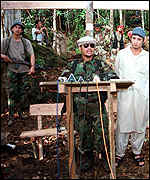
Abu Sayyaf rebels give a jungle press conference

In December 1994, the group bombed a Philippines Airlines plane on a flight from Manila to Tokyo, killing one passenger.
But most of its activities have centred on southern Mindanao.
An attack on the town of Ipil in 1995 left 50 people dead, and a grenade attack on a department store in Zamboanga in 1998 injured 60.

Analysts say such attacks show the group - which is believed to have a core membership of around 200 - is trying to spark a religious war.

The Philippines Government says Abu Sayyaf has been trying to evict Christians from its Basilan Island base.

*
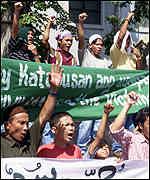
Muslims protest in Manila - but some Moros have taken a more violent path


As well as suspecting links with the mastermind behind the US World Trade Centre bombing, Ramzi Youssef, Manila believes it is connected to the man who tops America's most-wanted list, Osama Bin Laden.
Analysts say that Abu Sayyaf has received arms and munitions from Afghanistan.

Leaders

*
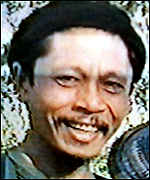
Commander Robot: In charge of the hostage-takers


The founder of Abu Sayyaf - Abdurajak Abubakar Janjalani - was an Islamic scholar.
He was killed in a clash with the Philippine Army in December 1998.
The group responsible for the latest hostage-taking appears to be led by Galib Andang, also known as Commander Robot.
He has been allegedly involved in earlier kidnappings.

Moderates

The Moros, who converted to Islam in the 14th century, have long resisted the Philippines' Catholic rulers, dating back to the Spanish colonial period.

*
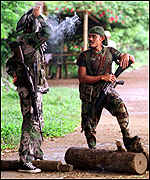
Philippine Army patrols try to keep the rebels in check

The current violence dates back to 1972, when then President Ferdinand Marcos imposed martial law.
Abu Sayyaf is the most militant of the anti-Manila groups and wants an independent Islamic state in Mindanao - an impoverished region with an annual income a mere fifth of the national Philippines average.
Moderates are calling simply for the implementation of a planned 13-province autonomous region in the southern Philippines.
The MNLF - from which Abu Sayyaf split - announced a ceasefire in 1996, and is pursuing talks with government officials.
A third group - the Moro Islamic Liberation Front, which numbers around 15,000 fighters - had also been on ceasefire, but has now halted all dialogue with the government after military assaults on its camps.
[Renamed version first captured Oct. 7, 2000]

Tuesday, 2 May, 2000, 10:49 GMT 11:49 UK
Who are the Abu Sayyaf hostage-takers?

The militant Islamic group Abu Sayyaf is one of several guerrilla organisations involved in a recent resurgence of violence in the Philippines.

The group is operating in the south of the country, where other militants have been warring for almost 30 years for an Islamic state, independent of the mainly Christian Philippines.

Abu Sayyaf - or "Father of the swordsman" in Arabic - was named after a mujahedin fighter in Afghanistan in the 1980s, where a number of its members fought against the Soviet-backed regime.

Previously a faction within the Moro National Liberation Front (MNLF), it split off in 1991 to pursue a more fundamentalist battle against the Philippine authorities.

Religious war

Hostage-taking is the latest in a series of actions which began in the early 1990s with a spate of bombings, assassinations and kidnappings of priests and businessmen.
*
Abu Sayyaf rebels give a jungle press conference

In December 1994, the group bombed a Philippines Airlines plane on a flight from Manila to Tokyo, killing one passenger.
But most of its activities have centred on southern Mindanao.
An attack on the town of Ipil in 1995 left 50 people dead, and a grenade attack on a department store in Zamboanga in 1998 injured 60.

Analysts say such attacks show the group - which is believed to have a core membership of around 200 - is trying to spark a religious war.

The Philippines Government says Abu Sayyaf has been trying to evict Christians from its Basilan Island base.

*
Muslims protest in Manila - but some Moros have taken a more violent path


As well as suspecting links with the mastermind behind the US World Trade Centre bombing, Ramzi Youssef, Manila believes it is connected to the man who tops America's most-wanted list, Osama Bin Laden.
Analysts say that Abu Sayyaf has received arms and munitions from Afghanistan.

Leaders
*
Commander Robot: In charge of the hostage-takers


The founder of Abu Sayyaf - Abdurajak Abubakar Janjalani - was an Islamic scholar.
He was killed in a clash with the Philippine Army in December 1998.
The group responsible for the latest hostage-taking appears to be led by Galib Andang, also known as Commander Robot.
He has been allegedly involved in earlier kidnappings.

Moderates

The Moros, who converted to Islam in the 14th century, have long resisted the Philippines' Catholic rulers, dating back to the Spanish colonial period.

*
Philippine Army patrols try to keep the rebels in check

The current violence dates back to 1972, when then President Ferdinand Marcos imposed martial law.
Abu Sayyaf is the most militant of the anti-Manila groups and wants an independent Islamic state in Mindanao - an impoverished region with an annual income a mere fifth of the national Philippines average.
Moderates are calling simply for the implementation of a planned 13-province autonomous region in the southern Philippines.
The MNLF - from which Abu Sayyaf split - announced a ceasefire in 1996, and is pursuing talks with government officials.
A third group - the Moro Islamic Liberation Front, which numbers around 15,000 fighters - had also been on ceasefire, but has now halted all dialogue with the government after military assaults on its camps.

Here I want to throw in an extremely rare, 7.94KB-sized AP news photo. In it, we're told, authorities are confiscating an Abu Sayyaf weapons cache; but in the foreground, not so full or centered that we would feel hit over the head by it, is an apparently custom designed Abu Sayyaf  flag in the tradition of  nation-states. With its ominous, curved yellow Islamic banana, (a symbol for "binding"), with "Abu Sayyaf" possibly translated  as "Father of the Hypodermic Needle," all we'd need is that fat manifesto we were promised and a decoder ring and we're set.


In studying the BBC's reporting on the Abu Sayyaf in the Philippines, I assembled a  list of links to almost 600 BBC articles, from first mention of the name, until the close of 2002, when the saga just starts to loop endlessly repeating itself, although the supply of funny new names for crops of villains is inexhaustible. Since there is no way of knowing if the list is nearing comprehensiveness, I use it to note sins of commission but not  necessarily omission.

None the less, by using the BBC's search function with reverse date, it would appear that with the BBC's Asia-Pacific bureaus and extensive general reporting in the Philippines, there wasn't a mention of Abu Sayyaf's name by the BBC until late 1998---and I do mean late, since this opening bell could have been the death knell  of the 200-member organization, as in an unduplicatable feat, authorities located Abdurajak Janjalani, the group's founder and chief, somewhere in his "jungle lair," slash "mountain stronghold," and summarily shot him dead.


January 11, 1999, BBC News, Sierra Leone: A muddled and brutal conflict
August 6, 1999, BBC News, Sierra Leone: Who are the kidnappers?
August10, 1999, BBC News, Rebels release last hostages

Manila Standard - Apr 4, 1995

April 7, 1995, The Manila Standard, page 2, Senate probes Ipil carnage, by Marichu Vilanueva,
Senate leaders decided yesterday to investigate failure of the intelligence arms of both police and military establishments in preventing the April 4 simultaneous arrcks by Muslim terrorist group Abu Sayyaf in Ipil, Zamboanga del Sur.

April 7, 1995, The Manila Standard, page 3, Raiders use hostages as human shields,


April 7, 1995, The Manila Standard, page 3, Ramos sacks Southcom chief, by Fel V. Maragay,
Deeply dismayed over the military's failure to foil terrorists' attack on Ipil, Zamboanga del Sur Tuesday, President Ramos yesterday sacked Brig. Gen. Regino Lacson as head of the AFP's Southern Command and replaced him with Maj. Gen. Edgardo Batenga, who headed the Northern Command.

April 7, 1995, The Manila Standard, "Abu Sayyaf: Bandits or global terrorists?" by Robert H. Reid, Associated Press Writer, page 3,

Six months ago, they were dismissed as "bandits" on the verge of extinction. Today, officials call them part of a vast network of Islamic extremists including defendants in the World Trade Center bombing.

Little is known about the Abu Sayyaf group, which officials blame for Tuesday's raid on the town of Ipil, which left at least 46 dead, 47 wounded and the southern community in ashes.

But authorities are now alarmed at the possibility that 16 years after the late Ayatollah Ruhollah Khomeini seized power in Iran, violent Islamic fundamentalism has spread to the Muslim community in the Philippines, estimated to be 6 million strong.

The recent violence has emerged at a time the government thought it was about to resolve the 25-year Muslim separatist crisis in the southern Philippines.
...
Nearly all that is known about the Abu Sayyaf group...comes from the Philippine military. The group has never generally disseminated a coherent manifesto outside of its circle of members and sympathizers. Its leader is Aburajak Abubaker Janjalani, a 34-year-old former teacher from a mixed Muslim-Christian family on Basilan Island 880 kilometers south of Manila.
...
Last July, Abu Sayyaf members waylaid a bus on Basilan, killed 15 Christian passengers and took about 35 more hostage. All were eventually released after local authorities paid about $7,700 in ransom.

The military then launched attacks on Abu Sayyaf strongholds and claimed that the group had been destroyed. Later, commanders admitted the fighters simply fled deeper into the mountainous jungle.

Concern about Abu Sayyaf began to heighten about five months ago.

Last Dec. 11, a caller purportedly fr54om Abu Sayyaf telephoned The Associated Press to claim responsibility for an explosion aboard a Philippine Airlines jet en route to Tokyo from Cebu. The plane landed safely on Pkinawa, but one Japanese was killed and 10 others injured.

Officials dismissed the claim, saying Abu Sayyaf lacked the technical skills.
...
April 7, 1995, The Manila Standard, Lessons from the raid on Ipil, by Amante E. Bigornia, page 9


April 7, 1995, The Manila Standard, page 8, Editorial, Fanciful speculations,
The "height of negligence," President Ramos fumed as he condemned the failure of the military to anticipate the attack last Tuesday on Ipil, Zamboanga del Sur.

April 7, 1995, The Manila Standard, page 6,  Nikki: What intelligence?
Senator Nikki Coseteng yesterday described as "wasted" the P1.3 billiuon intelligence funds of the Philippine National Police, Armed Forces of the Philippines and the National Security Council, as she chided the authorities' failure t discover the planned attack of some 200 heavily-armed Muslim extremists on the municipality of Ipil, Xamboanga del Sur. .... 

Saturday, July 19, 2014

New York Times, 1977, Carey Winfrey, Laurie Johnston, Peter Flint,

All images pertaining to the Everard fire in the New York Times on May 26, 1977 were credited to Action Movie News, Inc./ Kosinenko Goldenberg

Action Movie News, Inc. is a Domestic Business Corporation, located at 299 Park Avenue, New York, NY, 10171; formed on November 6, 1975. This file was obtained from the Secretary of State and has a file number of 383537.

Advanced Print & Video, compiles footage of F.D.N.Y. fire scenes and has been allowed special, privileged access to the scenes of New York City fires for nearly four decades. By outsourcing the videotaping of its work the F.D.N.Y. can absolve itself of the fraudulence, deceit and trickery that goes into editing and compiling these fire records.

"Kosinenko Goldenberg" in quotation marks returns only two hits on Google--both to StevenWarRan blogs.

The way Winfrey of the Times would have it, those who jumped did so from the lower of the two upper floors, while 20 were rescued from the higher floor at the Everard Baths by firemen on aerial ladders, is exactly backwards. It doesn't account for the two most seriously injured, one of whom became the ninth victim when he died in the hospital. His name was never released by city fire authorities, although he was said to have broken his spine.
Six patrons jumped from a second-floor ledge to the pavement, and 20 were rescued with aerial ladders from the third-floor windows facing 28th Street.
There were only two upper levels of escape from the Everard Baths: the broad show windows on the third floor, (what Winfrey calls the 2nd floor,) which had been painted over, and backed up on the inside with pressure walls made of two-by-fours and plywood, and lined with insulation. On the fourth floor, (what Winfrey calls the 3rd floor) where the exterior had been bricked up, the only possible mode of escape was through any of three, rectangular, through-the-wall openings for air conditioners, which at the time of the fire were mounted with fixed heavy-duty air-conditioning units. By the time any photographs or video were taken, all three of these openings had been opened up, although almost every image depicting them has been doctored in some way to disguise the obvious facts.

The New York Times reports:
Because many patrons signed in under false names, identification of the dead was expected to prove difficult. At the morgue, Dr. Dominick J. DiMaio, the city's Chief Medical Examiner, said none of the dead had been identified.
However, my recollection of how the bathhouse system worked, was not only did one leave their valuables---generally wallets and house keys---at the desk with total assurance, but it was an absolute requirement as a surety for the locker or room key.  How else would a bathhouse enforce an 8- or 12-hour limit on visits if everybody who entered their door went ghost at the threshold? Men in towels look remarkably alike---believe it or not. Irving Fine is repeatedly quoted as saying between 80 and 100 persons were inside when the fire occurred, but why didn't he just count his cash drawer and the keys the house had in its possession? You didn't have to know individual identities to arrive at an accurate count of patrons.

Winfrey says the "eighth body was carried out at 10:40 A.M.," which turned out to be the last body removed from the premises, so who's responsible for this rhetoric:
Many of the fatalities were believed to have occurred when the roof collapsed in the rear part of the building. A fireman who tried to reach that area said the smoke was simply too intense.
I moved to New York City in the fall of 1977, after I'd turned twenty, and missed any contemporary news coverage of the Everard fire. I began to question why it was then, that I had such a succinct mental picture of the fire in my mind. Not only was the image powerfully formed---it was completely erroneous. According to my vision, a row of round clerestory windows ran along the top of the building, and it was through these, that some of the skinny and supple managed to escape, while the portly couldn't pass through the eyes of the roundel.

On May 27, 1977, Laurie Johnston took over as lead writer for the Times. In her article, 9 Killed In Bath Fire Identified By Friends; Morgenthau Planning Investigation Into Whether Violations of Code Might Have Led to the Blaze, she reports
According to a Fire Department spokesman, rescue efforts were slowed by the small, round windows on the third floor and by paneling and insulation that covered all windows.
But there were no round windows, other than a giant, useless oculus-to-nowhere, and the "according to a Fire Department spokesman" crap doesn't cut it when the facts can be visually verified from the street. Carey Winfrey was the only writer to describe the upper floors of the Everard as being the 2nd- and 3rd floors---and she's within her journalistic doyenne rights since that's what it appears to be in Google Street view, but this would mean there's a heck of an attic; or a missing fourth floor; and the little matter of comprehension and consistency with other writers.

I know now I got my mental picture later on out of a novel---Dancer From the Dance, written pseudonymously by Andrew Halleran and apparently as influential a book as ever I read. Though I haven't picked it up in thirty years I'll bet payday Halleran novelistically has young boys crawling out of round holes instead of rectangular air-conditioning slots, even though the horror of someone clawing their way through a mechanical installation is exponentially more dreadful than any window.

Halleran had the same agent as Larry Kramer, who wrote Faggots; the two books were issued almost in tandem in 1978, by different big-name publishing houses, and reviewed together in the Times. All I remember about Kramer's book was trying to read it on a Metroliner traveling to Washington, D.C., and struggling to keep the cover shielded with a magazine while I read, so powerful and disturbing was it even to be publicly seen with the word. I'm sure many cultural buttons were meant to be pressed in so timely a pair of offerings, but I'd never imagine sanitizing the Everard was high on the list.
______________________________________________________________________________

June 17, 1964, New York Times, Bathhouse Blaze Kills 2, Injures 4, by McCandlish Phillips,
June 25, 1973, New York Times, page A1, Flash Fire in New Orleans Kills at Least 32 in Bar, by Roy Reed, [continued on page 66]
May 26, 1977, New York Times, page A1, 9 Killed by Fire at a West Side Bathhouse; Search Goes On for Bodies, by Carey Winfrey, View original in TimesMachine,
May 26, 1977, New York Times, page B9, Homosexuals Mobilize to Aid Fire Victims, by Laurie Johnston,
May 26, 1977, New York Times, page B9, Baths Had a Fashionable History, by Peter Flint,
May 27, 1977, New York Times, 9 Killed In Bath Fire Identified By Friends; Morgenthau Planning Investigation Into Whether Violations of Code Might Have Led to the Blaze, by Laurie Johnston, View original in TimesMachine,
May 28, 1977, New York Times, page 20, Judge Calls for National Inquiry Into 'Leak' in Terrorism Case, Times Machine,

June 17, 1964, New York Times, page 1, Baker Gains Control Of Vending Concern, [cont. page 21]Baker Acquires Majority Stock Of the Serv-U Vending Company, Part of the screen surrounding the recent activities of Robert G. Baker has been pulled aside by sources that have had dealings with the once powerful Senate employee.
June 17, 1964, New York Times, page 2, Jagan Asks U.N. To Study Guiana; Seeks Panel to Investigate Detention of Politicians; Jagan Appeal Heard,
June 17, 1964, New York Times, page 18, Students Briefed On Peril in South,
June 17, 1964, New York Times, page 27, Rockefeller Drive Cost $5 Million,
________________________________________________________________________________

June 17, 1964, New York Times, page A38, Bathhouse Blaze Kills 2, Injures 4, by McCandlish Phillips,

Two men were found dead yesterday morning amid charred timbers and still smoldering mattresses after a fire swept a bathhouse on the Lower East Side.

Above the men, at ceiling level, were the newly installed pipes of a sprinkler system that might have saved them from death in their rented cots. But the system was not fully installed and would not have been in operation until Thursday at the earliest.

Four other men were taken to Bellevue Hospital for treatment and at least 10 others were rescued. Firemen used a ladder to save a man clinging to a windowsill by his fingers two floors above the pavement.

The fire began in the century‐old Gordon's Bath at 24 First Avenue, just off Second Street, at about 9 A.M. Most of the 45 regulars and transients had left for the day, but about 15 were still in the dormitories. that form the top three floors of the four‐story structure.

The fire raced through the wooden interior. Smoke and the heat were so intense that the men could not get down the narrow wooden stairways, the only exit. They gathered at the frosted glass windows.

Clerks from stores ran across First Avenue and shouted at the desperate men not to jump. Fire engines approached and a crowd of about 200 gathered. Two men crawled out of second-story windows.

Man Clings to Sill

One clung by his fingers to the sill until firemen came with a ladder. The other worked his way along the two‐inch wide top of the bathhouse sign to the fire escape of the Ortiz Funeral Home next door and came down.

At the rear, a man in under­wear crawled out onto an adjoining roof and made his way to the street by a fire escape. The other men stood in top-floor windows, shouting. Firemen brought them down on ladders. The alarm was sounded at 9:22 A.M.; the fire was out at 9:45.

One of the dead men was identified as James Morris Mas­tes, 70 years old, a resident of the dormitory. The other, described as an elderly “newsboy who just used to come in and didn't give his name,” had not been identified by last night.

Leon Muhnueig, 74, and Leon Rosdahl, 57, both dormitory residents, were hospitalized, as were Isidore Melnick, 60, of 102-40 62d Avenue, Forest Hills, Queens, and Joseph Dubinsky, 67, of 97 East Seventh Street, both bath customers. They suffered smoke inhalation and minor burns.

Gordon's Baths is a brick building painted milky pink and orange. To the left are three vacant stores.

Fire‐red doors lead into a white tile hall and a stairway with a brass rail running up one side — almost exactly duplicating the style of the entrances in the flophouses on the Bowery two blocks west.

At the top of the short stairway is a cashier's cage of heavy iron grill work. Dormitory cots rent for $1.80 a night or $10 a week, mostly to truck drivers, dock workers and drifters.

This article can be viewed in its original form,

_______________________________________________________________________________

May 26, 1977, New York Times, 9 Killed by Fire at a West Side Bathhouse; Search Goes On for Bodies, by Carey Winfrey, View original in TimesMachine,

Nine men were killed and 10 were injured yesterday in an early-morning fire that destroyed a Manhattan bathhouse that catered to homosexuals.

Fire officials feared that more bodied would be found in the rubble, and Commissioner John T. O'Hagan said the search for bodies could go on for a week.

Scores of men some clad only in towels or robes, fled their rented cubicles and the dormitory at the Everard Baths at 28 West 28th Street, in the wholesale flower district, as dense smoke poured out of the three-story building. By the time the fire was brought under control at 8:45 A.M., an hour and three-quarters after it started, nearly 200 firemen and 31 pieces of equipment had been called to fight the blaze. Six patrons jumped from a second-floor ledge to the pavement, and 20 were rescued with aerial ladders from the third-floor windows facing 28th Street.

Commissioner O'Hagan said that an inspection last August resulted in an order for a sprinkler system to be installed at the baths, but that the owner had until July of this year to comply. In all probability," the Commissioner said, "a sprinkler system would have prevented this fire."

Irving Fine, 62 years old, who said he was the owner, said a sprinkler system had been installed but was not yet working. However, a spokesman for the Mayor's office said plans for a sprinkler system were rejected by the Buildings Department in January for noncompliance with codes.

page B8.

Even before the fire was brought under control, homosexuals across the city rallied to give blood, help in the identification of victims and raise funds. Many expressed concern that the inevitable publicity in the wake of the fire would force a crackdown on the homosexual world in general, while others said they hoped that fire violations in similar establishments would now be corrected.

Mayor Sees a Violation

At a late-afternoon news conference on the steps of Gracie Mansion, mayor Beame said he had asked the District Attorney "to investigate why a bathhouse would have overnight guests---this is in violation of their operating permit."

One of the survivors said the city allowed hazardous conditions to exist where homosexuals congregated.

"'Faggots' are given a certain amount of liberty in New York City," said Michael Rhone, 26, "and most of that is to hang out in sleazy sorts of low places that are substandard. At a straight health spa you wouldn't have rooms partitioned halfway up the walls so the fire could spread."

The blaze recalled a 1973 fire in a French Quarter bar in New Orleans in which 30 persons dies. That fire, in a second-floor bar called the Upstairs, which also catered to male homosexuals, was packed the evening of June 24, 1973, when flames cut off escape by both the stairs and the elevator. Although arson was widely suspected, New Orleans homosexual organizations contended that the investigation was not effectively pursued.

Bath places catering to male homosexuals, while not new, have proliferated throughout New York City over the last dozen or so years. Patrons watch television, swim, sit in sauna rooms, or "cruise" for sexual liasons. The standard attire is a towel. Though there's a 12-hour time limit, many patrons sleep overnight, in the large dormitory room or in the cubicles, which at the Everard were barely large enough to hold a single bed.

Because many patrons signed in under false names, identification of the dead was expected to prove difficult. At the morgue, Dr. Dominick J. DiMaio, the city's Chief Medical Examiner, said none of the dead had been identified.

Officials said they believed that the four-alarm fire, which broke out shortly before 7 A.M. and tied up rush-hour traffic, started when a mattress fire, thought to have been extinguished an hour earlier, re-ignited. Many empty fire-extinguishers inside the building indicated that the occupants had tried to fight the blaze for some time before calling the Fire Department.

Mr. Fine estimated there had been 80 to 100 men in the bathhouse when the fire broke out. "Tuesday night was always a good night in this place," said Jeffrey Sanyour, who had come to meet a friend. "Like a bar gets known for a certain night---this place was known for Tuesdays and Thursdays."

Raymond Walsh, 20, who paid a $7 fee for one of the 135 tiny cubicles, said he was awakened by the heat and saw an orange glow under his door. "I opened the door," he said, "and saw the room across the hall all in flames, even the wall. I started to panic and ran into the 'orgy room' ---the dorm room---and yelled to everybody to wake up. I don't know how I got down the stairs."

Michael James, 29, of Philadelphia was on the second floor when he noticed the flames. "I just saw some orange," he said. "You couldn't smell anything. Then in a matter of seconds the halls were filled with a dense smoke, the electricity went out and it was pitch dark. All you could hear was people hollering, 'This way down, this way down!'"

Miguel Agosto, 18, was trapped on the third floor, but escaped through a bathroom window. "I grabbed a bar outside the bathroom window and swung to the other roof," he said. Mr. Agosto was one of four patrons treated at Bellevue Hospital for smoke inhalation. Three others were admitted to the emergency ward, two in critical condition, one in serious condition.

Two Firemen Treated

Fireman Patrick Brown, 24, was treated at Bellevue for exhaustion. He had administered mouth-to-mouth resuscitation to unconscious victims for more than an hour. "I know two of them died," he said.

Fireman Thomas Dyer was treated for smoke inhalation.

Many of the fatalities were believed to have occurred when the roof collapsed in the rear part of the building. A fireman who tried to reach that area said the smoke was simply too intense. "I had my nose to the floor as it was. If you can't breathe, you can't move."

The fire was the second at the Everard in five years. A two-alarm fire gutted the top floor and destroyed much of the roof on March, 1972, but there were no injuries. "It was always a rat trap," said Walter LeBeau, a patron who escaped unscathed yesterday.

Built in 1890 by James Everard, an Irish brewer, the Romanesque structure enjoyed great success as a public bathhouse in the red-light and gambling district known at the turn of the century as the Tenderloin. It had catered to a homosexual clientele since the 1950's. An explicitly sexual newspaper described the Everard as "well-kept and reasonably clean, attracting a kinky cross-sectional clientele from every age group.

Mr. Rhone, one of the survivors, said that customers, who paid $5 for a locker or $7 for a cubicle ($6 and $9,25 on weekends) included "your old men, young gorgeous men, your models and your successful businessmen."

'Stretching the License'

The building was last licensed in 1921, according to Commissioner O'Hagan, when a certificate of occupancy was issued for a facility with a "pool, baths and dormitory." While Mr. O'Hagan stopped short of calling the owner in violation of that license, he said that with 135 cubicles, "obviously he was stretching it a bit."

As the eighth body was carried out at 10:40 A.M., the scene outside the baths was one of water hoses snaked through the street littered with broken glass. The doors leading to marble stairs in the bathhouse were open, and a sign reading "Everard Baths---Men Only" was visible.

The only windows still unbroken were those on the first floor, including an ornate intertwined "EB" in a stained glass.

The last occupant to emerge alive was a cat, carried out at 11:55 A.M. by a fire marshal.

A fireman who asked not to be identified said three of the bodies were burned beyond recognition. "You couldn't even tell they were bodies," he said.

"Eight is a lot," he added. "But the way they were packed in there, it could have been a lot worse."


Action Movie News, Inc./ Kosinenko Goldenberg

_________________________________________________________________________________

May 26, 1977, New York Times, page B9, Homosexuals Mobilize to Aid Fire Victims, by Laurie Johnston,
May 26, 1977, New York Times, page B9, Baths Had a Fashionable History, by Peter Flint,


_________________________________________________________________________________

May 27, 1977, New York Times, page A22, 9 Killed In Bath Fire Identified By Friends; Morgenthau Planning Investigation Into Whether Violations of Code Might Have Led to the Blaze, by Laurie Johnston, View original in TimesMachine,


The nine known dead in the Everard Baths fire were identified yesterday, mostly by friends rather than family members, as District Attorney Robert M. Morgenthau of Manhattan announced an investigation as to whether criminal violations of the fire and building codes might have caused the blaze Wednesday.

According to a Fire Department spokesman, rescue efforts were slowed by the small, round windows on the third floor and by paneling and insulation that covered all windows.

Seven of the nine persons injured in the fire at the homosexual bathhouse, at 28 West 28th Street, remained hospitalized, one in critical condition. Fire officials said other bodies might be found in the rubble.

The early morning fire sent 80 to 100 men fleeing from the building, some clad only in towels. Further search of the partially collapsed ruins awaited the removal of suspended wreckage by a crane.

Patrons and former patrons of the Everard Baths said yesterday that its practice of not requiring registration made it impossible to tell whether all customers present had been accounted for.

Inspections at Issue

Amid charges by homosexual-community leaders that the city "looks the other way in protecting the safety of gays," the investigation was expected to center on whether the Everard Baths had been improperly inspected or approved in view of their use.

The certificate of occupancy issued in 1921, when the Everard retained some of its fashionable clientele as a Turkish bath, described it as a "bathhouse and dormitories." Since then, most of the second and third floors have been divided into cubicles, with scarcely room for a bed and coat hangers, and with plywood partitions part way to the ceiling.

Irving E. Minkin, director of operations for the Buildings Department, said yesterday that the baths had passed inspection after a fire in March 1972 made renovation necessary. But he said he could only refer to plans filed with the department.

"We had no idea of cubicles there--there was no indication to us of any use other than stated in the certificate of occupancy," Mr. Minkin said. "The question of cubicles is 'iffy'--they would not change the basic legal use but might give us cause for concern."

Crowds of spectators opposite the burned-out building yesterday could see the partially detached pipes of an overhead sprinkler system, which was installed in response to a July 1977 deadline set by the Fire Department, but which had not been connected to the street main.

Sprinkler Order Rescinded

A 1964 Fire Department order to install sprinklers was rescinded in 1965, after the owners "provided certain safety items," said the first deputy fire commissioner, Stephen J. Murphy. There was no order to install sprinklers following the 1972 fire and renovation. However, in keeping with new fire regulations, the installation was ordered again last year.

A widespread rumor, said to be "gay community lore," that the Everard Baths were owned by either the Police Benevolent Association or the Police Athletic League, drew denials, including one from Mr. Morgenthau, who said "that it's not owned by the Police Athletics League, because I'm the president of the P.A.L."

Of the nine men who died in the fire, seven succumbed to smoke inhalation, one to respiratory burns and one--who jumped from an upper floor--to a fractured spine.

They were identified by the Medical Examiner's office as Amadi Alamo, 17 years old, West 108th Street; Kenneth Hill, 38, West 4th Street; Ira Landau, 32, West 75th Street, and James Stuard, 30, East 25th Street, all of Manhattan; Anthony Calarco, about 25, 1519 Mace Avenue, the Bronx; Patrick Knott, 27, Bay Parkway, Brooklyn; Hillman Wesley Adams, 40, Scotch Plains, N.J., and Brian Duffy and Nicholas Smith, no addresses given.

One patron who jumped, Philip Osbaum, 50, was listed in critical condition at Bellevue Hospital with a fractured trachea and fractured ribs. Others there, listed as satisfactory, are Kevin Duffley, 33; Luis Figueroa, 22, and John Stanisz, 22, inhalation and multiple minor injuries, all of Manhattan; Alexander Mamon, 28, Jamaica, Queens, inhalation and fractured ankle.

Thomas Dyer, a fireman, remained at Bellevue Hospital suffering from smoke inhalation.
_________________________________________________________________________________


May 28, 1977, New York Times, page 20, Judge Calls for National Inquiry Into 'Leak' in Terrorism Case, Times Machine,
A Federal Court judge in Manhattan called yesterday for a national investigation into the disclosure in The New York Times of non-public information relating to terrorist bombings.
_________________________________________________________________________________

June 17, 1964, New York Times, page A25, Keogh Is Released after 8 Months,

________________________________________________________________________________


at 29 seconds, the camera pivots to see a young civilian striding quickly towards the lens; who after making
face contact, turns and quickly moves away.

The certificate of occupancy issued in 1921, when the Everard retained some of its fashionable clientele as a Turkish bath, described it as a "bathhouse and dormitories." Since then, most of the second and third floors have been divided into cubicles, with scarcely room for a bed and coat hangers, and with plywood partitions part way to the ceiling.

According to a Fire Department spokesman, rescue efforts were slowed by the small, round windows on the third floor and by paneling and insulation that covered all windows.

A 1964 Fire Department order to install sprinklers was rescinded in 1965, after the owners "provided certain safety items," said the first deputy fire commissioner, Stephen J. Murphy. There was no order to install sprinklers following the 1972 fire and renovation. However, in keeping with new fire regulations, the installation was ordered again last year.