New York State Library 82nd Annual Report, 1899, (1901) page 62:
Fireproof safe.
The capitol walls are so massive that we have no fear of fire except as it might burn out individual rooms finished in wood. Hundreds of thousands of feet of oak have been used in shelving and interior finish, and in spite of careful installation of electric wires, we can not avoid the fear that some day this woodwork in some room will be accidentally set on fire and priceless material destroyed. The scientific explanation of how the fire occurred may be perfect, but the fact that rats or mice gnawed off insulation or that workmen accidentally broke it with their saws (as has happened a score of times in the past dozen years) might tell how it happened, but would not replace our lost treasures. Till we have a fireproof building, free from this danger, we must take the chances with ordinary books; but we have various treasures so costly that their destruction would cause serious criticism of the regents as trustees for not insisting on better protection than is now available, e. g. an autograph collector recently declared that our autographs of the signers of the declaration of independence were worth $20,000, In our manuscript room are collections which have cost the state vast sums and which money could not replace, yet there is no place to keep them except a room honeycombed with oak and interlaced with electric wires.
There are two solutions for adequate protection till the new building is ready : we may buy a large iron safe for the smallest and most costly collections; or better, take some small room, possibly in the basement if dampness can be thoroughly protected against (as it could be by making double walls with ventilation) and make a room strictly fireproof, without electric wires and large enough to hold all the rarities. A basement room would practically shut them off from public inspection, though they could be reached for occasional use. In the northwest pavilion it would be possible to make at comparatively small cost a fireproof room with ample daylight, open to visitors and yet safe from fire. From year to year other pressing needs have led us to defer this request, but we ought not to go longer without a large fireproof safe or fire-proof room. For lack of it we are liable to lose valuable gifts that would be put in our custody except for fear of fire.
Care of rooms.
During Gov. Flower's administration attention was called to the frequent losses in the state library and the subject was carefully considered by the superintendent of public buildings, representatives of the regents and the governor. It was found that the peculiar character of a great library was recognized the world over in unusual safeguards. In colleges and universities, where many janitors and cleaners have access to all ordinary rooms, it is customary to set apart the library as distinct, with locks to which there are few keys and none in the hands of the ordinary janitorial force. In other words, the library in its nature is a great safe for storing many things of large pecuniary value, which could be easily removed if the rooms were treated like other parts of the buildings. The superintendent declared it impossible for him or any one in his position with a great force constantly changing, many of the men coming from a distance and little known, to afford proper protection to the great collections of the library. Examination of cost by both systems made it clear that it would be economy to separate the library from the rest of the building and put its janitors under direct charge of the regents, who were responsible, as trustees, for safety of its property. As the rooms were so connected that it was impracticable to lock off the regents office, and as the regents examinations themselves required extreme vigilance, these were included with those transferred from the superintendent.
Experience has confirmed the wisdom of the action. At less cost we have secured better results and there has been marked improvement since access to the library has been so closely limited. The old locks were removed and at present there are only four keys, one for the head janitor, one for the night watchman, one carefully locked in the building for emergencies and one held by the director. Not even the senior librarians have a key to the rooms as either the janitor, night watchman or one of the staff is on duty and responsible for every person who passes the doors at any hour. Without this absolute control of the rooms, it would be simply impossible to afford proper protection to the many costly books in our great collection. Under the old system, losses were not due to lack of interest on the part of persons who had keys but to lack of appreciation of the dangers. Some visitor to gratify a laudable curiosity would ask to have the doors unlocked and to be admitted for a few minutes to see the library. Both visitor and janitor were perfectly trustworthy, but through the door thus opened sneak thieves, who have caused so much trouble in this building, would slip in and secreting themselves in alcoves or small rooms would have opportunity for petty thefts. Fortunately we had no very large losses, but the new system relieves most of this difficulty.
As we review the year we find that we are sharing the experience of all active great libraries. Each year we feel the pressure both for more room, a larger staff to meet the reasonable demands made on us, and for more books, because more books are printed than ever before and people insist as never before on having what they wish and need and will not be put off with some substitute printed perhaps years before the book they really want to see. Experience has proved that it pays to assist readers in a way not thought of a generation ago and the patrons of the state library naturally demand such assistance. All this adds to necessary expenses ; but, on the other hand, the extent and spirit of the service given calls out warm public appreciation of the large practical returns from taxpayers' money wisely and economically expended on what is becoming more truly each year the real people's university.
Respectfully submitted
Melvil Dewey
Director
82nd Annual Report, 1899. page 60:
Pursuant to the direction embodied in -the resolution adopted by your honorable body [Assembly] on the 6th day of February, 1899, viz :
Resolved, That the superintendent of public buildings be and he is hereby directed to ascertain and report to this house, with all convenient speed, as to the adequacy of that portion of the state capitol assigned to the use and occupancy of the state library, for its present needs and its probably future requirements.
I have ascertained and hereby respectfully report the following facts.
That the portion of the state capital used and occupied by the state library comprises 64,553 square feet of floor surface, in addition to considerable space in the capital corridors adjacent to said library used and occupied for the exhibition of Indian relics, hydraulic and electrical machinery, photographs of school buildings, etc.
From the fact that of the abovementioned 64,553 square feet of floor surface, 4,000° square feet is devoted to the storage of books, in cases, it is self-evident that there is not sufficient shelf room for said books,* [*This refers to the books boxed up in cases in the basement and it fails to mention those stored over the assembly chamber and in other parts of the attic story. Altogether there are now more than 150,000 volumes nailed up and inaccessible for lack of shelf room,] and as I am informed and believe that these books are accumulating rapidly, it is fair to assume that some arrangements for their accommodation will have to be made in the very near future.
It should be borne in mind that if the location of the state library is changed from its present quarters, all the metal shelving, book cases, elaborate carving, and special appliances, extending, as they do, through two or more stories, with numerous galleries, must be removed and the regular floor levels of the building carried through the space they now occupy, to adapt those quarters to other purposes; and that but an inconsiderable proportion of such fixtures and appurtenances could be utilized elsewhere.
Respectfully submitted
H. H. Bender
Supt. Public Buildings
Sunday, November 06, 2011


Saturday, November 05, 2011
Start to Remodel Damaged Capital.
April 2, 1911, New York Times, page 10, START TO REMODEL DAMAGED CAPITOL;
Contractors Tearing Down the Most Dangerous Parts of the Fire-Wrecked Walls.
ALBANY, April 1. -- A contracting firm under the direction of Franklin B. Ware, State Architect, began work to-day on the burned part of the Capitol. Some of the walls are being shored so that the more dangerous parts on the western side of the Capitol may be taken down. The most dangerous spot is in the wall which supports the dormer windows on the roof of the northwestern pavilion. The opposite pavilion must also be removed.
The work of salvage in the State Library is bringing about better results than was hoped for and Education Commissioner Draper said to-day that about 50,000 books, mostly from the reference section, would be recovered. These are being taken to religious and other buildings, where they can be spread out to dry. The greatest care has to be taken to prevent thievery by relic hunters. It is asserted that there are paid agents of various interests here who are resorting to all manner of means to gain possession of valuable books, manuscripts, and relics. Because of this all passes have been revoked and new ones are issued only to persons having business in the Capital.
Dr. Draper says that the most serious question in the rehabilitating of the State Library will be the necessary funds. He has called a special meeting of the Regents of the university in this city on Wednesday evening to initiate measures for the rebuilding of the State Library.
The Commissioner also issued an appeal to the school children of Albany to help the State in recovering Indian relics, coins, or other relics scattered by the fire, by bringing them, or reporting any knowledge concerning them, to the teachers of the schools or to the temporary quarters of the State Library in State Street.
Twisted sword blades recovered from the ruins were delivered to Commissioner Draper to-day. They are all that remain of the weapons presented by the Governor of New York to to Gen. Worth at the close of the Mexican war. The sword presented by Frederick the Great to Gen. George Washington is missing.
Arnold J.T. Von Laer, State Archivist, who is being assisted by H.F. Phelps Stokes as the representative of the Trustees of the New York public Library, watched every shovelful of stuff taken out of the library to-day. Mr. Von Laer said that the contents of the archive room, if figured merely in the commercial worth of the autographs on the documents, was easily $1,000,000, and that out of this approximately $10,000 has been saved.
Many records have been needlessly lost through the haste of workmen, according to State Historian Victor H. Paltsits. He says that he picked up yesterday about 500 feet from where the papers were being thrown out a conveyance of land in the Town of Groton bearing the date 1723.
Gov. Dix and many other State officials and employes to-day attended the funeral services of Samuel Abbott of Syracuse, the watchman who was burned to death in the State Library. The body of Mr. Abbott, with that of his wife, who died in this city in January, were taken to Syracuse to-night for burial.
The police to-day received a letter from the parents of David Mintz of Newark, N.J., who fear their son may have perished in the Capital fire. Mintz came to Albany on Monday with R.E. Sherman of Hartford, Conn. On Tuesday Mintz told Sherman he intended to sleep in the Assembly Chamber that night and would meet him the next morning. He failed to keep his appointment, and has not been seen since.
Contractors Tearing Down the Most Dangerous Parts of the Fire-Wrecked Walls.
ALBANY, April 1. -- A contracting firm under the direction of Franklin B. Ware, State Architect, began work to-day on the burned part of the Capitol. Some of the walls are being shored so that the more dangerous parts on the western side of the Capitol may be taken down. The most dangerous spot is in the wall which supports the dormer windows on the roof of the northwestern pavilion. The opposite pavilion must also be removed.
The work of salvage in the State Library is bringing about better results than was hoped for and Education Commissioner Draper said to-day that about 50,000 books, mostly from the reference section, would be recovered. These are being taken to religious and other buildings, where they can be spread out to dry. The greatest care has to be taken to prevent thievery by relic hunters. It is asserted that there are paid agents of various interests here who are resorting to all manner of means to gain possession of valuable books, manuscripts, and relics. Because of this all passes have been revoked and new ones are issued only to persons having business in the Capital.
Dr. Draper says that the most serious question in the rehabilitating of the State Library will be the necessary funds. He has called a special meeting of the Regents of the university in this city on Wednesday evening to initiate measures for the rebuilding of the State Library.
The Commissioner also issued an appeal to the school children of Albany to help the State in recovering Indian relics, coins, or other relics scattered by the fire, by bringing them, or reporting any knowledge concerning them, to the teachers of the schools or to the temporary quarters of the State Library in State Street.
Twisted sword blades recovered from the ruins were delivered to Commissioner Draper to-day. They are all that remain of the weapons presented by the Governor of New York to to Gen. Worth at the close of the Mexican war. The sword presented by Frederick the Great to Gen. George Washington is missing.
Arnold J.T. Von Laer, State Archivist, who is being assisted by H.F. Phelps Stokes as the representative of the Trustees of the New York public Library, watched every shovelful of stuff taken out of the library to-day. Mr. Von Laer said that the contents of the archive room, if figured merely in the commercial worth of the autographs on the documents, was easily $1,000,000, and that out of this approximately $10,000 has been saved.
Many records have been needlessly lost through the haste of workmen, according to State Historian Victor H. Paltsits. He says that he picked up yesterday about 500 feet from where the papers were being thrown out a conveyance of land in the Town of Groton bearing the date 1723.
Gov. Dix and many other State officials and employes to-day attended the funeral services of Samuel Abbott of Syracuse, the watchman who was burned to death in the State Library. The body of Mr. Abbott, with that of his wife, who died in this city in January, were taken to Syracuse to-night for burial.
The police to-day received a letter from the parents of David Mintz of Newark, N.J., who fear their son may have perished in the Capital fire. Mintz came to Albany on Monday with R.E. Sherman of Hartford, Conn. On Tuesday Mintz told Sherman he intended to sleep in the Assembly Chamber that night and would meet him the next morning. He failed to keep his appointment, and has not been seen since.
Costliest of Capitals.
Even in an ostensibly critical article, the New York Times can just lie like a rug, as she misrepresents the most publicized scandal from twenty years earlier---the infamous "papier mache ceiling" in the Assembly Chamber.
March 30, 1911, New York Times,
The Assembly Chamber had to be substantially rebuilt when structural deficiencies caused its solid stone ceiling to begin to collapse less than ten years after it was completed.
1888 Stone vaulted ceiling of Assembly Chamber replaced after it failed structurally.
From: http://www.albany.edu/museum/wwwmuseum/statestreet/thecapitol.html
March 30, 1911, New York Times,
NEWTON, Mass. March 29.—George W. Abbott of West Newton, son of Samuel J. Abbott, the night watchman at the New York State Library in the Capital Building, is on his way to Albany to investigate the report that his father lost his life in the fire. Mrs. L. M. Newton, a daughter, also lives in Newton. Her father, she said, was seventy-seven years old.
Costliest of Capitals.
$23,000,000 Spent on Albany Structure---Trail of Graft Charges.
The Capitol in Albany, construction of which started in 1867, but which was still undergoing fundamental architectural changes as late as 1905, is a massive stone building, 400 feet by 300 feet, with walls 100 feet high. It was originally planned to cost $4,000,000, but the total ran above $25,000,000, thus exceeding the cost of the next most expensive State Capital, at Harrisburg, Penn., by $12,000,000.
Since the submittal of the first plans for the new building by Thomas Fuller, architect, and J. McAlpine, Consulting Engineer, the history of the construction process has been recorded in terms of accusations of graft, official investigation, and new levies for the completion and alteration of the original and amended plans.
The first intimation that the construction work did not meet the requirements came when it was announced that the heavy stone towers for which the plans called could not be built because the foundation would not bear the strain. The most massive part of the building, it was said, was built on a clay bank overlying quicksand. The first charge of misapplication of funds came in 1879, when only $9,500,000 had been spent. The investigation which followed, as well as all other future investigations, ended without any direct charges of wrongdoing.
In 1887 one wing of the building began to settle, due, it was thought, to the clay bank underneath. To lessen the weight on the foundation all the stone ceilings were then replaced by papier mache ceilings adorned with oak panels. Dissatisfaction with this reconstruction work resulted in the appointment of a committee of experts, of which the late Stanford White was a member. The findings showed that only three of the twenty-seven drawings had been prepared before the contract had been let, and that these were neither singed or dated.
A doubt was expressed as to the bona fide character of the bids received. Material changes in building materials had been freely made in violation of the law, and the new ceiling was found to contain less than half of the required number of oaken frames called for in the contract. The cost exceeded the amount of the bid by over $23,000. In short, the investigation showed that the contract had been violated in almost every specification and requirement.
Then followed a series of destructive cracks in walls, in the great stone arches, and in the famous Assembly staircase. Added to that came complaints that the building was poorly ventilated, that the acoustics were bad, and that all the window frames were made of iron, the expansion in Summer making it impossible to open the windows, whereas the contraction allowed the cold to come in in Winter. In 1905, during Governor Cleveland’s administration, there was an honest attempt made to correct as many of the deficiencies as a levy of $1,000,000 would allow.
Among the rooms of the Capital suffering particularly from a free change of specifications was the Executive Chamber. The contract called for long mahogany panels extending from floor to ceiling. Instead, “bay mahogany” or “baywood” was used. One genuine mahogany panel was used, however, and its darker finish and finer grain stood in marked contrast with the remainder of the walls. Again, in the Court of Appeals, there was a huge stone fireplace which, though many years old, had never been used. When the court was in session on one occasion a fire was started with the result that the Judges were smoked out of the chamber. The chimney flue was found to be only six inches wide.
Writers upon architecture say that the Capital reminds them of the famous Taj Mehal in India. There is nothing equivalent to the style in this country. Originally it was intended to copy the Italian Renaissance; this was partially forsaken for the Romanesque, however, and now the style has been commonly called "free Renaissance."
The Assembly Chamber had to be substantially rebuilt when structural deficiencies caused its solid stone ceiling to begin to collapse less than ten years after it was completed.
1888 Stone vaulted ceiling of Assembly Chamber replaced after it failed structurally.
From: http://www.albany.edu/museum/wwwmuseum/statestreet/thecapitol.html
Haunting Land Grants
The following article published a fortnight or so after the spectacular blaze at the State Capitol in Albany destroyed New York's authentic political, cultural and financial history, neatly reveals several of the many unscrupulous motivations behind an organized elite's act of incendiarism in service to their pathological agenda.
April 14, 1911, The Albany Evening Journal, page 2, TROOPS PAID FOR DUTY IN CAPITOL
Thanks to the recent commemorative 128-page volume (that is, if you count the front cover as being page one. Everything Arcadia Publishing puts out is in the same standardized format,) The New York State Capitol and the Great Fire of 1911, by Paul Mercer and Vicki Weiss, on page 18, we can find Ware's unrealized schemata.

CAPTION: This proposed plan for the development of Capital Hill, drawn up by Franklin B. Ware, shows the State Education Building, the capitol, city hall, and All Saints Cathedral. The Court of Appeals building was not built on the plot between Capitol Place and Swan Street, and the five smaller buildings to its left never were built. Ware was New York State architect from October 15, 1907, through May 1912.
On page 62 of the 1910 The NEW YORK RED BOOK, is found Mr. Ware's then-current professional CV
Which leads us to Secretary Charles Grace of the Plumbers union---although for a perfect match a Masonic stone cutter would have better served, given that granite literally melted in the extreme high heat of the capital fire. The co-opting of labor by capital was already an old story in post-muckraking 1911. Having fed at the construction trough for 30 years in building the state capital, politicians were ready for a rebuilding.
Likewise, it isn't hard to figure out Edward Hagaman Hall's entreaty for "liberal appropriations" to rebuild both library and museum, especially when calling for "making facsimiles of rare unpublished documents." In just such a way could an inconvenient history be sanitized to one's liking, with troublesome originals likely secreted away rather than actually being burned.
Which brings us to "Pay Night at the Armory." As soon as I read that it reminded me of notations found in the General Index of the Documents and Laws of the State of New-York, Prepared and Published Under a Joint Resolution of the Senate and Assembly of the 26th March, 1841, such as:
An Illustrated Legislative Manual: The NEW YORK RED BOOK, ALBANY NY: J. B. LYON COMPANY, PUBLISHERS, 1910.
April 20, 1911,Page 1, New York Times, DIX TO ASK PUBLIC TO REBUILD CAPITOL, About $1 a Head All Round, He Figures, Would Help Out This Empire State.
April 14, 1911, The Albany Evening Journal, page 2, TROOPS PAID FOR DUTY IN CAPITOL
Protecting of State Property After the Fire Last Month Cost About $8,500First off, let's address State Architect Franklin B. Ware's plan, "to acquire all the property on the Streets abutting on the capitol and Capitol park, and form a horseshoe of department buildings about them," a plan which was coming little more than two weeks after an unforeseen and unforeseeable disaster had temporarily incommoded state office workers. A new $4,000,000 New York State Department of Education Building across the street from the capital was less than a year away from completion. As per plan, the education department, including the state Regents, library and museum were soon to vacate their sizable offices in the old capital. So why a sudden impulse for such visionary growth?
SOLDIERS PAID AT THE ARMORY LAST NIGHT
It is Believed $1,000,000 Will Be Available for the Purchase of New Library In Next Two Years—Talk of New Buildings.
It cost the state about $8,500 to maintain a military guard at the capitol in the days immediately following the fire last month. Several companies were ordered out for service to protect the state's property and to keep the public away from dangerous portions of the building. This service continued from eight to 11 days.
The soldiers received in pay $5,432.92, and $1,416.76 was paid out for subsistence. The amount expended for transportation and supplies is estimated at from $330 to $400.
"While on duty the state pays its officers at the following rate, the difference in each rank depending on the length of service: Majors, $8.33 to $11.11 a day; captains, $7.67 to $9.33; first lieutenants, $5.56 to $7.67; second lieutenants, $4.72 to $5.61. The enlisted men are paid as follows while on duty: Staff sergeants, $2 a day; sergeants, $1.50; corporals, $1.40; privates, $1.25. To the daily pay of those who have served more than five years 15 cents is added.
Pay Night at the Armory.
Last night was a lively one at the armory, the men of the four companies being paid for the tour of duty performed at the capitol. The checks were turned over to the four company commanders yesterday by the adjutant general's office, and as soon as it became known that they were ready all hands arranged to be on deck last night.
Through the courtesy of the Albany Trust company, the members of Company C were paid in cash. Treasurer Alonzo P. Adams, jr., and William P. Davis were on hand in the company rooms, and as each man received his check they cashed it for him. The men from the other companies received their checks and were not long in exchanging them into cash in the various stores on the hill.
Church Library Not For Sale.
Dr. A. S. Draper. state commissioner of education, announced to-day that the valuable Church library which was recently sold is not in the market and no effort is being made to secure any portion of it for the state. Only a part of the collection of rare books would be available for the new state library and this part cannot be purchased.
Liberal Appropriation Urged.
Dr. Draper received to-day from Edward Hagaman Hall, secretary of the American Scenic and Historic Preservation society, a communication stating that at a meeting of the trustees of the society Monday it was voted as the sense of the trustees that the State should make liberal appropriations not only for rehabilitating the library and museum, but also for making facsimiles of rare unpublished documents translating such as are in foreign languages and printing them, so that such manuscript treasures of the state as have escaped destruction in the capital fire, may be at least protected from utter annihilation of their contents by being printed, and their contents themselves being made public and available for the use of historians and scientists.
It is believed that about $1,000,000 will be available for the purchase of books and records during the next two years.
Talk of New Buildings.
There has been talk of a bill being introduced in the Assembly on Monday night providing for a fund of $1,000,000 for necessary repairs to the capital and the creation of buildings for the accommodation of departmental offices, thus practically giving over the capital to the use of the Legislature, the governor and such departments as are in close touch with the Legislature. This is State Architect Ware's plan, but Majority Leader Smith of the Assembly says that just now nothing definite is decided upon excepting the raising of less than a million for the restoration of the capitol. He believes that the entire third floor should be entirely devoted to the uses of the Legislature, and agreed with Architect Ware that most of the departments should be in separate buildings within easy distance of the capitol. In fact, the plan talked of is to acquire all the property on the Streets abutting on the capitol and Capitol park, and form a horseshoe of department buildings about them.
Assembly Chamber's Occupancy.
It will not be definitely settled until the Legislature reconvenes next week whether the assemblymen will decide that it should be necessary to go on with daily business in the Assembly chamber. The Axminister carpet and the padding underneath it are dry, but the ... Ohio sandstone are still damaged. Some of the assemblymen who have been about their chamber fell that business can be resumed with safety; others that it would be detrimental to health to sit in there for a week or two to come.
Some of the rooms of the attorney general in the southwestern corner, on the second floor, have been dried out and fitted up in shape for reoccupancy, and Attorney General Carmody and his official family will move back from their temporary quarters in the city hall next week. Mr. Carmody will also occcupy the rooms formerly used by Adjutant General Verbeck and his office forces, which adjoin the attorney general's suite on the east. The adjutant general will take up quarters at 174 State street.
Secretary Grace Says Facts Distorted.
Charles Grace, secretary of Plumbers union No. 7, states that some of the article published about the retirement of John H. Moran and the men he employed from the capital work are misleading. He says that there is only one plumbers' union in the United States and Canada, and that the members do nothing but plumbing work. The sub-contract which Mr. Moran was performing at the capital, Mr. Grace said, was purely plumbing, and that no steamfitting whatever was required. Mr. Grace said further that some of the master plumbers would like to have it appear that it was one union bucking another. Such is not the case, he says, for the plumbers have no fight with Local No. 45. The men whom Plumbers' union No. 7 objected to, he says, are not members of No. 45, but nonunion plumbers brought here from New York city when the strike was inaugurated last August.
Thanks to the recent commemorative 128-page volume (that is, if you count the front cover as being page one. Everything Arcadia Publishing puts out is in the same standardized format,) The New York State Capitol and the Great Fire of 1911, by Paul Mercer and Vicki Weiss, on page 18, we can find Ware's unrealized schemata.
CAPTION: This proposed plan for the development of Capital Hill, drawn up by Franklin B. Ware, shows the State Education Building, the capitol, city hall, and All Saints Cathedral. The Court of Appeals building was not built on the plot between Capitol Place and Swan Street, and the five smaller buildings to its left never were built. Ware was New York State architect from October 15, 1907, through May 1912.
On page 62 of the 1910 The NEW YORK RED BOOK, is found Mr. Ware's then-current professional CV
STATE ARCHITECT. FRANKLIN B. WARE.While an October 16, 1907, New York Times article, NEW STATE ARCHITECT, Franklin B, Ware of This City is Appointed by Gov. Hughes, delves further into the young man's multiple careers:
Franklin B. Ware, the State Architect, was appointed to his present position on October 15, 1907, by Governor Hughes, to fill the vacancy caused by the death of Mr. George L. Heins.
Mr. Ware was born in New York city in 1873 and was graduated from the Architectural Department, School of Mines, Columbia University, in 1894. He then entered the office of his father, becoming a member of the firm of James E. Ware & Sons in 1896. Mr. Ware is a member of the New York Chapter of the American I Institute of Architects. He has been concerned with the construction or many important buildings, among them the Twelfth Regiment Armory, New York city, the Madison Avenue Presbyterian Church, Model Tenements for the City and Suburban Homes Company, and several libraries and public school buildings.
He was elected to the Board of Aldermen in New York city in 1901, and served two terms. While a member of the Board he was especially interested in the work of the Committee on Buildings, of which he was chairman during one term.
He is a member of the Republican Club of New York city, Phi Delta Theta Fraternity, Horseshoe Harbor Yacht Club, Columbia University Club, and the Fort Orange Club of Albany.
ALBANY, Oct. 15,--Gov. Hughes this afternoon appointed Franklin B. Ware of New York City to be State Architect, in place of George L. Heins, recently deceased.His Wikipedia entry has him beginning his internship in his daddy's office in 1900, while simultaneously serving as a (boodle?) alderman, real estate speculator, and reserve military, so it isn't hard to picture on which side his career toast was buttered.
The salary is $7,500 and the State Architect holds office at the pleasure of the Governor.
Mr. Ware is a graduate of Columbia University, a member of the firm of James E. Ware & Son, architects, and the director of a realty company. He was a member of the Board of Alderman for four years prior to 1905 and is a corporal of the Seventy-first New York Regiment and a member of the Republican Club. He is 34 years old.
Which leads us to Secretary Charles Grace of the Plumbers union---although for a perfect match a Masonic stone cutter would have better served, given that granite literally melted in the extreme high heat of the capital fire. The co-opting of labor by capital was already an old story in post-muckraking 1911. Having fed at the construction trough for 30 years in building the state capital, politicians were ready for a rebuilding.
Likewise, it isn't hard to figure out Edward Hagaman Hall's entreaty for "liberal appropriations" to rebuild both library and museum, especially when calling for "making facsimiles of rare unpublished documents." In just such a way could an inconvenient history be sanitized to one's liking, with troublesome originals likely secreted away rather than actually being burned.
Which brings us to "Pay Night at the Armory." As soon as I read that it reminded me of notations found in the General Index of the Documents and Laws of the State of New-York, Prepared and Published Under a Joint Resolution of the Senate and Assembly of the 26th March, 1841, such as:
1840 Sheriff of: Report relative to paying the militia called out to assist, Doc. S. Vol. 2 No. 83That is why we find comfort information instead, like found in Chris Carola's Associated Press article, NY marks 100th anniversary of 1911 Capitol fire:
Manor Of Rensselaerwyck:
1835 Report on a resolution to inquire whether ground rents, quarter sales, &c. are subject to taxation Doc. S Vol. 2 No. 83
1840 Report of Comptroller relative to paying the militia called out to assist sheriff, Doc. S Vol. 3 No. 67
1840 *Governor's message relative to the difficulties in the, Doc. S Vol. 3 No. 70
1840 *Report on bill for the payment of the militia, Doc. A Vol. 5 No.175
1840 Report in relation to the difficulties in the Doc. A Vol. 6 No. 271
1841 Report of the commissioners appointed to effect a settlement of the disputes between the landlord and tenants of the.. Doc. A Vol. 7 No. 261
Another item saved from the blaze is a page, circa 1675, from a wealthy Dutch woman's account with an Albany baker. The entry shows a purchase of "Sinterklaas" goodies. Mercer and Weiss believe it could be the earliest record of the celebration of the feast of Saint Nicholas - aka Santa Claus - in the New World.This, rather than an account of a Patroon who, well into the 19th century, could administer capital punishment to his tenant, with no recourse to an appeal for the tenant. Interestingly, the Rensselaerwyck papers were only placed in the state library a few months before the fire which destroyed the majority of them. And we're left with the ersatz reality of Santa Claus cookies, and a dead man supposedly haunting the dry and serviceable Axminister carpets in the Assembly chamber on Halloween night.
An Illustrated Legislative Manual: The NEW YORK RED BOOK, ALBANY NY: J. B. LYON COMPANY, PUBLISHERS, 1910.
April 20, 1911,Page 1, New York Times, DIX TO ASK PUBLIC TO REBUILD CAPITOL, About $1 a Head All Round, He Figures, Would Help Out This Empire State.
Friday, October 14, 2011
The first quarter century of the New York state library school, 1887-1912. New York State Library School, State of New York Education Department, 1912, page 61

Study Room, New York State Library School, 1897-1900
Room 51, southwest tower of Capital, fifth floor.


Lecture Room, New York State Library School, 1897-1900
Room 51A, State Capital. Afterward used as Director's office.

Lecture Room, New York State Library School, 1900-
Room 71, State Capital, southeast tower, seventh floor. [?]


Study Room, New York State Library School, 1893-1897.
Room 31, State Capital. Used also for several years for the summer school.
Spring had just begun to take the chill out of the air, when we awakened one morning to find the New York State Library in ashes. As we stood on the street corner watching the smoldering flames, which now and again burst forth with renewed energy and played with awful beauty within the narrow confines of the tower, we wondered how this great library could ever be restored. But we did not doubt that the work would go on, for we knew our director and his staff. It was not long before we were all assembled in the audtorium of the State Normal College, and Mr Wyer standing before us held up one poor charred volume saying, "My friends, this is the New York State Library." Upon so small a foundation were plans quickly laid for the future; comfortable quarters were provided at the State Normal College, lectures delivered, books purchased, and with only a day's interruption our work proceeded with its former interest and efficiency.
As we looked upon the blackened walls of the Capitol we realized how great a calamity had fallen on the State but we were also filled with admiration for the courage and energy of our faculty. There was no faltering, no hesitation but a marvelous spirit of determination to save what was possible from the ruins and to rebuild upon the same broad lines.
To the class of 1912 there was one gleam of light in the darkness. The fire had been terrible but if it had to be, we were glad it had come at this time. Our recent examination in shelf and accession work had caused us many pangs of anxiety but out of the blackness peeped a silver-lining. Everything had been destroyed so our examination papers were no more. But our joy was short lived for everything was lost except one small iron box and this contained the examination papers, only blackened a little along the edges.
Then came the library trip, when we traveled from place to place, invested with somewhat the same feeling of importance that took possession of David Copperfield when he donned his first suit of mourning. In the eyes of the library world we were refugees from a great fire and
received with unusual interest. We told and retold the story of the conflagration and dwelt with pardonable pride on all that had been accomplished in the succeeding weeks.
On our return we found our room at the Normal College provided with unhoped-for conveniences and equipped with an excellent working library. So the year ended with a little fun intermingled with the long hours of cataloging and the bond between faculty and students was drawn more closely because of the great crisis through which they had passed together.
The next fall we assembled, our own class somewhat diminished in numbers, but not in enthusiasm. The gloomy loft of the guild house of the Cathedral of All Saints had been transformed into a pleasant study room and the walls lined with a splendid collection of books. In spite of the fire there seemed to be no lack of material for our work and we delighted in the soft strains of music which came to us from the choir boys in the cathedral.
Soon the strange faces of the juniors became familiar to us. We entertained them; they invited us to a dance; the months slipped by and we separated to do practice and research work in various parts of the country. All too quickly June arrived and our two years at Albany became but a memory.
Our course had been varied and broken, but was there one who was not glad and proud to belong to the " fire class? " We had lost much in the form of lecture notes and books, but we had gained far more in seeing the courage with which men and women could face a great disaster and the ability and perseverance which made it possible to build a new library on the ashes of the old.

Study Room, New York State Library School, 1897-1900
Room 51, southwest tower of Capital, fifth floor.


Lecture Room, New York State Library School, 1897-1900
Room 51A, State Capital. Afterward used as Director's office.

Lecture Room, New York State Library School, 1900-
Room 71, State Capital, southeast tower, seventh floor. [?]


Study Room, New York State Library School, 1893-1897.
Room 31, State Capital. Used also for several years for the summer school.
Friday, October 07, 2011
Giving Back.
From the [Albany] Times-Union: 1911 Capitol fire
 Burnt artifacts salvaged from the State Capitol fire of March 29, 1911 in Albany. (Courtesy NYS Library)
 Dan Odell with three Audubon bird prints at his Delmar home Wednesday June 8, 2011. Damaged in the 1911 Capitol fire and discarded by the state,the prints were salvaged by Odell's grandfather, state zoologist Sherman C. Bishop. They were in Bishop's summer cottage and Odell is now giving them back to the state on the Capitol fire's centennial. (John Carl D'Annibale / Times Union)
 An Audubon print of a Rice Bird, one of three bird prints salvaged by Sherman C. Bishop, NYS zoologist from 1916-1928. Bishop's grandson Dan Odell is now giving them back to the state on the Capitol fire's centennial. (John Carl D'Annibale / Times Union)
 An Audubon print of a Yellow Throated Warbler, one of three bird prints salvaged by Sherman C. Bishop, NYS zoologist from 1916-1928. Bishop's grandson Dan Odell is now giving them back to the state on the Capitol fire's centennial. (John Carl D'Annibale / Times Union)
 An Audubon print of a Blue Yellow-backed Warbler, one of three bird prints salvaged by Sherman C. Bishop, NYS zoologist from 1916-1928. Bishop's grandson Dan Odell is now giving them back to the state on the Capitol fire's centennial. (John Carl D'Annibale / Times Union)
Discarded Audubon prints returning to state - State Museum will get lithographs damaged in 1911 fire at Capitol. by Paul Grondahl, Staff writer
Published 12:01 a.m., Sunday, June 19, 2011
Following page 34:

The folio edition of Audobon's Birds of America as saved from the ruins.
Also found at:Annual report, Issue 94, 1912, (Google eBook)

Discarded Audubon prints returning to state - State Museum will get lithographs damaged in 1911 fire at Capitol. by Paul Grondahl, Staff writer
Published 12:01 a.m., Sunday, June 19, 2011
ALBANY -- The stunning avian colors in John James Audubon's life-size color lithographs have been clouded by smoke from the 1911 Capitol fire and a century of benign neglect, but the valuable bird prints once assumed to be destroyed have risen, phoenix-like.From: New York State Library 94th Annual Report 1911, Transmitted to the Legislature March 27, 1912.
Now, the grandson of the state zoologist who salvaged them from a large discard pile of fire-damaged materials long ago is planning to return them to the State Museum collection.
"I thought it was the right thing to do," said Dan Odell, 59, a retired state Office of Mental Health administrator.
Odell's grandfather, Sherman C. Bishop, rescued three of the marginally salvageable Audubon engravings from a sodden, charred pile of 90 plates that were destroyed in the March 29, 1911, fire and were about to be thrown out. They were among more than 10,000 State Museum items lost in the catastrophic fire that left a night watchman dead and consumed nearly the entire collection of the State Library, including 500,000 books and 300,000 manuscripts.
Bishop began work as state zoologist in 1916 and five years later offered the three prints he rescued to his friend Langdon Gibson, an explorer and naturalist who lived in Schenectady. Gibson had the smoke- and water-damaged edges trimmed off, framed them and gave them back to Bishop as a gift. The three Audubon images are the yellow-throated warbler, blue yellow-backed warbler and rice bird. They were engraved, printed and hand-colored by R. Havell in the 1820s and 1830s and were contained in what is known as a Havell edition. It was the only Audubon volume in the State Museum collection.
Bishop hung the three bird prints in his summer cottage in the Finger Lakes. That's where they remained for the next six decades, until Odell's mother gave him the prints in the 1980s.
"They'd been sitting in my closet ever since and I wasn't doing anything with them, so I decided to give them back," Odell said.
He was spurred to action after reading a Times Union story last month about descendants of A.J.F. van Laer, the State Library's archivist who rushed into the burning Capitol in 1911 to save Colonial Dutch records he was translating. His descendants donated books and items to the State Library from van Laer's estate.
"It's nice to have a representation of Audubon's work back in our collection," said Patricia Kernan, a biological illustrator with the State Museum. "It's a very important piece of history for us."
She said the prints will require conservation work and they will be stored properly for the first time -- with archival paper and temperature and humidity controls.
Because the prints have been trimmed down and they are damaged, their value is limited, perhaps worth about $2,000 apiece. An online dealer of Havell edition Audubon plates in good condition is offering them for sale from $5,000 apiece to more than $100,000 based on the type and size of the bird.
Union College has an extra-large and rare set of Audubon prints, known as a "double elephant folio" edition. Those 435 bound and hand-colored etchings are valued in excess of $1 million. They were restored and returned to the Schaffer Library in 2006. One hundred of the Audubons were recovered after being stolen from the college in 1971.
Bishop left his job as state zoologist in 1928 and took a faculty position in the zoology department at the University of Rochester. He continued to work there until his death in 1951. His research specialty was spiders and salamanders and his "Handbook of American Salamanders" remains a standard college text.
Odell rediscovered the Audubon prints when he and his wife, a certified public accountant, began downsizing and packing. They have sold their large Colonial home in Delmar home and are moving this summer into a loft apartment in Cohoes.
In his retirement, Odell has become a licensed outdoor guide and has led parties on fishing and hiking trips into the Adirondack back country. He has traversed some of the locales where his grandfather conducted field work and collected specimens. In his backpack, Odell carries his grandfather's L.L. Bean hunting knife and enamel camping plates.
"I feel a connection to the past," said Odell, whose great-uncle was the former New York Gov. Benjamin B. Odell, who held the office from 1901-1905.
"I'm glad I could return some of the State Museum's history to its collection," he said.
Reach Grondahl at 454-5623 or pgrondahl@timesunion.com.
Following page 34:

The folio edition of Audobon's Birds of America as saved from the ruins.
Also found at:Annual report, Issue 94, 1912, (Google eBook)
Thursday, October 06, 2011
The Burning of the New York State Library - March 29, 1911.
March 30, 1911, New York Times, Page 10, Column 4,
The Capital Fire.
To the Editor of The New York Times
Let us give thanks to St. Abraham again. The Republican Party is saved again. It has burned the documents. ------------ N.

The Capital Fire.
To the Editor of The New York Times
Let us give thanks to St. Abraham again. The Republican Party is saved again. It has burned the documents. ------------ N.
Wednesday, October 05, 2011
PALTSITS ASSAILS DRAPER.
June 24, 1910, New York Times, PALTSITS ASSAILS DRAPER.
State Historian Accuses Commissioner of Education of Lobbying.

Although, in at least one image, apparently released through the Associated Press for the first time in 2011, the wooden cases appear to have survived the fire relatively unscathed.
In the major piece of reporting published in The New York Times the day following the fire, can be found a quote from Paltsits that literally jumps out:
April 20, 1911,Page 1, New York Times, DIX TO ASK PUBLIC TO REBUILD CAPITOL, About $1 a Head All Round, He Figures, Would Help Out This Empire State.

There are a great many eerie parallels between the fire at the State Capital in Albany on March 29, 1911 and the fire 289 days later at the Equitable Life Assurance Building in lower Manhattan. Both were spectacular events in the media, if not equally so on the ground. Both buildings were of the same massive, mid-19th-century, masonry and iron construction, and were standards of that era's indestructibility by fire, yet both experienced quick, raging fires leading to partial building collapses.

Neither structure was insured against damage by fire, nor were the valuable contents in each insured against loss.

The burning up of libraries was a central event in both fires, although the loss of Equitable's touted law library was insignificant in comparison. But a primary motive for both arsons was the destruction, or at least the claim of destruction, for many important legal and business documents. The survival of bronze statues figured in media coverage of both---one of Henry Hyde, the founder of the Equitable Society, the other George Washington, the founder of the United States of America.

"Sparks" from the New York state capitol fire, Albany, N.Y., March 29, 1911. Over 50 souvenir views
Minutes of The Commissioners For Detecting Conspiracies In The State of New York: Albany County Sessions 1778-1781, Volume III. Analytical Index. 1909-1910, Edited by Victor Hugo Paltsits,
An Illustrated Legislative Manual: The NEW YORK RED BOOK, page 62
March 30, 1911, New York Times,"$5,000,000 Loss in Capitol Fire",
March 29, 1911 (Extra Edition) New York Times, "State Capital Afire After Caucus Quits,"
March 28, 2011, Associated Press, NY marks 100th anniversary of 1911 Capitol fire
March 28, 2011, Albany Times-Union,1911 Capitol fire remains seared into city's history,
State Historian Accuses Commissioner of Education of Lobbying.
ALBANY, June 23. -- Charges of "misrepresentation, pernicious lobbying, and coercion," are made against State Commissioner of Education Andrew S. Draper by State Historian Victor Hugo Paltsits, in a circular letter which he has sent to Presidents of historical societies, educators, and other persons interested in historical study and research. The accusations grow out of the efforts of the Commissioner to defeat legislation proposed by Mr. Paltsits at the last two sessions to have the historian's department made a bureau in the Department of Education.Less than a year after this contretemps, on March 29, 1911, the New York State House in Albany, built of massive stone construction and widely considered fireproof, inexplicably caught fire late at night, in a blaze so quick spreading and intensely hot it has to be judged by modern sensibilities to be the result of incendiarism---although no direct mention of this possibility was ever made in the public newspapers of the time. In addition to "about 600,000 volumes it contained 400,000 pamphlets, and 300,000 historical manuscripts," many of which were of an "irreplaceable nature," and the entire undivided collection was nearly totally destroyed. Also lost were the library of the Assembly, comprising much of the essential record of State legislation, as well as the entire case record of the Claims Court, the forum for civil litigants seeking damages against the State of New York. Other losses, including "10,000 of the State Museum's most prized archaeological and ethnographic objects stored in tall glass cases, including its world-famous Iroquois collection were consumed in a flaming corsage," as the Albany Times-Union wrote this year in coverage of the 100-year anniversary of the event.
The bill gave the State Historian access to all county records for the purpose of examining them and ascertaining whether they contained anything of historical value. It also gave him the right to copy and photograph such originals and prohibited their destruction by county officials or custodians of records without first consulting and receiving his permission.
The legislation which Mr. Paltsits was endeavoring to have passed had the indorsement of historical societies throughout the State, and of nearly every every prominent educator, as well as many writers on historical subjects. These men, as is clear from letters on file in the office of the State Historian, are also opposed, almost without exception, to subordinating the department to that of the Commissioner of Education.
Mr. Paltsits declined to-day to give out his letter for publication on the ground that it was personal correspondence, and he even refused to confirm the accuracy of a copy which reached THE TIMES correspondent through other channels.
Dr. Draper is out of town. Dr. Thomas E. Finegan, Third Assistant Commissioner of Education, said to-day:
"Mr. Paltsits is laboring under some very strange delusions with reference to the entire matter. There was no pernicious lobbying, nor any effort except what was made in the open on behalf of this department to defeat that bill. We believed---and I think with some justification---that the powers the bill would have given the State Historian over public records were too sweeping, especially as they would have covered certain manuscripts of tremendous value in the State Library, which under the existing law is in the custody of the Regents and this department.
"We did not feel that we could afford to divide the responsibility with the State Historian. As a way out it was suggested to Mr. Paltsits that he become an official in this department and have the benefits of everything in the State Library. He declined to do so."

Although, in at least one image, apparently released through the Associated Press for the first time in 2011, the wooden cases appear to have survived the fire relatively unscathed.
In the major piece of reporting published in The New York Times the day following the fire, can be found a quote from Paltsits that literally jumps out:
"Victor Hugo Paltsits, State Historian, said to-night that he had long feared the loss of the priceless historical records in the State Library, which he has repeatedly tried to have transferred to his own department.Such expressed public opinion would indicate to me Paltsits was either a plot co-conspirator who was tasked with planting seeds of legitimacy---if not actual justification---in the press coverage of a what would seem otherwise to be an incredible event; or else he was providing a serious indictment of the public officials whose stewardship of the collection held them ultimately responsible for any lack of fire safety, prevention, or effective response. This loss occurred of the State Library occurred just in advance of its planned move into new quarters in a nearly completed building just across the street from the Capital in Albany, where for the first time much of the collection stood the chance of being accessible for historical review. Given this, and much else, I'd say Paltsits represents a true whistle blower, although in the hallmark of insiders to a powerful conspiracy, there were no repercussions for men like Dr. Finegan and Dr. Draper afterward.
"'They were stored,' he said, 'in an improvised room, the shelving and furniture of which were all of wood. The whole thing was tinder and could not have withstood fire from within or without. The disaster had been expected by those of us who were familiar with the ground.'"
April 20, 1911,Page 1, New York Times, DIX TO ASK PUBLIC TO REBUILD CAPITOL, About $1 a Head All Round, He Figures, Would Help Out This Empire State.
Lieut. de Kay's characterization of the fire as "being altogether unforeseen or unforeseeable," directly contradicts what Governor Dix had said previously that evening, in praising Dr. Draper's "foresight" for preserving two of the most precious documents under his care. It also sounds awfully similar to "nobody in this administration, and I don't think in the previous administration, could have imagined them flying airplanes into buildings."
"Party lines are removed in the great problems of citizenship,. and now, when the State has suffered such a heavy and unexpected loss through the recent fire in its Capital, it is proper that an appeal should be made to all its citizens. In that fire many of the State's most valuable documents were destroyed. It was only through the foresight of Dr. Draper that two of the most valued documents---Washington's Farewell Address and Lincoln's Proclamation---were not lost in the fire. Two years ago Dr. Draper expressed his fear that the documents might be lost through just such a conflagration, and he put them away in a safe in his office. It was thought for a time that the sword given by Frederick the Great has also been saved, but unfortunately it was in the fire. It was found in the burnt building three days later damaged, but not so badly but that it can be, and I hope will soon be, repaired.
"As a result of the fire, the State now finds itself obliged to rebuild the State Library, which was worth over $2,000,000, and repairs to the Capital will also cost about $2,000,000. There is, besides, the necessity of erecting a State educational building. All these are important improvements to the State's property for the use of future generations. They will require money---about $1 from each citizen of the State. "The need of providing a building where the important papers and documents shall hereafter be kept safe from fire and water must be self-evident to all citizens, and an appeal will be made to all its loyal citizens to respond to the need. I know that they and you will rise to the occasion and that with your help our great problem can be solved."
The Governor's aid, Lieut. Commander de Kay, was asked afterward for more details as to the nature of the proposed collection, but he said that as far as he knew the matter had not yet taken very definite shape. He thought it had been suggested because the loss due to the fire, being altogether unforeseen or unforeseeable, had fallen so much more heavily now when an earnest effort is being made to curtail expenditures, He could add nothing to what the Governor had said.

There are a great many eerie parallels between the fire at the State Capital in Albany on March 29, 1911 and the fire 289 days later at the Equitable Life Assurance Building in lower Manhattan. Both were spectacular events in the media, if not equally so on the ground. Both buildings were of the same massive, mid-19th-century, masonry and iron construction, and were standards of that era's indestructibility by fire, yet both experienced quick, raging fires leading to partial building collapses.

Neither structure was insured against damage by fire, nor were the valuable contents in each insured against loss.
The burning up of libraries was a central event in both fires, although the loss of Equitable's touted law library was insignificant in comparison. But a primary motive for both arsons was the destruction, or at least the claim of destruction, for many important legal and business documents. The survival of bronze statues figured in media coverage of both---one of Henry Hyde, the founder of the Equitable Society, the other George Washington, the founder of the United States of America.

"Sparks" from the New York state capitol fire, Albany, N.Y., March 29, 1911. Over 50 souvenir views
Minutes of The Commissioners For Detecting Conspiracies In The State of New York: Albany County Sessions 1778-1781, Volume III. Analytical Index. 1909-1910, Edited by Victor Hugo Paltsits,
An Illustrated Legislative Manual: The NEW YORK RED BOOK, page 62
March 30, 1911, New York Times,"$5,000,000 Loss in Capitol Fire",
March 29, 1911 (Extra Edition) New York Times, "State Capital Afire After Caucus Quits,"
March 28, 2011, Associated Press, NY marks 100th anniversary of 1911 Capitol fire
March 28, 2011, Albany Times-Union,1911 Capitol fire remains seared into city's history,
Tuesday, October 04, 2011
Minutes of The Commissioners For Detecting Conspiracies In The State of New York:
Minutes of The Commissioners For Detecting Conspiracies In The State of New York: Albany County Sessions 1778-1781, Volume II. Analytical Index. 1909-1910,
Edited by Victor Hugo Paltsits, State Historian,
The Commissioners for detecting and defeating Conspiracies, was officially created on February 5, 1778 in response to the invasion of New York by the British army, and the fear of domestic foes, such as the Tories. The nine Commisioners, aided by armed forces, traveled throughout New York, where they sought out and arrested "enemies of the State." This 3-volume work analyzes the laws passed for the repression of disaffection and disloyalty in the state of New York.
Volume I: 1778-1779 covers inquisitorial bodies of New York during the American Revolution and the origin of the Commissioners, operations of the Commissioners as revealed by Albany County Board proceeding, and minutes of Commissioners for Conspiracy meetings.
Volume II: 1780-1781 continues with the minutes of the Commissioners for Conspiracies meetings, followed by Appendix I: Laws, Appendix II: Financial Accounts, and Appendix III: Miscellanea.
Volume III: Analytical Index is "closely analytical, by persons, places and subjects. The vagaries that occur in personal and place nomenclature, so common to the period, have been preserved in parentheses after the standard entry or are pointed out by cross-references, which have been used freely for this purpose, as well as for calling attention to correlated or synonymous topics." This volume is a "magnet with which to extract the ore from a rich mine of operations of commisioners for conspiracies during the American Revolution."
Edited by Victor Hugo Paltsits, State Historian,
The Commissioners for detecting and defeating Conspiracies, was officially created on February 5, 1778 in response to the invasion of New York by the British army, and the fear of domestic foes, such as the Tories. The nine Commisioners, aided by armed forces, traveled throughout New York, where they sought out and arrested "enemies of the State." This 3-volume work analyzes the laws passed for the repression of disaffection and disloyalty in the state of New York.
Volume I: 1778-1779 covers inquisitorial bodies of New York during the American Revolution and the origin of the Commissioners, operations of the Commissioners as revealed by Albany County Board proceeding, and minutes of Commissioners for Conspiracy meetings.
Volume II: 1780-1781 continues with the minutes of the Commissioners for Conspiracies meetings, followed by Appendix I: Laws, Appendix II: Financial Accounts, and Appendix III: Miscellanea.
Volume III: Analytical Index is "closely analytical, by persons, places and subjects. The vagaries that occur in personal and place nomenclature, so common to the period, have been preserved in parentheses after the standard entry or are pointed out by cross-references, which have been used freely for this purpose, as well as for calling attention to correlated or synonymous topics." This volume is a "magnet with which to extract the ore from a rich mine of operations of commisioners for conspiracies during the American Revolution."
Friday, September 09, 2011
Just Think of it Like a Nancy Drew Mystery
THE WILLIAM GIBLIN RESCUE NARRATIVE:
Basically, just an incomplete news archive, but I'm tired of doing all the work and letting you just sit there.
As a fundamental point, I would agree, that the conception and magnitude of the false September 11th narrative will rationally continue to work its magic for the vast segment of human consciousness in this alignment, in just the manner that Goebbels articulated as "The Big Lie." But for the earlier 1912 Equitable storyline, we have underdeveloped Edward Bernays types working alongside men with little press passes stuck in the silk brims of their hats.
It is so stupid, and so contradictory, it will cause you to awaken with such a snap you'll need a chiropractic adjustment.
Basically, just an incomplete news archive, but I'm tired of doing all the work and letting you just sit there.
As a fundamental point, I would agree, that the conception and magnitude of the false September 11th narrative will rationally continue to work its magic for the vast segment of human consciousness in this alignment, in just the manner that Goebbels articulated as "The Big Lie." But for the earlier 1912 Equitable storyline, we have underdeveloped Edward Bernays types working alongside men with little press passes stuck in the silk brims of their hats.
It is so stupid, and so contradictory, it will cause you to awaken with such a snap you'll need a chiropractic adjustment.
Wednesday, August 17, 2011
Photographer Edward N. Jackson
One figure can help us tie together three notable episodes of American corporate terrorism, ranging from the attacks on the World Trade Center on September 11th, 2001, to a precursor skyscraper building collapse, that of the Equitable Life Assurance Building on January 9, 1912, an event which in both its outline and in many of its details stands eerily as the template for the later New York City disaster.
In between these two structural failures, was the Wall Street bombing of September 16, 1920, which took place in the street out front of the headquarters of J.P. Morgan & Company.
The history of Edward Jackson, as it is found online, is itself an example of an apparent system of information management organized around a government-military-media-university axis. His story is told primarily by his putative biographer, Joseph Caro, whose book, "Edward N. Jackson ~ Prince of News Photography," was supposed to have been released in 2009, but which remains unknown at Amazon.com as of mid-2011.
Caro is reported to be responsible for the major online resource for information about Jackson, a web page "which supports the author's forthcoming book on Eddie Jackson." That information comes from a second source, a web page posted by a Professor of History at Northern Virginia Community College by the name of C.T. Evans. There we also find a link to a third web source, now defunk, but still available at archive.org, which appears to be a graduate thesis by a student at Southern Nazarene University, in Bethany, Oklahoma. An entry at Wikipedia for Jackson, seems for the most part, to be directly lifted from Caro's web site.
In the absence of a more public profile for Jackson, we must consider that each of these three sources carry privileged information, and while none verify the important facts found in the other by which I assemble my argument, they do not contradict each other, and we're left with no option but to take them at their word.
The home page link to Caro's web site on Jackson is broken, but we can go directly to his "Free Lance News" page on the Equitable Building Fire-1912. There Caro tells us that


Each of the four images found on the Edward Jackson page displays evidence of doctoring and manipulation of a type found consistently throughout the image record of September 11th, but that is a technical analysis to be saved for later. The actionable image for my purposes here is the following, which to my knowledge is the product of the single photo opportunity allowed from inside the burned-out building at 120 Broadway. On page 5 of the January 11, 1912, edition, the New York Times published a reverse image of this statue credited to the Brown Bros. agency, a photo which is very difficult to reconcile with Jackson's image. (See: MENACE IN RUINS OF THE EQUITABLE; or, if you subscribe:http://timesmachine.nytimes.com/browser/1912/01/11/P5 )

In 1912 Jackson was a 27-year-old from a dirt-poor background in Philadelphia. Caro tells us that as a child he and his family were often forced to resort to eating in soup kitchens. Although Jackson had begun apprenticing with a studio photographer at age 15 in Philadelphia, moving with the firm to Atlantic City in 1903, and at some point later to New York City, his status at the time of the Equitable fire was clearly that of a "free lance" photographer. Caro contradicts himself here, telling us first that the Equitable fire was "[o]ne of Eddie's first free-lance photo opportunities before working for the American Press Association," but on his bio page, Caro says Jackson was "work[ing] for the American Press Association in the photo engraving department in 1912 where he also became a free lance news photographer."
In any event, what is clear is that Jackson would have lacked the professional credentials to have gotten through police cordons blocks away, let alone into the Equitable Building itself. It is difficult to find a modern analogy to what the Equitable Building represented in its time--although Fort Knox would be a close second. The Equitable Building was literally a treasure house, being the repository for the equivalent in hundreds of billions of dollars in securities, stocks, bonds and cash; holding the fortunes of the likes of the Harrimans, the Belmonts, the Goulds, Russell Sage, and Thomas Fortune Ryan; as well as the corporate holdings of the Mercantile branch of the Bankers' Trust, the Equitable Trust Company, Kuhn, Loeb & Co., William A Read & Co., and Kountze Bros. bankers. J.P. Morgan had purchased the controlling interest in the Equitable Life Assurance Society in 1909.
The Equitable Building was the most secure building in America. The idea that Jackson could launch an enormously successful career off of his privileged access at this "scene as it unfolds" indicts the system of action photojournalism as participating in a foreknowledged manipulation of events.
His career took off after the Equitable fire. Caro tells us:

Maybe the most famous picture of the Paris Peace Conference, the "The Big Four" (27 May 1919) was taken by Edward N. Jackson, a photographer with the Army Signal Corps and Wilson's official photographer in Europe.

Eddie Jackson in his army uniform

The unnamed writer from Southern Nazarene University in Bethany, Oklahoma, whose work, tentatively titled, "20s & 30s" Tabloid Journalism - Mankind's Obsession for Sensationalism, appears four times at archive.org, from Nov. 17, 2007 to Oct. 5, 2008, takes over from here:
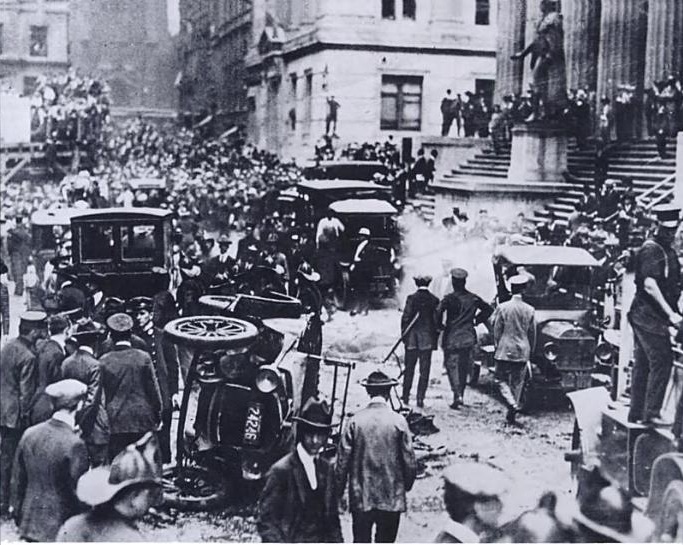
That Jackson could have been at this locale by luck, or chance, or happenstance is an absurdity. The 1920 Wall Street bombing has all the earmarks of a politically motivated catalyzing event---and not one likely to benefit the BOLSHEVIST OR GUILDSMAN, let alone the anarchists, communists, or militant socialists.
Chose your boogeyman via the New York Times:
but on September 20th the lead story becomes EXPLOSIVES FOUND TO BE MISSING IN HUNT FOR BOMB PLOT CLUE;
Did they forget what they published on September 15?
FEEL DU PONT BLAST.; 3,000 Pounds of Powder Shake Wide Region in Pennsylvania.
Or that on June 13, 1915, General T. Coleman DU PONT BUYS EQUITABLE LIFE; Gets 502 of Society's Total of ...
New-York Tribune. September 17, 1920
Explosives Expert Declares Blast Was No Accident
[page 5, Columns 1 & 2]
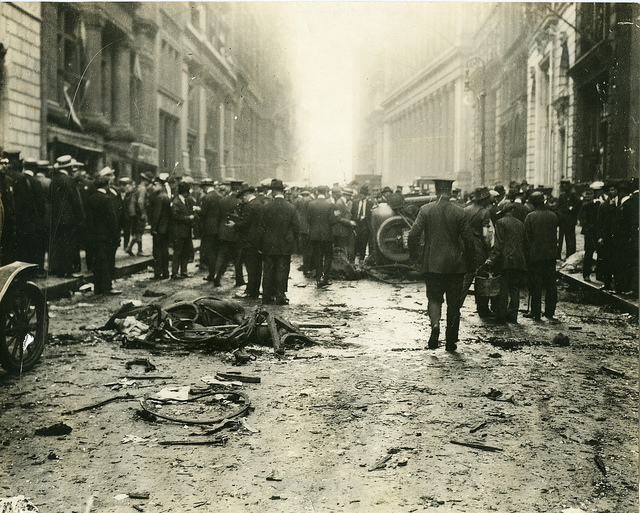
Supposedly the bomb sent metal projectiles through windows 32 stories up, but it couldn't even blow up a goddamn horse.
The Wall Street bombing slipped down the memory hole for one reason--it was no good as manufactured reality.
Do I need to make the painfully obvious associations with 9/11?
My 16,963-word transcript of reporting on the bombing in the
New-York Tribune. September 17, 1920,
In between these two structural failures, was the Wall Street bombing of September 16, 1920, which took place in the street out front of the headquarters of J.P. Morgan & Company.
The history of Edward Jackson, as it is found online, is itself an example of an apparent system of information management organized around a government-military-media-university axis. His story is told primarily by his putative biographer, Joseph Caro, whose book, "Edward N. Jackson ~ Prince of News Photography," was supposed to have been released in 2009, but which remains unknown at Amazon.com as of mid-2011.
Caro is reported to be responsible for the major online resource for information about Jackson, a web page "which supports the author's forthcoming book on Eddie Jackson." That information comes from a second source, a web page posted by a Professor of History at Northern Virginia Community College by the name of C.T. Evans. There we also find a link to a third web source, now defunk, but still available at archive.org, which appears to be a graduate thesis by a student at Southern Nazarene University, in Bethany, Oklahoma. An entry at Wikipedia for Jackson, seems for the most part, to be directly lifted from Caro's web site.
In the absence of a more public profile for Jackson, we must consider that each of these three sources carry privileged information, and while none verify the important facts found in the other by which I assemble my argument, they do not contradict each other, and we're left with no option but to take them at their word.
The home page link to Caro's web site on Jackson is broken, but we can go directly to his "Free Lance News" page on the Equitable Building Fire-1912. There Caro tells us that
One of Eddie's first free-lance photo opportunities before working for the American Press Association, was the New York Equitable Building eight-alarm fire in the financial district on Pine Street in January, 1912.And as Caro editorializes:
Eddie Jackson had an instinctive eye for photo composition as these early pictures taken in the 1912 Equitable Building fire clearly show. With no formal training in photography or composition, Eddie shows us and his photographic peers of the era his ability to construct a photograph to a high dramatic level---even during the excitement of the scene as it unfolds. As Eddie Jackson stated later in life "a good photograph is worth 10 columns of copy."Caro does us a service by posting four images taken at the fire and its aftermath. Since none of the dozen or so competing daily newspapers in that era published bylines or personal photo credits for the work appearing in their pages, it would be impossible to reconstruct Jackson's credits today without high-level editorial and archival help.
Each of the four images found on the Edward Jackson page displays evidence of doctoring and manipulation of a type found consistently throughout the image record of September 11th, but that is a technical analysis to be saved for later. The actionable image for my purposes here is the following, which to my knowledge is the product of the single photo opportunity allowed from inside the burned-out building at 120 Broadway. On page 5 of the January 11, 1912, edition, the New York Times published a reverse image of this statue credited to the Brown Bros. agency, a photo which is very difficult to reconcile with Jackson's image. (See: MENACE IN RUINS OF THE EQUITABLE; or, if you subscribe:http://timesmachine.nytimes.com/browser/1912/01/11/P5 )
In 1912 Jackson was a 27-year-old from a dirt-poor background in Philadelphia. Caro tells us that as a child he and his family were often forced to resort to eating in soup kitchens. Although Jackson had begun apprenticing with a studio photographer at age 15 in Philadelphia, moving with the firm to Atlantic City in 1903, and at some point later to New York City, his status at the time of the Equitable fire was clearly that of a "free lance" photographer. Caro contradicts himself here, telling us first that the Equitable fire was "[o]ne of Eddie's first free-lance photo opportunities before working for the American Press Association," but on his bio page, Caro says Jackson was "work[ing] for the American Press Association in the photo engraving department in 1912 where he also became a free lance news photographer."
In any event, what is clear is that Jackson would have lacked the professional credentials to have gotten through police cordons blocks away, let alone into the Equitable Building itself. It is difficult to find a modern analogy to what the Equitable Building represented in its time--although Fort Knox would be a close second. The Equitable Building was literally a treasure house, being the repository for the equivalent in hundreds of billions of dollars in securities, stocks, bonds and cash; holding the fortunes of the likes of the Harrimans, the Belmonts, the Goulds, Russell Sage, and Thomas Fortune Ryan; as well as the corporate holdings of the Mercantile branch of the Bankers' Trust, the Equitable Trust Company, Kuhn, Loeb & Co., William A Read & Co., and Kountze Bros. bankers. J.P. Morgan had purchased the controlling interest in the Equitable Life Assurance Society in 1909.
The Equitable Building was the most secure building in America. The idea that Jackson could launch an enormously successful career off of his privileged access at this "scene as it unfolds" indicts the system of action photojournalism as participating in a foreknowledged manipulation of events.
His career took off after the Equitable fire. Caro tells us:
Eddie's first foreign assignment as a fledgling photojournalist for the APA was to travel to Panama to photograph the Panama Canal before its official opening in 1914
Three months before the United States entered World War I (April, 1917), she continued, reluctantly, to have a trade status with Germany and allowed their ships to enter U.S. ports. When the German Submarine Deutschland arrived in New London, Conn. on a cold, dark January night in 1917, Eddie 'borrowed' a canoe and paddled around to take his photograph.
In 1915 Jackson was invited by his friend Thomas Alva Edison, newly appointed as President of the Naval Review Board, to document the inspection of a highly secret United States submarine “E-2” in the Brooklyn Navy yard. The United States had not entered WWI and did not want the warring nations to know about the development of submarine capability. Two weeks later the submarine mysteriously exploded killing several personnel. Eddie Jackson's clandestine photograph of the U.S. E-2 Submarine Explosion in dry-dock after the explosion that killed several sailors, happened in the battery room that Thomas Edison inspected two weeks earlier. Jackson’s forbidden photograph of the damaged submarine appeared in all of the New York papers.
Many years past the draft age, Jackson joined the Army Signal Corps (reserves) at the age of 32 and reported for training at Camp Alfred Vail in Little Silver New Jersey on October 22nd 1917. Due to his extensive photographic experience he was promoted to 1st. Lieutenant and was assigned the title as "Official War Photographer." Several months later he was selected to be President Woodrow Wilson’s official photographer:
Maybe the most famous picture of the Paris Peace Conference, the "The Big Four" (27 May 1919) was taken by Edward N. Jackson, a photographer with the Army Signal Corps and Wilson's official photographer in Europe.
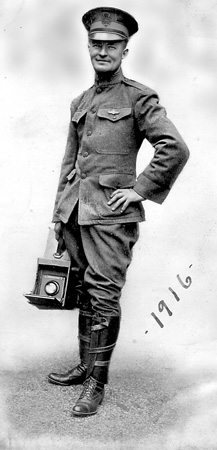
Eddie Jackson in his army uniform
Returning from France a seasoned, recognized professional news photographer, Jackson was offered many employment offers. He decided to work with Joseph Mendill Patterson and his cousin Robert R. McCormick, who were co-publishers of the Chicago Tribune and wanted to start a New York tabloid newspaper The New York Daily News. Launched on June 26, 1919 with Edward N. Jackson as their lead photographer, the publishers wanted large and prominent photographs of city news, entertainment and sports events and local city coverage, all of which was assigned to Jackson. The New York Daily News is today the sixth largest newspaper in the country and has won ten Pulitzer prizes.
"A photographer's photographer" quote by First Lady Mrs. Warren G. Harding who stated the Edward Jackson's photograph of her was "the best photo ever taken." The photo ran on the entire front page of the February 5, 1921 New York Daily News.
The unnamed writer from Southern Nazarene University in Bethany, Oklahoma, whose work, tentatively titled, "20s & 30s" Tabloid Journalism - Mankind's Obsession for Sensationalism, appears four times at archive.org, from Nov. 17, 2007 to Oct. 5, 2008, takes over from here:
One of the first exclusive picture opportunities for the tabloid occurred on September 16, 1920. Captain Edward N. Jackson of the Daily News was on a routine assignment in Wall Street when a dynamite bomb in a horse-drawn wagon went off, killing thirty people and injuring a hundred. Jackson went to work, capturing the best pictures of the disaster. Other photographers soon arrived on the scene, but by then the police had already drawn lines about the explosion area. Jackson consequently was the only journalist to escape with on-the-scene pictures of the victims and first aid work. In cases such as this, history influenced the paper to cover the story, and the paper’s pictorial coverage augmented history by supplying pictures that would have otherwise never existed.
That Jackson could have been at this locale by luck, or chance, or happenstance is an absurdity. The 1920 Wall Street bombing has all the earmarks of a politically motivated catalyzing event---and not one likely to benefit the BOLSHEVIST OR GUILDSMAN, let alone the anarchists, communists, or militant socialists.
Chose your boogeyman via the New York Times:
REV. D.D. IRVINE'S THEORY.; Says "Vatican Created Atmosphere" That Caused Bomb to be Thrown.Of course, on the 17th, the Times reported that EXPLOSIVE STORES ALL ACCOUNTED FOR,
THINKS GERMANS SET BLAST; HEARD THREAT; Teuton in Wall Street Uttered Warning Just After the Tragedy, ...
DENY UNION MEN SET WALL ST. BOMB; Federal Agents and Police Discredit Theory That LaborFight Cau
RED PLOT SEEN IN BLAST;
BANKERS THREATENED IN RED PUBLICATION
PLANS SEDITION LAW TEST.; Seymour Stedman Speech to Fores Issue In Kentucky.
LEE SAYS EXPLOSION WAS AN ACCIDENT; Socialist Asserts His Belief That Bomb Story Is a Capitalistic Inven
but on September 20th the lead story becomes EXPLOSIVES FOUND TO BE MISSING IN HUNT FOR BOMB PLOT CLUE;
Did they forget what they published on September 15?
FEEL DU PONT BLAST.; 3,000 Pounds of Powder Shake Wide Region in Pennsylvania.
Or that on June 13, 1915, General T. Coleman DU PONT BUYS EQUITABLE LIFE; Gets 502 of Society's Total of ...
New-York Tribune. September 17, 1920
Explosives Expert Declares Blast Was No Accident
[page 5, Columns 1 & 2]
Investigation Eliminates Licensed Wagons of Two Concerns, Only Ones With Right to Haul Dynamite
An investigation into all deliveries of dynamite made here recently was begun immediately after the explosion yesterday by the Bureau of Fire Prevention of the Fire Department.
Twenty inspectors were detailed to the work of checking up deliveries and the movements of dynamite wagons under Dr. William F. Doyle, chief of the bureau, and John F. Dixon, chief inspector of combustibles.
The inquiry resulted in eliminating the E. I. de Nemours Cornpay's truck from any possible responsibility for the explosion. At the same time the only other legitimate dealer licensed to deliver the explosive was eliminated.
It resulted also in the statement being made that it was unlikely that surreptitious shipment or delivery was the cause, as this practice does not obtain, owing to the stringency of the regulations governing the handling of explosives.
Explosives Trucks Bonded
The Dupont Company is licensed and bonded to deliver dynamite with an electric truck. This was in its garage at the time of the explosion and had not made a delivery below Sixteenth Street yesterday, according to both officials of the company and the word of inspectors. The vehicle which may have contained the explosive and was destroyed was horse drawn.
The only one other dealer in dynamite who also is licensed to sell and deliver the explosive in New York City is Carl H. Dittmar, of 102 West 130th Street. He operates two horse-drawn vehicles. Neither of these had been below Forty-eighth Street during the day, inspectors were told.
The Du Pont Company has two trucks, but only one is operated at a time, as only one is bonded. The other is kept for emergency reasons and is out of commission at present, it was said at the company's office in the Equitable Building.
C. C. Moore, an official of the company, said the truck had made no deliveries below Sixteenth Street during the day and was in its garage at the time of the blast. Chief Inspector Dixon said it was unlikely that the explosion could have been caused by a surreptitious shipment of dynamite, as contractors must make a sworn statement daily of the amount on hand. Each stick of dynamite is numbered and the magazines are inspected daily.
Check Kept on Explosive?
All blasting is done by licensed men and a check in kept upon the explosives. There is no such thing as an attempt to evade the laws governing their sale and delivery, according to Dixon.
Dixon, who is the Fire Department expert on explosives, said that if all of the experts in the country were brought here, in his opinion, not even three of them would be able to agree as to the form of explosive used and the quantity.
"I do not think it was an accident," he said, after his inspection of the scene.
The bureau turned over window sash weights and other pieces of metal found to the Police Department.
Supposedly the bomb sent metal projectiles through windows 32 stories up, but it couldn't even blow up a goddamn horse.
The Wall Street bombing slipped down the memory hole for one reason--it was no good as manufactured reality.
Do I need to make the painfully obvious associations with 9/11?
My 16,963-word transcript of reporting on the bombing in the
New-York Tribune. September 17, 1920,
Thursday, July 28, 2011
Somehow it Always Looked Bigger in the Lobby

John Quincy Adams Ward's bronze statue of Henry B. Hyde, unveiled in the ground-floor arcade of the Equitable Building, at 120 Broadway on May 2, 1901, on the second anniversary of Hyde's death, and which remained there until a fire and building collapse devastated the building on January 9, 1912, was then given by the Equitable Life Assurance Society of the United States in 1972 to the Metropolitan Museum of Art in New York City, where it remains not on view. It stands 21 inches in height, and otherwise measures seven-and-a-half inches by six-and-a-quarter inches.
See also: May 3, 1911, New York Times, "Tribute To Henry B. Hyde, Statue of Equitable Life Assurance Society's Founder Unveiled."
Note the luncheon guests listed in the 2nd paragraph:
Before the brief ceremony that preceeded the pulling of the string which let fall from the bronze its canopy of Stars and Stripes, a meeting was held in the board room of the society, up stairs. Senator Chauncey M. Depew and James W. Alexanderr, who is now President of the Equitablem, made speeches. Among those present were Louis Fitzgerald, E.H. Harriman, H.G. Marquand, Melville E. Stone, T. Jefferson Coolidge, Jacob H. Schiff, Sir William C. Van Horne, Col. John Jacob Astor, A.J. Cassatt, John A. Stewart, Levi P. Morton, August Belmont, Adolph S. Ochs, Cornelius Bliss, Gage E. Tarbell, William Alexander, Col. John J. McCook, G.B. Post, J.Q.A. Ward, Thomas T. Eckert, W.H. McIntyre, Samuel M. Inman, V.P. Snyder, Brayton Ives. C. Ledyard Blair, C.B. Alexander, Thomas D. Jordan, Marcellus Hartley, William A. Wheelock, and George H. Squire.


The above photograph was taken in 1912 by Edward N. Jackson. Joseph Caro's website, www.edwardnjackson.com, which supports his forthcoming book on Eddie Jackson, tells us that
One of Eddie's first free-lance photo opportunities before working for the American Press Association, was the New York Equitable Building eight-alarm fire in the financial district on Pine Street in January, 1912.
Eddie Jackson had an instinctive eye for photo composition as these early pictures taken in the 1912 Equitable Building fire clearly show. With no formal training in photography or composition, Eddie shows us and his photographic peers of the era his ability to construct a photograph to a high dramatic level-even during the excitement of the scene as it unfolds. As Eddie Jackson stated later in life "a good photograph is worth 10 columns of copy."Jackson went on to a distinguished career during WWI as personal photographer of President Wilson. Afterward, he worked for the New York Daily News, as an archive.org page tells us:
One of the first exclusive picture opportunities for the tabloid occurred on September 16, 1920. Captain Edward N. Jackson of the Daily News was on a routine assignment in Wall Street when a dynamite bomb in a horse-drawn wagon went off, killing thirty people and injuring a hundred. Jackson went to work, capturing the best pictures of the disaster. Other photographers soon arrived on the scene, but by then the police had already drawn lines about the explosion area. Jackson consequently was the only journalist to escape with on-the-scene pictures of the victims and first aid work. In cases such as this, history influenced the paper to cover the story, and the paper’s pictorial coverage augmented history by supplying pictures that would have otherwise never existed.Jackson put it best himself perhaps:
Human history in its writing is fairly authentic – but I would offer that photographic history has an element of certainty about it that is indisputably authentic. The picture tells its own story – and proves it, is corroborative, and records details that are often lost in writing. Edward N. Jackson (1932)

The fire and collapse at the Equitable Building on January 9, 1912, was an early use of a nearly identical template as was later used on September 11th, 2001. The eerie parallels between the two events point out the manipulated and false-flag nature of much of what we take to be organic reality, especially as it comes to the powerful, and those who record and serve them.

Subscribe to:
Posts (Atom)